


What Is Mineral Water Plant Capacity?
Choosing the right mineral water plant capacity is an important step when planning a water treatment and bottling business. Capacity affects the amount of treated water a plant can produce, the machinery required, storage needs, electricity consumption, and the overall investment.
Plant capacity is commonly measured in litres per hour (LPH). For example, a 1000 LPH system is designed to treat up to 1000 litres of water per hour under its specified operating conditions.
However, the actual quantity of finished water available for packaging can differ. Raw-water quality, treatment recovery, plant downtime, maintenance, and the performance of connected equipment all influence production.
The three capacities discussed in this guide—1000 LPH, 2000 LPH, and 5000 LPH—can suit different production requirements. The right option depends on your expected demand, available space, packaging format, and future business plans.
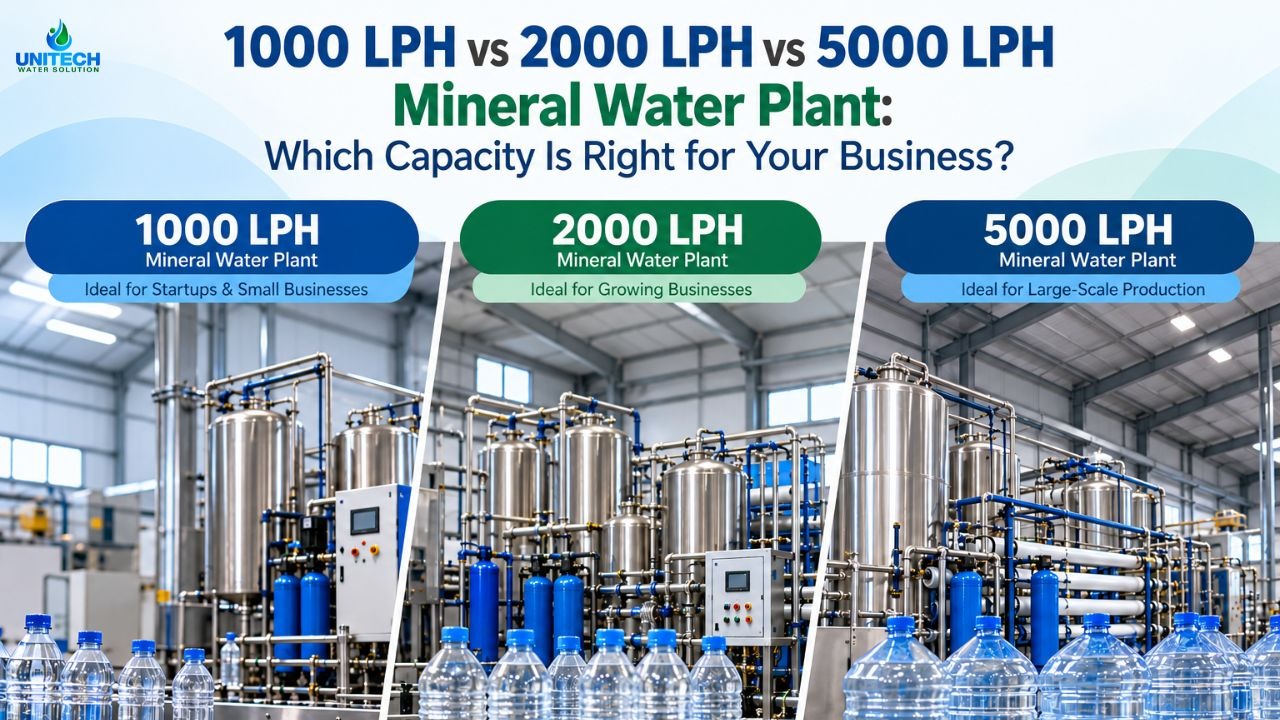
1000 LPH vs 2000 LPH vs 5000 LPH Mineral Water Plant
The following table compares the three capacities based on typical planning requirements. The exact equipment and output depend on the plant design and the quality of the source water.
|
Comparison Factor |
1000 LPH Plant |
2000 LPH Plant |
5000 LPH Plant |
|
Designed treatment capacity |
1000 litres per hour |
2000 litres per hour |
5000 litres per hour |
|
Theoretical output in 8 hours |
8000 litres |
16,000 litres |
40,000 litres |
|
Treatment equipment |
Selected for the required capacity and water quality |
Selected for higher treatment demand |
Designed for higher-volume treatment requirements |
|
Pretreatment system |
Based on raw-water test results |
Based on raw-water test results |
Based on raw-water test results |
|
Storage requirements |
Based on production and operating needs |
Based on production and operating needs |
Based on production and operating needs |
|
Filling and packaging |
Matched to expected packaging demand |
Matched to expected packaging demand |
Matched to higher packaging demand |
|
Space and utilities |
Depends on equipment layout |
Depends on equipment layout |
Depends on equipment layout |
|
Suitable planning focus |
Lower production requirement |
Medium production requirement |
Higher production requirement |
Note: The eight-hour figures are theoretical treatment volumes calculated at the stated rated capacity. They are not guaranteed packaged-water output figures. Actual output depends on operating conditions, treatment recovery, downtime, and the capacity of the filling and packaging line.
Understanding Each Plant Capacity
1. 1000 LPH Mineral Water Plant
A 1000 LPH mineral water plant is designed to treat up to 1000 litres of water per hour under specified operating conditions. It may be considered by businesses with a lower initial production requirement.
Before selecting this capacity, calculate the amount of water you expect to package each day. Also consider the size of your storage tanks, the number of bottles or containers you plan to fill, and the operating hours available.
The treatment system should be designed according to the raw-water test results. Depending on the source water, the plant may require pretreatment, filtration, reverse osmosis (RO), and other suitable treatment stages.
The filling and packaging equipment should also match the treatment system's output. A bottling line that operates more slowly than the treatment system can limit overall production.
2. 2000 LPH Mineral Water Plant
A 2000 LPH mineral water plant has twice the nominal treatment capacity of a 1000 LPH system. It may suit a business expecting greater demand or planning a higher daily production target.
This capacity requires careful coordination between treatment, storage, and packaging. The RO system, pumps, filters, tanks, and supporting utilities must be selected according to the required production and water quality.
Packaging requirements are equally important. The number of bottles filled per hour depends on bottle size, filling speed, changeover time, and the type of filling machinery used.
Before choosing this capacity, review current demand and expected future demand. The aim is to select a plant that meets production requirements without purchasing equipment that is unnecessary for the planned operation.
3. 5000 LPH Mineral Water Plant
A 5000 LPH mineral water plant is designed for a substantially higher treatment volume. It may be considered for operations with larger production targets and suitable infrastructure.
A system of this size needs coordinated planning for pretreatment, RO or other required treatment stages, storage, pumps, electrical supply, and packaging equipment. The available raw-water supply must also be sufficient for the plant's operating requirements.
Storage capacity and filling speed should be planned together. If the bottling line cannot handle the treated water available, the full production capacity may not be used efficiently.
Before finalising a 5000 LPH setup, assess the site layout, utility requirements, workforce, maintenance needs, and expected demand. The equipment specification should be based on the complete production plan rather than treatment capacity alone.
Machinery and Treatment Requirements
The machinery required for a water treatment and bottling project depends on the source water, required water quality, production capacity, and packaging method.
Water Treatment Equipment
A plant may include the following equipment, depending on the design:
- Raw-water storage tank: Holds the incoming water before treatment.
- Pretreatment filters: Remove specific suspended particles and other impurities based on water quality.
- Activated carbon filter: Used where required to reduce chlorine, odour, or certain organic compounds.
- Water softener or antiscalant dosing system: Selected according to water hardness, scaling risk, and the treatment design.
- Reverse osmosis system: Reduces dissolved salts and other substances that the selected membrane system is designed to remove.
- Post-treatment equipment: Additional treatment stages are selected according to the required finished-water quality.
- Treated-water storage tank: Stores treated water before the next production stage.
- Pumps, pipes, and control panels: Support water movement and plant operation.
Not every plant needs the same equipment. A raw-water analysis and treatment design should determine the appropriate system configuration.
Bottling and Packaging Equipment
For packaged drinking water production, the project may also require:
- Bottle rinsing or washing equipment, as appropriate
- Bottle filling machine
- Capping machine
- Labelling machine
- Batch coding equipment
- Shrink wrapping or secondary packaging equipment
- Conveyors and related handling systems
The final selection depends on the bottle size, packaging format, required filling speed, and degree of automation.
Types of Water Plants
Different water plant types serve different purposes. The terms should not be treated as interchangeable when selecting equipment or preparing a project quotation.
RO Plant
An RO plant uses reverse osmosis membranes to reduce dissolved substances in water. Its configuration depends on the incoming water quality and the required treated-water specifications.
Industrial RO Plant
An industrial RO plant is designed for industrial or commercial water treatment requirements. The required capacity, pretreatment, membrane arrangement, and output-water quality depend on the application.
Packaged Drinking Water Plant
A packaged drinking water plant combines suitable water treatment with the equipment needed to fill and package water. The complete project may include treatment, storage, filling, capping, labelling, and packaging machinery.
Mineral Water Plant
A mineral water plant is a commonly used commercial term, but the exact water category matters. In India, naturally occurring mineral water and packaged drinking water are distinct regulatory categories. The treatment process, product description, and compliance requirements must match the category under which the product is sold.
Mineral Water Bottling Plant
A mineral water bottling plant focuses on the production and packaging process. Depending on the project, it may include a water treatment system as well as bottle filling, capping, labelling, and packaging equipment.
When comparing suppliers, confirm whether the quotation covers only the treatment system or the complete treatment and bottling plant.
Investment and Operating Cost Factors
The investment required for a water treatment or packaged drinking water project depends on more than its LPH rating. Two plants with the same nominal capacity can have different costs because of differences in water quality, equipment specifications, automation, and project scope.
The main factors include:
- Raw-water quality and the treatment stages required
- Treatment system capacity and equipment specifications
- Pumps, electrical systems, and control panels
- Storage tank capacity and material
- Filling, capping, labelling, and packaging machinery
- Installation, plumbing, electrical work, and site preparation
- Automation level and production workflow
- Electricity, water use, consumables, and maintenance
- Testing, quality control, and applicable compliance requirements
Indicative Cost Estimates
Published estimates can provide an initial budgeting reference, but the scope of each estimate must be checked before comparing prices.
|
Plant or Project Type |
Published Indicative Estimate |
Important Note |
|
1000 LPH industrial RO plant |
₹4.5–7 lakh |
Industrial RO system estimate; confirm included equipment and installation. |
|
2000 LPH industrial RO plant |
₹7–10 lakh |
Industrial RO system estimate; confirm the quotation scope. |
|
5000 LPH industrial RO plant |
₹14–22 lakh |
Industrial RO system estimate; confirm the specifications and exclusions. |
|
Small-scale packaged drinking water project, around 2000–3000 LPH |
₹30–50 lakh |
Broader project estimate; equipment and packaging scope can vary. |
|
Medium-scale packaged drinking water project |
₹50 lakh–₹1 crore |
The project budget depends on the selected setup and requirements. |
|
Fully automatic mineral water plant |
Starting from ₹1 crore |
Published starting guidance; obtain a current, itemised quotation. |
Cost reference pages:
- Industrial RO plant cost guide:https://www.unitechwater.co.in/blog/industrial-ro-plant-cost.php
- Fully automatic mineral water plant:https://www.unitechwater.co.in/fully-automatic-mineral-water-plant.php
These figures are indicative published estimates, not confirmed current quotations. The industrial RO figures relate to treatment systems, while the packaged drinking water figures may cover a broader project. They are not directly comparable. Confirm current prices, taxes, installation, bottling machinery, and included equipment with the supplier.
What Should You Check Before Finalising Investment?
Before selecting a supplier, ask for an itemised quotation that explains:
- The treatment capacity and expected operating conditions.
- The equipment included in the treatment system.
- Whether storage tanks and filling or packaging machinery are included.
- The water-quality assumptions used to design the plant.
- Installation, electrical work, and other site requirements.
- Expected power consumption and maintenance requirements.
- Warranty, servicing, consumables, and replacement-part details.
Comparing quotations against the same requirements makes it easier to assess the actual project cost.
How to Select the Right Mineral Water Plant Capacity
1. Estimate Daily Demand
Work out the quantity of water you expect to produce and package each day. Consider the number of containers, bottle sizes, and expected orders.
2. Confirm Raw-Water Quality
Get the source water tested. The results help determine the required treatment process and equipment specifications.
3. Match Treatment and Packaging Capacity
Check both the treatment output and the filling-line speed. The complete production process should be designed to work together.
4. Review Space and Utilities
Confirm that the site can accommodate treatment equipment, storage, packaging machinery, access areas, drainage, and required electrical services.
5. Compare Complete Quotations
Ask suppliers to specify what is included and excluded. Compare equipment, installation, automation, and operating requirements rather than relying only on the quoted plant capacity.
6. Plan for Future Requirements
Consider whether demand is likely to increase. Select a capacity that fits the business plan and available budget, while checking whether future expansion is practical.
Conclusion
Choosing between a 1000 LPH, 2000 LPH, and 5000 LPH mineral water plant starts with understanding your production requirements. Each capacity has different planning needs for treatment equipment, storage, packaging, utilities, and maintenance.
Before investing, assess the raw-water quality, calculate expected demand, and compare itemised quotations for the complete setup. Make sure the treatment system and bottling line can support your production targets.
Unitech Water Solution provides water treatment and RO plant solutions for different applications. Request a quote to discuss your water quality, required capacity, treatment needs, and project specifications before finalising a suitable system.
Frequently Asked Questions
1000 LPH means a rated treatment capacity of 1000 litres per hour under specified operating conditions. Actual finished-water output depends on water quality, treatment recovery, operating time, and plant downtime.
A 2000 LPH plant has twice the nominal treatment capacity of a 1000 LPH plant. The equipment, storage, utility requirements, and packaging setup must be selected according to the intended production plan.
At its stated rated capacity, a 5000 LPH system has a theoretical treatment volume of 40,000 litres over eight hours. Actual output can be lower depending on operating conditions and treatment recovery.
The suitable capacity depends on daily demand, source-water quality, budget, packaging requirements, and available infrastructure. Estimate demand before deciding between 1000 LPH, 2000 LPH, and higher-capacity systems.
Cost depends on treatment equipment, pretreatment, water quality, storage, pumps, filling and packaging machinery, automation, installation, utilities, and maintenance requirements.
No. An industrial RO plant is a water treatment system. A packaged drinking water plant may include treatment equipment along with storage, filling, capping, labelling, and packaging machinery.
Check the raw-water test results, treatment design, capacity, included equipment, packaging requirements, operating costs, supplier support, and applicable Indian regulatory requirements for the intended water category.