


Introduction
Two entrepreneurs can invest in the packaged drinking water industry and follow very different paths. One supplies 20 litre jars to homes and offices, while the other sells bottled water through shops, hotels and distributors. Both businesses serve a regular need, but their equipment, costs and delivery models differ.
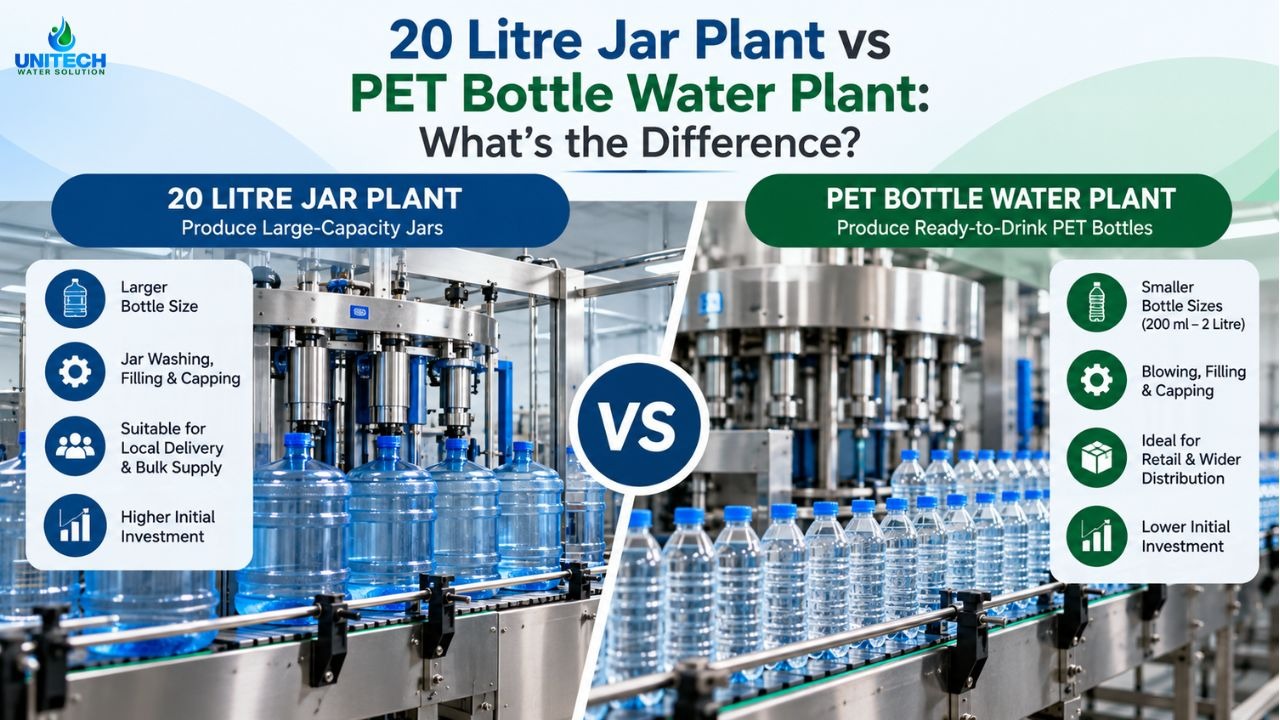
Choosing between these options starts with understanding the jar plant vs bottle plant difference. A jar plant focuses on reusable containers and repeat local orders. A PET bottle plant focuses on individual bottles, packaging, branding and wider distribution.
The right choice depends on your budget, local demand, production targets and ability to manage deliveries. You also need to consider packaging expenses, machinery, water treatment requirements and the working capital needed to run the business.
This guide compares both plant types in the Indian market, including estimated setup costs, production steps, operating expenses and suitable customers. It will help you decide which model fits your business plans before investing in machinery.
1. What Is the Real Difference Between a Jar Plant and a Bottle Plant?
The main difference is the packaging format and how you sell the finished product. This choice affects machinery, daily operations, delivery costs and the customers you need to reach.
What Is a 20 Litre Jar Plant?
A 20 litre jar plant produces packaged drinking water in large, reusable jars. Customers return empty jars and receive filled replacements, usually through scheduled or on-demand deliveries.
This model suits businesses serving apartment complexes, offices, shops, factories and other local customers. Revenue can come from repeat orders, monthly supply arrangements and new customer subscriptions.
The main operational challenge is managing jar returns, cleaning, sanitation and delivery routes. You must also track containers carefully to reduce losses and maintain enough jars for daily demand.
What Is a PET Bottle Water Plant?
A PET bottle water plant fills packaged drinking water into bottles of different sizes, such as 200 ml, 500 ml, 1 litre and 2 litres. Depending on the setup, the plant may use ready-made bottles or manufacture bottles from PET preforms.
These bottles usually enter retail stores, hotels, restaurants, event venues and distribution networks. The business depends on production efficiency, attractive packaging, product availability and competitive selling prices.
Compared with jar operations, PET bottling requires more attention to packaging materials, labelling, batch coding and finished-goods storage. Distribution margins and retailer relationships also affect the business's financial performance.
Quick answer: A jar plant focuses on reusable containers and local repeat deliveries. A PET bottle plant focuses on single-use packaging, branding and wider distribution.
2. Water Jar Business vs Bottled Water Business: Which Model Suits You?
Neither model guarantees higher profits. The better option is the one that matches your investment capacity, customer demand, operating skills and sales network.
Target Customers for Each Model
A 20 litre jar business is well suited to households, offices, factories, clinics and other customers that need regular water supplies in larger quantities. Repeat orders can make demand easier to plan once you build a stable customer base.
A PET bottle business targets customers who need convenient, sealed, portable packaging. These include retail stores, restaurants, hotels, events, travel outlets and institutions.
Think about how customers in your target area buy water today. A strong local demand for office deliveries may support a jar model. Established retail contacts and demand for smaller packs may favour PET bottles.
Should You Start With Jars or PET Bottles?
Consider a jar plant if you have a limited initial budget, can deliver locally and want to build repeat business. It may offer a simpler packaging operation, provided you manage container returns and sanitation well.
Consider a PET bottle plant if you have enough capital for packaging machinery and stock, along with a realistic plan to reach retailers or distributors.
A hybrid model is another option. You could start with one format and add the other after checking demand, production capacity, available space and cash flow. However, both formats need suitable equipment, operating procedures and regulatory planning.
Do not assume you can add a bottling line without further investment. Plan the site layout, utilities and future expansion before construction begins.
Comparison Table: Which Plant Fits Your Business?
|
Feature |
20 Litre Jar Plant |
PET Bottle Water Plant |
|
Best suited for |
Local delivery businesses |
Retail and distribution businesses |
|
Initial packaging |
Reusable jars |
New bottles or preforms |
|
Key equipment |
Jar washer and filler |
Bottle filling and packaging line |
|
Sales approach |
Direct and repeat customers |
Retailers, distributors and institutions |
|
Main logistics task |
Collect and return jars |
Deliver and replenish packaged stock |
|
Main cost pressure |
Delivery and jar management |
Packaging and distribution margins |
|
Growth opportunity |
More routes and local accounts |
More outlets, formats and territories |
3. Production Process: How a 20 Litre Jar Filling Plant Setup Differs From a Bottle Line
Both plant types need a treatment process suited to the raw-water source and applicable product standards. The difference lies mainly in how the containers are prepared, filled, sealed and dispatched.
How a Jar Plant Works
A typical jar production process follows these steps:
- Water treatment: Treat raw water using the process selected for its quality and the required product specifications.
- Jar inspection: Check returned jars for damage, cracks, odours and visible contamination.
- Washing and sanitising: Clean and sanitise jars using suitable equipment and validated procedures.
- Filling: Transfer treated water through hygienic filling equipment.
- Capping and sealing: Close jars with suitable caps and apply required seals.
- Quality checks and dispatch: Check finished products and send orders through planned delivery routes.
Jar washing deserves special attention because containers return from different customers. A poor cleaning process can affect product safety and customer confidence.
How a PET Bottle Plant Works
A typical PET bottling process includes:
- Water treatment: Prepare water according to the selected treatment design.
- Bottle preparation: Use ready-made bottles or form bottles from PET preforms.
- Rinsing and filling: Prepare containers as required, then fill them using hygienic equipment.
- Capping and coding: Close bottles and apply batch or date codes.
- Labelling and packaging: Add labels and group bottles into suitable packs.
- Quality checks and dispatch: Inspect finished products before storage and distribution.
An integrated line can coordinate these steps to reduce manual handling. However, automation should match actual demand; buying a high-speed line before securing enough orders can increase financial pressure.
4. Operating Costs and Logistics: Where the Money Really Goes
The purchase price of a plant tells only part of the story. Packaging, energy, labour, maintenance and delivery can strongly influence the cost of every unit sold.
Monthly Operating Costs
A jar business spends money on electricity, water treatment, cleaning supplies, caps, jar replacement, labour and transport. Lost or damaged jars also affect costs. Delivery expenses can become significant when customers are spread across a wide area.
A PET bottle business must regularly purchase bottles or preforms, caps, labels and secondary packaging. It also pays for electricity, labour, equipment maintenance, warehousing and distribution.
Packaging is a recurring expense for PET bottles because the business generally uses a new bottle for each sale. Jar businesses can reuse suitable containers, but they must pay for washing, handling, replacement and return logistics.
To compare both models fairly, calculate the cost per saleable litre or finished unit, including packaging, wastage and delivery.
Logistics and Distribution
Jar businesses work best when customers sit within a manageable delivery area. Route planning, timely collection of empty jars and container tracking help control transport costs. Deposits or other clear return policies can also reduce losses.
PET bottle businesses can serve a wider market through distributors and retailers. However, they need sufficient finished stock, reliable transport, warehouse space and a plan for retailer credit.
Before investing, ask yourself:
- Can I reach enough local customers for regular jar orders?
- Can I track returned jars and manage delivery routes?
- Do I have access to retailers or distributors for bottled water?
- Can I fund packaging purchases before customer payments arrive?
- Can my site handle finished-product storage and vehicle movement?
Your answers may reveal that distribution capability matters more than production capacity alone.
5. Example Scenario: Choosing the Right Plant for a New Business
Example scenario :
Imagine an entrepreneur in Ahmedabad who has ₹20 lakh available for a packaged drinking water business. The entrepreneur already knows several apartment managers, offices and small factories that may need regular 20 litre jar deliveries.
Instead of spending the entire budget on machinery, the entrepreneur first checks local demand, competing suppliers, delivery distances and site suitability. They then obtain quotations for a treatment system, jar washing and filling equipment, jars, transport and required compliance.
Suppose the initial customer survey supports a modest daily delivery route. A jar-focused business may be a sensible starting point, provided the final project cost fits the budget and leaves enough working capital.
After building a stable customer base, the entrepreneur could assess demand for smaller bottles from shops, restaurants and event organisers. Before adding PET bottling, they would compare projected sales with the additional equipment, packaging stock, staffing and distribution expenses.
The entrepreneur should also confirm the required approvals and product standards before commercial production. They should not assume that demand enquiries alone guarantee sales.
Key takeaway: Choose the plant around confirmed market demand and total project costs, not simply the machine with the lowest purchase price.
Conclusion
Choosing between a jar plant and a PET bottle plant means choosing how you will produce, package and sell drinking water. A 20 litre jar business can suit entrepreneurs who want to serve homes, offices and industrial customers through local delivery routes. A PET bottle business may suit those with the capital, packaging setup and distribution network to supply retailers and other outlets.
The jar plant vs bottle plant decision should start with customer demand, not machinery prices alone. Compare the full setup cost, working capital, operating expenses and realistic sales potential before investing.
If you are unsure which model suits your market, review both options with a plant supplier and request a cost estimate based on your capacity and site requirements.
Planning to setup a Packaged Drinking Water Business?
Planning a packaged drinking water business in India? Contact Unitech Water Solution to discuss your water source, target capacity, machinery requirements and project budget. Its team can help assess your plant configuration and explain the scope of a suitable setup.
Frequently Asked Questions
Profitability depends on sales volume, selling price, packaging expenses, delivery costs, equipment utilisation and customer acquisition. Jar businesses may benefit from repeat local orders, while PET bottle businesses can reach more outlets but face ongoing packaging and distribution costs. Compare expected monthly sales with all operating expenses before deciding.
A preliminary machinery budget may range from approximately ₹3 lakh to ₹15 lakh, depending on capacity, automation and equipment scope. A complete commercial setup can cost more after adding treatment systems, jars, infrastructure, testing, transport and working capital. Request an itemised quotation based on your planned output and location.
A preliminary equipment estimate may range from approximately ₹12 lakh to ₹75 lakh or more. The total depends on production speed, bottle sizes, automation and whether you manufacture bottles from PET preforms. Civil work, utilities, packaging stock and compliance-related expenses may increase the overall project budget.
Yes, if your budget, site and business plan support expansion. During the initial design, discuss future space, electrical capacity, water treatment requirements, storage and production flow. A PET line will still require suitable bottling and packaging equipment, additional investment and the relevant regulatory arrangements.
Packaged drinking water businesses must meet the applicable food safety and product requirements. BIS requirements have changed, so do not rely on outdated guidance that assumes every packaged drinking water product follows the same certification route. Check the current FSSAI and BIS rules for your exact product and business before purchasing machinery or starting production.
Space and staffing depend on production capacity, automation, storage and dispatch needs. A jar operation needs room for washing, filling, clean and returned jars, and vehicle loading. A PET plant needs room for its production line, packaging materials and finished goods. Ask your supplier for a site layout and staffing estimate before finalising the facility.