



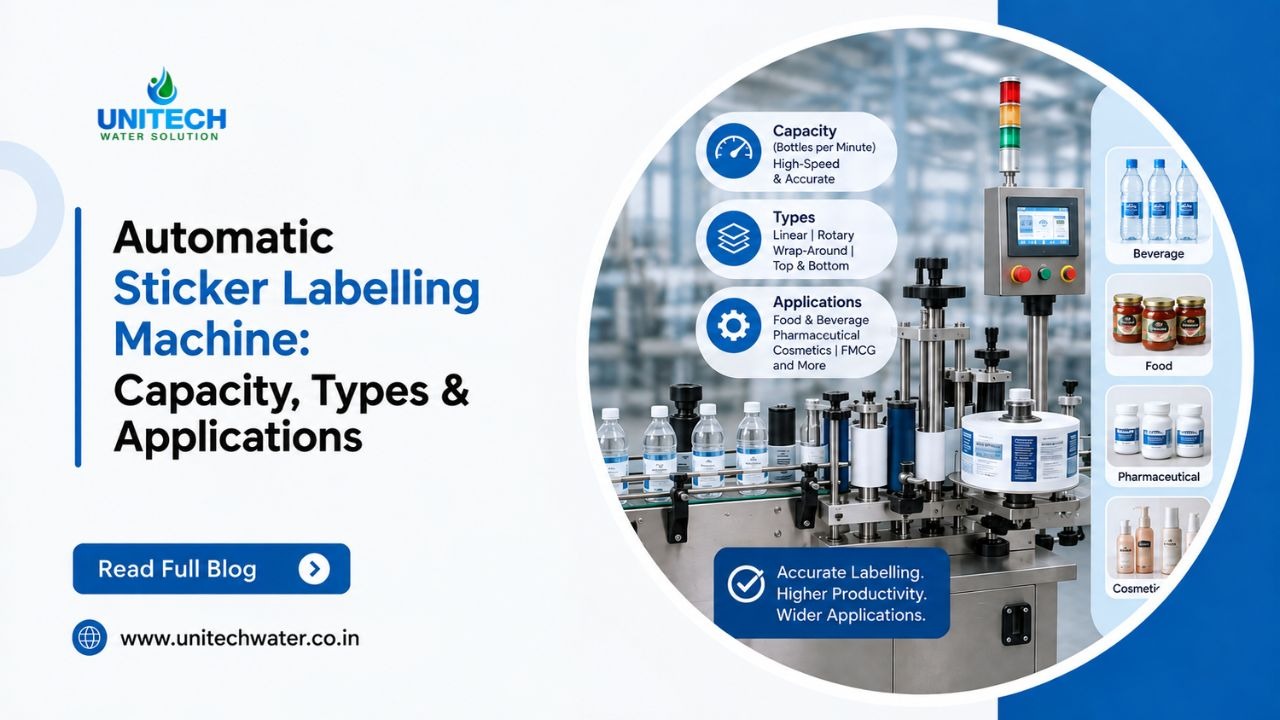
An Automatic Sticker Labelling Machine is an important part of modern packaging operations where products need to be labelled quickly, accurately, and consistently. From bottles and jars to cartons, pouches, containers, pharmaceutical vials, and shipping packages, automated labelling systems help manufacturers apply self-adhesive labels without relying on repetitive manual work.
These machines are used across industries where labels carry branding, product information, barcodes, batch numbers, regulatory information, instructions, or traceability data.
However, selecting the right machine involves more than comparing labels-per-minute figures. Production speed, container dimensions, label size, application position, roll diameter, product handling, coding systems, inspection requirements, and packaging line configuration all affect the final equipment choice.
This guide explains the capacity, types, applications, features, and important selection factors of automatic sticker labelling equipment.
What Is an Automatic Sticker Labelling Machine?
An Automatic Sticker Labelling Machine automatically dispenses and applies pressure-sensitive or self-adhesive labels to products as they move through a packaging line.
A complete industrial labelling system usually includes a product transportation system and one or more label applicators. Products are conveyed toward the labelling station, detected by sensors, labelled at the required position, and then transferred to the next packaging operation.
Depending on the application, labels may be applied:
- Around a cylindrical container
- On one side of a product
- On the front and back
- On the top or bottom
- Across a closure
- Around a corner
- On cartons and secondary packaging
How the Automatic Labelling Process Works
Although machine configuration varies, a typical system follows a simple sequence.
A product enters through the conveyor and is detected by a sensor. The controller then synchronises the label dispensing mechanism with product movement. The label separates from its backing liner at the dispensing edge and is transferred onto the product.
A roller, brush, belt, air stream, or applicator pad may then press or position the label depending on the technology being used.
Modern automatic label applicators may also integrate printers, barcode readers, vision inspection systems, rejection units, production counters, and line-control interfaces.
Products and Containers That Can Be Labelled
Automatic systems can handle a wide range of formats, including:
- Bottles and jars
- Vials and pharmaceutical containers
- Cosmetic containers
- Boxes and cartons
- Food trays
- Pouches
- Cans
- Drums and chemical containers
- Electronic products
- Shipping cartons
The correct handling mechanism depends largely on whether the product is cylindrical, rectangular, oval, flexible, unstable, or irregularly shaped.
Automatic Sticker Labelling Machine Capacity and Specifications
The capacity of an Automatic Sticker Labelling Machine should be evaluated as a combination of speed, label dimensions, product dimensions, accuracy, and production-line conditions.
There is no single standard capacity for every machine.
For example, one industrial applicator configuration lists capacity of up to 70 products per minute, while a dedicated pharmaceutical wrap-around system lists capacity of up to 400 products per minute. High-performance applicators can operate at substantially higher label-web speeds in specialised applications.
Labelling Speed and Products per Minute
Machine speed may be specified using:
- Products per minute
- Labels per minute
- Metres of label web per minute
The required speed should normally be matched to the upstream filling, sealing, inspection, and downstream packaging operations.
Installing a machine capable of 300 containers per minute provides little advantage if the filling line consistently produces only 80 containers per minute.
Actual output can also be affected by label length, container spacing, sensor response, label material, product stability, coding requirements, and inspection operations.
Label Size and Web Width
The minimum and maximum supported label dimensions are critical.
Different applicators have different operating ranges. One industrial system, for example, specifies label dimensions of approximately 15–160 mm in width and 10–100 mm in length, while other specialist applicators support different ranges.
Buyers should therefore provide the machine manufacturer with actual label drawings rather than relying only on general product dimensions.
Label Roll Diameter and Core Size
Larger label rolls can reduce the frequency of production stops for reel replacement.
Important parameters include:
- Maximum outside roll diameter
- Label roll core diameter
- Label web width
- Winding direction
- Gap between labels
As one example of how specifications vary, a Label-Aire industrial applicator supports a maximum standard roll outside diameter of 406 mm and a 76 mm core. These values should not be treated as universal specifications because reel capacity varies by machine model.
Product Dimensions and Container Shapes
The machine must accommodate the minimum and maximum dimensions of the product range.
Round bottles may require a wrap-around belt or roller system, while rectangular containers may need side stabilisation. Flexible products can require completely different handling compared with rigid containers.
Labelling Accuracy
Accuracy is particularly important when:
- Labels need to align with an existing graphic
- Multiple labels are applied to the same product
- Small pharmaceutical containers are being labelled
- Tamper-evident labels are used
- Premium cosmetic packaging requires consistent presentation
Machine accuracy should always be evaluated under actual production conditions rather than only from theoretical specifications.
Types of Automatic Sticker Labelling Machines
The appropriate machine design depends on line speed, container shape, number of labels, application position, and available production space.
Linear Sticker Labelling Machine
In a linear system, products move continuously along a straight conveyor through one or more labelling stations.
Linear machines are widely used because they can accommodate several container formats and are relatively straightforward to integrate into existing production lines.
They are commonly used for bottles, jars, cartons, and containers in food, cosmetics, chemicals, and pharmaceutical operations.
Rotary Sticker Labelling Machine
A rotary machine transfers products onto a rotating carousel or star-wheel arrangement.
Individual containers can be accurately controlled during the labelling process, making rotary configurations suitable for higher-speed production and applications requiring precise product positioning.
Rotary applicators are used for products such as beverages, food containers, pharmaceuticals, and cosmetics.
Wrap-Around Labelling Machine
Wrap-around labelling applies a pressure-sensitive label around the circumference of a cylindrical product.
Typical applications include:
- Beverage bottles
- Pharmaceutical vials
- Sauce bottles
- Cosmetic bottles
- Chemical containers
- Jars
Wrap-around systems are available for both moderate-volume and high-speed production.
Front and Back Labelling Machine
Front-and-back systems use two applicators to place separate labels on opposite sides of a container.
They are commonly used for shampoo bottles, lubricant containers, household chemicals, sauces, cosmetics, and other oval or rectangular packaging.
Top and Bottom Labelling Machine
These systems apply labels to the upper surface, lower surface, or both surfaces of a product.
Top-and-bottom labelling is widely used with pre-packaged foods and other flat products.
Wipe-On Label Applicator
A wipe-on applicator dispenses the label so that contact with the moving product progressively transfers the label onto its surface.
The technology is suitable for many standard conveyor-based applications where the product and label can remain in motion.
Blow-On and Tamp Labelling Systems
A blow-on system separates the label from its liner and uses controlled air to transfer it onto the product without requiring the dispensing edge to follow the product surface.
A tamp system typically transfers the label onto an applicator pad and then moves the pad toward the product.
These technologies are useful for cartons, irregular products, recessed surfaces, secondary packaging, and applications where direct wipe-on transfer is not ideal.
Applications of Automatic Sticker Labelling Machines
Automatic labelling equipment is used wherever consistent identification, branding, compliance, or traceability is required.
Food and Beverage Industry
Applications include bottles, jars, sauces, oils, packaged foods, confectionery, trays, and beverage containers.
Machines may perform wrap-around, top, bottom, front, or back labelling depending on package design.
Pharmaceutical and Healthcare Industry
Pharmaceutical labelling demands high levels of process control.
Applications can include vials, bottles, syringes, inhalers, cartons, pipette bottles, insulin cartridges, and other healthcare products. Systems may also incorporate print inspection, code verification, serialization, and product rejection.
Cosmetics and Personal Care
Cosmetic packaging frequently combines complex container shapes with demanding presentation requirements.
Automatic systems are used for shampoo bottles, perfumes, creams, nail polish, mascara, cosmetic jars, and personal care products. Precise positioning is particularly valuable where packaging appearance directly affects shelf presentation.
Chemicals and Household Products
Sticker labelling machines are commonly used for cleaners, lubricants, agrochemical products, automotive fluids, detergents, and industrial chemicals.
Logistics and E-Commerce
Automatic label applicators can apply barcode, identification, shipping, routing, and tracking labels to cartons and packages as they move along conveyors.
Industrial and Electronics Products
Components, hardware, electrical products, spare parts, and industrial goods may require identification labels, serial numbers, barcodes, warning labels, or product information.
Industrial labelling systems are therefore used far beyond conventional consumer packaging.
Key Features of an Automatic Sticker Labelling Machine
Features vary considerably by model, but modern equipment may include servo-driven label dispensing, touchscreen controls, product sensors, label sensors, speed synchronisation, recipe storage, batch counters, tool-less adjustment, variable-speed conveyors, printing integration, barcode verification, vision inspection, and rejection systems.
Modular machines can also be configured for top, bottom, side, two-sided, or wrap-around labelling depending on production requirements.
For manufacturers processing many SKUs, quick format changeovers can be particularly important because reducing setup time increases usable production capacity.
Benefits of Automatic Sticker Labelling
Replacing manual label application with an automatic system can provide several operational advantages.
These include more consistent label positioning, higher production throughput, reduced dependence on repetitive manual operations, better integration with packaging lines, improved barcode readability, support for automated inspection, repeatable changeovers, and improved product presentation.
Automation also makes it easier to coordinate labeling with filling, capping, coding, inspection, cartoning, and end-of-line packaging equipment.
How to Select the Right Automatic Sticker Labelling Machine
Machine selection should begin with the product and production process rather than with a speed specification alone.
Evaluate Production Speed
Determine current and expected future production rates.
The labeller should be capable of supporting normal operating speed with sufficient margin for production peaks.
Consider Product Shape and Label Position
Identify whether products are round, square, oval, tapered, flexible, or irregular.
Then determine whether the label will be applied to the front, back, top, bottom, side, circumference, corner, or closure.
Check Label Dimensions and Material
Provide information about:
- Minimum and maximum label dimensions
- Label roll diameter
- Core diameter
- Label material
- Liner material
- Adhesive characteristics
- Transparent or opaque labels
Transparent labels may require different sensing technology than conventional paper labels.
Review Coding and Inspection Requirements
Determine whether the machine must integrate with:
- Thermal transfer printers
- Inkjet coders
- Laser marking systems
- Barcode readers
- Vision inspection
- Serialization systems
- Rejection units
These requirements can significantly affect machine configuration.
Consider Changeover and Future Production Needs
A machine purchased only around one current SKU may become restrictive when packaging formats change.
Consider future bottle sizes, additional labels, increased production capacity, new product lines, and potential coding or inspection requirements.
Flexible adjustment, recipe storage, modular applicators, and upgrade options can help extend the useful life of the equipment.
Final Takeaway
An Automatic Sticker Labelling Machine can improve the speed, consistency, and control of product labelling across food and beverage, pharmaceutical, cosmetics, chemicals, logistics, electronics, and other manufacturing industries.
However, machine capacity should not be evaluated only by maximum labels per minute. Product dimensions, label size, roll specifications, container stability, application position, accuracy, coding requirements, changeover frequency, and overall packaging-line speed all influence the correct configuration.
Before selecting a machine, prepare samples or drawings of the products and labels along with your required production rate and application details. This allows the equipment supplier to recommend a labelling system based on actual production conditions rather than generic capacity figures.
Planning to automate your product labelling process?
Discuss your container sizes, label dimensions, required output, label position, and production-line requirements with a labelling machine specialist to identify the appropriate configuration for your application.