


In today’s competitive manufacturing environment, accurate and consistent product labelling is no longer optional. Businesses across the packaging industry are increasingly investing in automated labelling systems to improve speed, reduce errors, and enhance overall productivity. When choosing a labelling solution, manufacturers often compare two popular options: the Automatic Sticker Labelling Machine and the Semi-Automatic Labelling Machine.
This blog provides a detailed, easy-to-understand comparison of both machine types based on cost, production output, and return on investment (ROI). It also explains how these machines impact packaging line efficiency and help businesses scale operations smoothly.
Understanding Labelling Machines in the Packaging Industry
A labelling machine for the packaging industry is designed to apply stickers or labels accurately on products such as bottles, jars, containers, and boxes. These machines ensure uniform placement, compliance with packaging standards, and improved brand presentation.
Depending on production volume and automation level, businesses choose between semi-automatic and fully automatic systems. Each option serves different operational needs and budgets.
What Is an Automatic Sticker Labelling Machine?
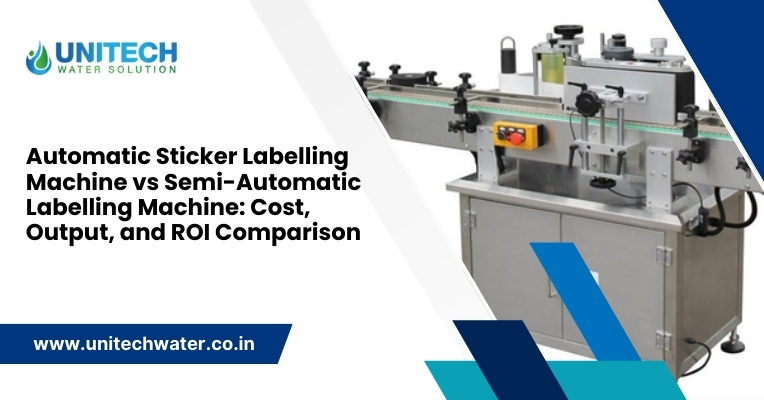
An Automatic Sticker Labelling Machine is a fully automated system that applies labels without manual intervention. Products move through the machine via conveyors, and labels are applied precisely using sensors and control systems.
These machines are widely used in high-speed production environments where accuracy and consistency are critical. Advanced models may also include features such as barcode reading, batch coding, and integration with filling and sealing equipment.
What Is a Semi-Automatic Labelling Machine?
A Semi-Automatic Labelling Machine requires some level of manual handling. The operator places the product in position, and the machine applies the label once triggered. While it reduces manual effort compared to hand labelling, it does not offer the same speed or automation level as fully automatic machines.
Semi-automatic machines are commonly used by small and medium-sized manufacturers with limited production volumes.
Cost Comparison: Automatic vs Semi-Automatic Labelling Machines
Initial Investment
The upfront cost of a Semi-Automatic Labelling Machine is generally lower. This makes it an attractive option for startups or businesses with budget constraints.
In contrast, an Automatic Sticker Labelling Machine requires a higher initial investment due to advanced automation, sensors, and conveyor systems. However, the cost reflects its higher productivity and long-term value.
Operating and Labor Costs
Semi-automatic machines depend heavily on operators, which increases labor costs over time. Output consistency can also vary depending on operator skill.
Automatic machines significantly reduce manual dependency, leading to lower labor expenses and consistent performance. Over time, this difference plays a major role in overall cost efficiency.
Output and Productivity Comparison
Production Speed
Automatic machines are designed for continuous, high-speed operation. They can label hundreds or even thousands of products per hour without interruption.
Semi-automatic machines operate at a slower pace, as each product requires manual placement. This limits daily production capacity.
Accuracy and Consistency
An Automatic Sticker Labelling Machine ensures precise label placement on every product, minimizing rejection and rework. This consistency is crucial for regulated industries such as food, pharmaceuticals, and cosmetics.
Semi-automatic machines provide acceptable accuracy but may experience slight variations due to manual handling.
Packaging Line Efficiency and Workflow Impact
Packaging line efficiency is a key factor when selecting a labelling solution. Automatic machines integrate seamlessly with other equipment such as filling machines, capping units, and sealing systems. This creates a smooth, uninterrupted production flow.
Semi-automatic machines function as standalone units and may cause bottlenecks in fast-moving packaging lines. While suitable for small batches, they can limit scalability as demand grows.
ROI Comparison: Which Machine Delivers Better Long-Term Value?
Return on Investment for Automatic Machines
Although the initial cost is higher, an Automatic Sticker Labelling Machine delivers strong ROI through:
- Reduced labor costs
- Higher production output
- Minimal label wastage
- Improved brand consistency
For medium to large manufacturers, the payback period is often shorter than expected due to operational savings.
ROI for Semi-Automatic Machines
Semi-automatic machines offer reasonable ROI for low-volume production. They are ideal for businesses testing new products or managing limited output.
However, as production demand increases, the operational limitations can impact profitability and slow growth.
Role of Automatic BOPP Hot Glue Labelling Machine
An Automatic BOPP Hot Glue Labelling Machine is a specialized type of automatic system used for wrap-around labels. It is commonly applied in beverage, food, and FMCG industries where durability and high-speed performance are required.
This machine type enhances label adhesion, reduces material cost, and supports continuous operation, further improving packaging line efficiency in high-output environments.
Choosing the Right Labelling Machine for Your Business
The choice between automatic and semi-automatic machines depends on several factors:
- Daily production volume
- Budget and long-term growth plans
- Labor availability
- Packaging line speed
- Label type and product shape
Businesses aiming for scalability and consistent quality often benefit more from automated labelling systems.
Future of Automated Labelling Systems
The packaging industry continues to shift toward automation. Automated labelling systems are becoming smarter, more flexible, and easier to integrate. Features such as IoT connectivity, real-time monitoring, and quick changeovers are shaping the future of labelling technology.
Investing in automation today helps manufacturers stay competitive and meet evolving market demands.
Conclusion
Both the Automatic Sticker Labelling Machine and Semi-Automatic Labelling Machine serve important roles in the packaging industry. Semi-automatic machines are suitable for small-scale operations with limited output needs, while automatic machines deliver higher productivity, better packaging line efficiency, and stronger ROI over time.
For businesses planning long-term growth, automation offers a clear advantage in speed, accuracy, and operational consistency.
Frequently Asked Questions
The main difference lies in automation level. Automatic machines operate without manual intervention, while semi-automatic machines require operator involvement.
It can be suitable if the business has consistent production volume and plans to scale operations in the future.
Automation reduces manual handling, eliminates bottlenecks, and ensures smooth integration with other packaging equipment.
Food and beverage, pharmaceuticals, cosmetics, FMCG, and chemical industries widely use automated labelling systems.
Yes, they reduce label material costs and support high-speed production, making them cost-effective for large-scale operations.