


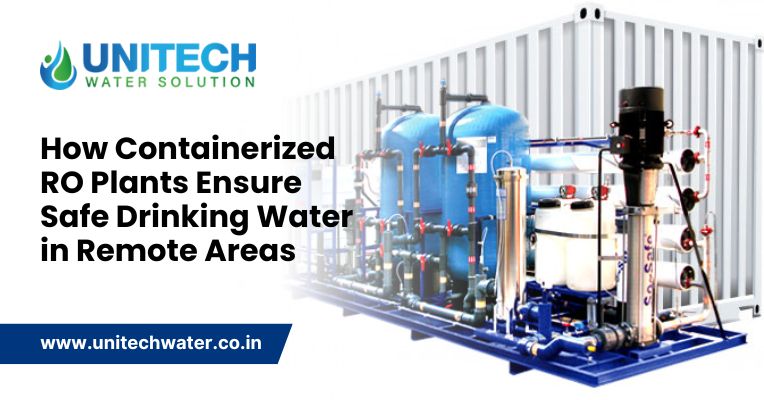
Access to clean and safe drinking water is a critical challenge in many remote and rural areas. Traditional water treatment systems often require large infrastructure, skilled operators, and significant investment, making them unsuitable for areas with limited resources. This is where containerized RO plants come into play, offering a versatile, portable, and efficient solution for providing safe drinking water.
In this article, we explore how containerized RO plants work, their advantages, applications, and how they ensure reliable water purification in even the most remote locations.
What Are Containerized RO Plants?
A containerized RO plant is a water purification system built into a standard shipping container. These plants are pre-assembled, tested, and ready to operate, making them ideal for rapid deployment. Unlike traditional RO systems, containerized plants are fully portable and can be transported to remote areas without major installation work.
Key features of containerized RO plants include:
- Compact design suitable for limited spaces
- Pre-assembled and modular systems for easy setup
- Integrated pumping, filtration, and chemical dosing systems
- Easy scalability for larger water requirements
These systems are designed to provide high-quality water while minimizing operational challenges, making them perfect for disaster relief, remote industrial sites, and rural communities.
How Containerized RO Plants Work
Containerized RO plants use reverse osmosis technology to remove impurities from water, including dissolved salts, bacteria, and viruses. The process generally involves several stages:
Pre-Treatment: Water is filtered to remove sediments, chlorine, and other contaminants that can damage RO membranes.
RO Membrane Filtration: High-pressure pumps force water through semi-permeable membranes, separating pure water from contaminants.
Post-Treatment: Mineral balancing and UV sterilization may be applied to ensure safe and palatable drinking water.
Storage and Distribution: Purified water is stored in tanks within the container or distributed to local pipelines for consumption.
By combining multiple purification steps, containerized RO plants ensure consistently safe and high-quality drinking water, even in areas where water sources are contaminated.
Advantages of Containerized RO Plants in Remote Areas
1. Portability and Easy Installation
Unlike traditional RO plants that require civil construction, a portable RO water treatment plant can be delivered directly to the site, connected to power and water supply, and made operational within a few hours. This is particularly useful for remote locations, disaster relief zones, and temporary settlements.
2. Compact and Space-Saving
The modular and compact design of containerized RO plants makes them ideal for areas with limited space. They can be installed on small plots or rooftops, providing a mobile water purification system without the need for extensive infrastructure.
3. Scalable and Modular
Containerized plants can be easily expanded by adding more units. This flexibility allows communities and industries to increase water production as demand grows. Modular RO plants are especially valuable for industrial applications where water requirements may change over time.
4. Reduced Operational Costs
Pre-assembled systems reduce installation costs and require minimal on-site labor. Modern containerized RO plants are also energy-efficient, further lowering operational expenses.
5. Reliable Water Quality
With integrated industrial RO plant components, these systems consistently produce water that meets safety standards for drinking, cooking, and other uses. This reliability is crucial in remote areas where alternative water sources may be unsafe.
Applications of Containerized RO Plants
Containerized RO plants are versatile and can be applied in various scenarios:
- Remote Villages and Rural Communities: Provides safe drinking water where municipal supply is unavailable.
- Disaster Relief and Emergency Situations: Rapid deployment during floods, earthquakes, or droughts.
- Industrial Sites: Ensures clean water for manufacturing, mining, and construction in off-grid locations.
- Military and Defense Camps: Portable water solutions for personnel in remote bases.
- Temporary Events and Large Gatherings: Ensures water safety in festivals, camps, and field hospitals.
The adaptability of these plants makes them a practical solution for both public and private sectors.
Maintenance of Containerized RO Plants
Proper maintenance is essential to ensure long-term performance. Key maintenance practices include:
- Regular cleaning and replacement of RO membranes
- Monitoring water quality and system pressure
- Checking pre-treatment filters and dosing systems
- Periodic inspection of pumps and valves
With proper care, a compact RO plant can provide safe water for many years, even in challenging environments.
Why Choose Containerized RO Plants Over Traditional Systems?
|
Feature |
Containerized RO Plant |
Traditional RO Plant |
|
Installation Time |
Hours |
Weeks to months |
|
Portability |
High |
Low |
|
Space Requirement |
Compact |
Large |
|
Scalability |
Easy |
Difficult |
|
Operational Costs |
Lower |
Higher |
|
Maintenance |
Simple |
Complex |
This comparison highlights why containerized RO plants are increasingly preferred for remote and industrial water solutions.
Conclusion
Containerized RO plants are transforming the way safe drinking water is delivered to remote and underserved areas. With features like portability, compact design, scalability, and reliable purification, these portable RO water treatment plants provide an effective solution to water scarcity and contamination issues. By integrating industrial RO plant technology and modular systems, communities and industries can access clean, safe, and high-quality water with minimal infrastructure.
For areas facing water challenges, adopting a mobile water purification system or a compact RO plant is not just practical—it’s essential for health, productivity, and sustainable development.
Frequently Asked Questions
Yes, many containerized RO plants are designed for seawater desalination, providing safe drinking water in coastal and remote areas.
Production capacity varies from 1,000 liters to over 100,000 liters per day, depending on the size and configuration of the plant.
Modern containerized RO plants are equipped with energy-saving pumps and systems to minimize electricity consumption.
Yes, they can be configured with solar or diesel-powered systems for locations without reliable electricity.
These plants can purify groundwater, surface water, brackish water, and seawater using multi-stage treatment systems.