


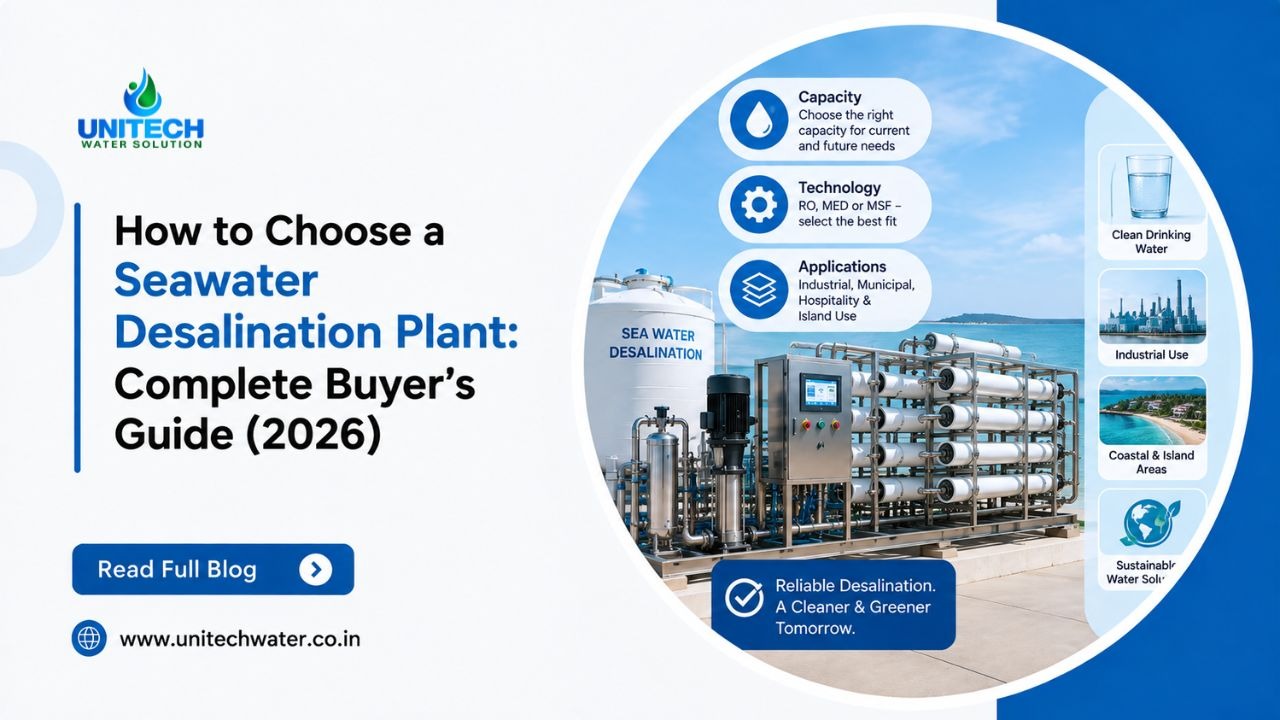
Knowing how to choose a seawater desalination plant can save you lakhs in avoidable costs. A wrong choice shows up later as fouled membranes, high power bills, low output or failed discharge approvals. Coastal industries, hotels, resorts, ports, power plants and island communities now depend on the seawater RO plant (SWRO plant) to get reliable fresh water from the sea. This guide covers what to check before you buy an industrial seawater RO plant, in the order you should check it.
Quick answer: To choose a seawater desalination plant, (1) calculate your daily water demand and add a 15–20% margin, (2) test the seawater for TDS, SDI, temperature and boron, (3) match pretreatment to the water quality, (4) specify seawater-grade membranes, a duplex stainless steel high-pressure pump and an energy recovery device, (5) plan brine discharge and approvals, and (6) compare suppliers on total cost of ownership, not just the purchase price.
In this guide:
- What is a seawater desalination plant?
- Step 1: Calculate capacity
- Step 2: Analyse the seawater
- Step 3: Choose pretreatment
- Step 4: Membranes, pump and materials
- Step 5: Energy recovery and power
- Step 6: Single-pass or double-pass
- Step 7: Brine discharge and compliance
- Step 8: Skid-mounted or containerized
- Step 9: Automation and after-sales support
- Cost: CAPEX vs OPEX
- Supplier checklist and red flags
- FAQs
What Is a Seawater Desalination Plant?
A seawater desalination plant removes dissolved salts from seawater to make it fit for drinking, industrial or process use. Most plants today use seawater reverse osmosis (SWRO). A high-pressure pump pushes pretreated seawater through semi-permeable membranes that reject about 99.7% of dissolved salts.
A typical seawater RO system has these stages:
- Intake: an open intake or beach well
- Pretreatment: filtration, chemical dosing and cartridge filters
- High-pressure pumping: roughly 55–70 bar (800–1,000 psi)
- RO membranes: where the salt is removed
- Energy recovery: captures pressure from the reject brine
- Post-treatment: pH correction, remineralization and disinfection
- Storage and distribution
Step 1: Calculate Your Real Water Demand and Capacity
Capacity drives everything else, including cost, footprint and power load. Undersize the plant and you face shortages. Oversize it and you pay for membranes, pumps and electricity you don't need.
- List every use: drinking, process, cooling make-up, cleaning, laundry, kitchens and irrigation.
- Work out average and peak daily demand.
- Add a 15–20% margin for peak season and maintenance shutdowns.
- Allow for growth over the next 5–10 years.
- Decide operating hours. A plant running 24 hours needs far fewer membranes and a smaller pump than one running 10 hours for the same daily output.
The conversion is simple: 1,000 LPH running 24 hours = 24 m³/day.
|
Plant size |
Output (24 h) |
Typical use |
|
1,000–5,000 LPH |
24–120 m³/day |
Small hotels, resorts, coastal workshops |
|
5,000–20,000 LPH |
120–480 m³/day |
Large resorts, coastal industries, fish processing |
|
20,000–50,000 LPH |
480–1,200 m³/day |
Industrial units, ports, large hospitality projects |
|
50,000+ LPH |
1,200+ m³/day |
Power plants, refineries, municipal supply |
Worked example: A 5,000 LPH plant at 40% recovery needs 12.5 m³/h of feed seawater. It produces 5 m³/h of fresh water and discharges 7.5 m³/h of brine. The intake pump, pretreatment and discharge line all have to be sized for those flows, and a quotation that shows only product water capacity is incomplete.
Step 2: Analyse the Seawater Before You Buy
No two seawater sources are the same. Open-sea intake can carry algae, silt and organic matter, while a beach well is usually cleaner but may contain iron or manganese. Test these before finalizing any design:
- TDS: ~35,000 ppm is typical, but semi-enclosed gulfs and creeks can be considerably higher.
- SDI (Silt Density Index): the RO feed should ideally be below 3.
- Temperature: it affects membrane flux and design pressure.
- Turbidity, organics and bacteria: these drive fouling risk.
- Boron, silica, iron, manganese and hardness: these affect scaling and product quality.
Higher TDS needs higher pressure and gives lower recovery, so test your own water instead of relying on a general figure. A good supplier will ask for a full seawater analysis report before quoting.
Step 3: Choose the Right Pretreatment
Pretreatment protects your membranes and is where cheap plants cut corners. Weak pretreatment can shorten membrane life and raise cleaning and downtime costs.
A typical train includes intake screening, coagulant dosing, multimedia filtration (MMF), antiscalant dosing, dechlorination (SMBS) and a 5-micron cartridge filter. For difficult water you may add ultrafiltration (UF).
|
Parameter |
Conventional (MMF) |
Ultrafiltration (UF) |
|
Treated water SDI |
Higher and more variable |
Consistently lower |
|
Best for |
Clean seawater, beach wells |
Algal blooms, turbid or variable water |
|
Footprint |
Larger |
Smaller |
|
Upfront cost |
Lower |
Higher, but lower risk of membrane fouling |
Choose MMF if your water is stable and clean. Choose UF if quality changes seasonally or you can't afford unplanned downtime.
Step 4: Select Seawater-Grade Membranes, Pump and Materials
Membranes. Use only seawater RO membranes, never brackish-water ones. Check salt rejection (99.7% or better), flux, boron rejection and fouling resistance. Brand matters, but so does design: too few membranes means high flux, faster fouling and shorter life. Ask whether the supplier can source genuine, warrantied membranes.
High-pressure pump. This is the heart of the plant. It must match your flow and pressure, and it should be made of duplex or super duplex stainless steel, because seawater at high pressure corrodes ordinary steel quickly.
Pressure vessels and piping. High-pressure sections need seawater-rated FRP vessels and corrosion-resistant piping. Low-pressure sections can use UPVC, HDPE or FRP.
Step 5: Look at Energy Recovery and Power Supply
Energy is often the largest running cost, commonly around 40–60% of the cost of producing water. An energy recovery device (ERD), such as a pressure exchanger or turbocharger, captures pressure from the rejected brine and reuses it, which can cut a plant's energy use dramatically. Well-designed plants with an ERD typically run around 3–4 kWh per m³, while plants without one can use far more.
Illustrative energy cost: at 3.5 kWh/m³ and ₹8 per unit, a 100 m³/day plant uses about 350 kWh/day, roughly ₹2,800/day, or about ₹28 per m³ in electricity alone.
Also confirm your power supply: voltage, phase, generator capacity and load stability. A variable frequency drive (VFD) on the high-pressure pump reduces startup stress and saves energy. If you rely on a generator, size it for pump start-up current, not just running load.
Step 6: Single-Pass or Double-Pass SWRO?
|
Feature |
Single-pass |
Double-pass |
|
Product TDS |
~200–500 ppm |
Below ~10 ppm |
|
Boron removal |
Moderate |
High |
|
Energy and capital cost |
Lower |
Higher |
|
Best for |
Drinking water, hotels, general industry |
Boiler feed, pharma, electronics, strict boron limits |
Most drinking and general industrial uses work with single-pass. Choose double-pass only if your process demands very low TDS or you must meet strict boron limits. Check your target against BIS IS 10500 for drinking water, or IS 14543 if you will bottle the water as packaged drinking water.
Step 7: Plan Brine Discharge and Approvals
Every SWRO plant produces brine, at roughly 55–65% of the feed flow at typical recovery, and its salinity is much higher than seawater. Plan this early:
- Discharge method: a diffuser outfall, deep-sea discharge or mixing before release.
- Approvals: State Pollution Control Board consent and, near the coast, possible Coastal Regulation Zone (CRZ) clearance. Requirements vary by state and site, so check current rules with the relevant authority.
- Intake impact: protect marine life with proper screening and intake design.
- Chemicals: know what antiscalants and cleaning chemicals end up in the discharge.
Projects often stall on approvals rather than equipment, so raise this with your supplier at the start.
Step 8: Skid-Mounted or Containerized Plant?
|
Skid-mounted |
Containerized |
|
|
Best when |
You already have a plant room |
Space or civil work is limited, or the site is remote |
|
Installation |
More site work |
Mostly factory-assembled and tested |
|
Weather protection |
Needs a building |
Built-in |
|
Startup |
Slower |
Faster, close to plug-and-play |
Step 9: Automation and After-Sales Support
Look for a PLC/HMI control system with automatic start, stop and flushing, high and low pressure protection, conductivity monitoring, tank-level control and alarms. Remote monitoring helps your supplier diagnose problems without a site visit.
Then check the support package: installation, commissioning, operator training, a spare parts list, a CIP (clean-in-place) procedure, a maintenance schedule and a clear membrane warranty. A plant is only as reliable as the service behind it.
Cost: Look at CAPEX and OPEX Together
The cheapest quote is rarely the cheapest plant over five years. Compare:
- CAPEX: equipment, pretreatment, membranes, ERD, tanks, civil and electrical work, installation.
- OPEX: electricity, membrane replacement, chemicals, cartridge filters, labour and maintenance.
Cost per m³ falls as capacity rises and as energy recovery improves. Larger plants get better economies of scale, and plants with an ERD and good pretreatment have lower running costs. Ask each supplier for an estimated cost per m³ of fresh water, not just the equipment price.
Supplier Checklist and Red Flags
Ask every supplier:
- Which membranes, pump and ERD are you specifying, and why?
- What are the feed flow, recovery rate and brine flow?
- What is the guaranteed product water quality and energy consumption (kWh/m³)?
- What warranty covers the membranes and pump?
- Do you handle installation, commissioning and operator training?
- Can I see similar installed plants and references?
Red flags:
- No request for a seawater analysis
- Quotation shows product capacity only
- Vague or unbranded membranes and pumps
- No energy recovery on a plant above small capacity
- Very low price with weak pretreatment
- No after-sales or spare parts plan
Choosing an Industrial Seawater RO Plant Supplier
A good desalination system supplier engineers the plant around your site rather than selling a standard model. Unitech Water Solution, based in Ahmedabad with a factory at Vatva GIDC, designs and manufactures seawater desalination plants, industrial RO plants, containerized RO plants andultrafiltration plants, and suppliesRO membranes, antiscalant chemicals and cartridge filters. The company is an ISO-certified manufacturer and an authorized channel partner for DOW FilmTec membranes in India, and provides installation, commissioning and operator training.
Conclusion
Learning how to choose a seawater desalination plant comes down to a sequence: size for real demand, test your seawater, protect the membranes with the right pretreatment, use seawater-grade components and energy recovery, plan brine discharge early, and judge suppliers on lifetime cost and support. Get those steps right and your SWRO plant will give you steady, affordable fresh water for years.
Planning a seawater desalination project?
Contact Unitech Water Solution with your capacity requirement, seawater analysis and project location, and get a customized proposal for your industrial seawater RO plant.
Frequently Asked Questions
Calculate peak and average daily demand, add a 15–20% margin, and decide how many hours per day the plant will run. Then convert to LPH or m³/h. Include future expansion so you don't outgrow the plant in a few years.
An SWRO plant treats water at around 35,000 ppm TDS and needs much higher pressure (roughly 55–70 bar), stronger materials and lower recovery. Brackish water RO handles lower salinity at lower pressure and energy.
A well-designed SWRO plant with energy recovery typically uses around 3–4 kWh per m³. Actual figures depend on salinity, temperature, plant size and design.
Typically 35–45%. At 40% recovery, 100 m³ of seawater gives about 40 m³ of fresh water and 60 m³ of brine.
Yes. It is the most important protection for your membranes. Poor pretreatment leads to fouling, higher pressure, frequent cleaning and shorter membrane life.
Several years with good pretreatment and correct operation, but life varies with feed quality and maintenance. Poor pretreatment or bad operating practice can shorten it sharply.
Usually you need State Pollution Control Board consent for brine discharge, and sites near the coast may need CRZ clearance. Rules vary, so confirm current requirements before you order.
Daily water requirement, operating hours, seawater analysis report, product water quality target, power supply details, installation type (skid or container), project location and future expansion plans.