



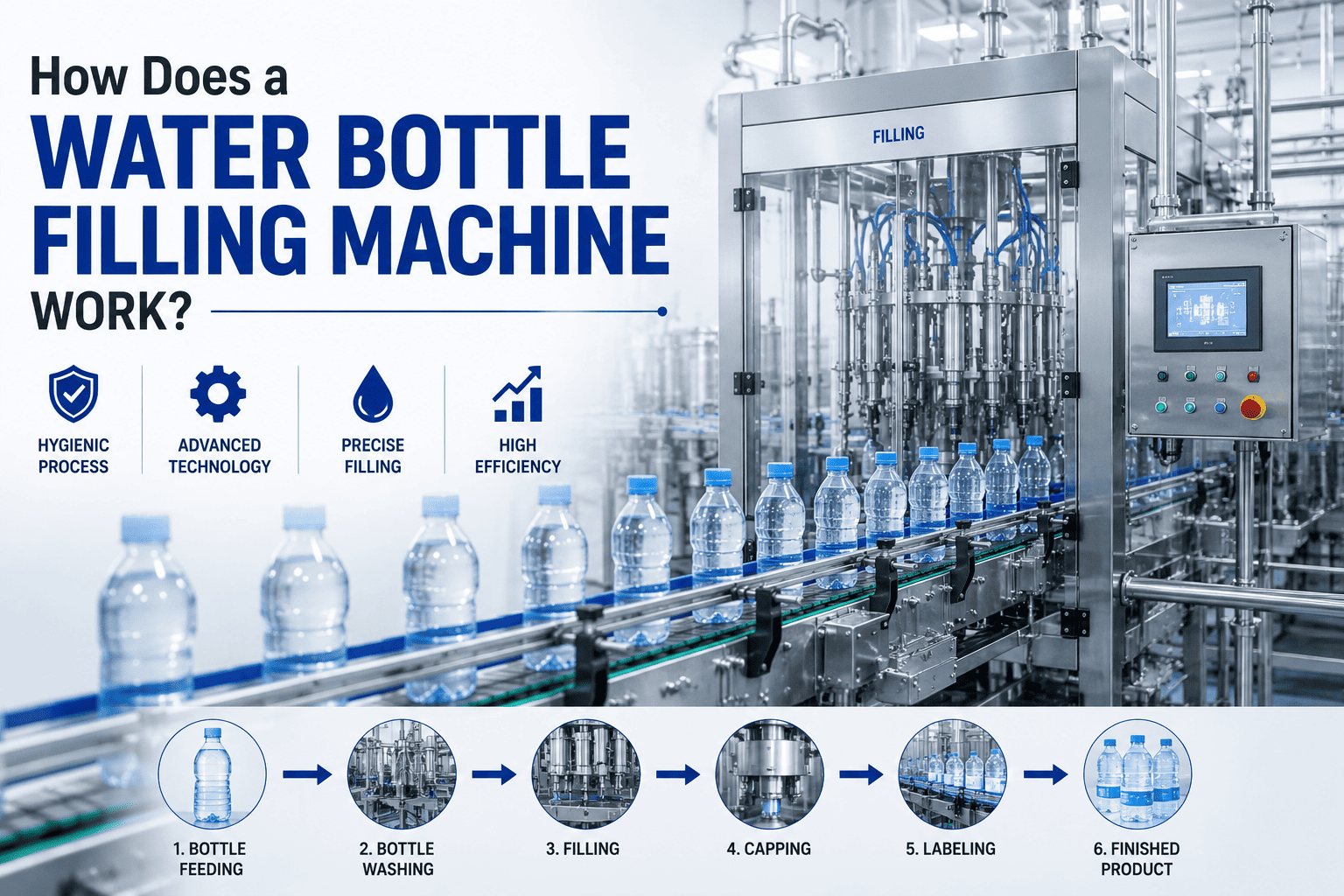
A water bottle filling machine automatically transfers treated water into bottles at a controlled volume and production speed. Depending on the machine configuration, bottles are positioned, filled through dedicated filling heads or valves, discharged, and transferred to the capping stage.
In a modern bottled water production line, the filling machine connects the bottle-rinsing stage with capping, labelling, and packaging. Automated systems reduce manual handling and help maintain consistent filling performance across production runs.
Understanding how bottle filling works helps businesses select the appropriate machine based on bottle size, filling capacity, automation level, water characteristics, and production requirements.
How Does Bottle Filling Work?
The basic water bottle filling process follows a sequence:
Bottle Infeed → Rinsing → Positioning → Filling → Level Control → Bottle Discharge → Capping
The exact configuration varies by machine type and application, but the objective remains the same: transfer treated water into bottles consistently and efficiently.
Step-by-Step Water Bottle Filling Process
Step 1: Bottle Infeed
Empty bottles enter the filling line through a conveyor system. The bottles are guided toward the rinsing and filling section.
Automated conveyors help maintain a continuous flow of bottles and synchronize the movement of containers with the filling machine.
Step 2: Bottle Rinsing
Before filling, bottles may pass through a rinsing system designed to remove particles and prepare the containers for filling.
This stage is particularly important for maintaining hygienic production conditions.
Step 3: Bottle Positioning
The bottles are positioned below the filling heads.
Sensors, guides, or mechanical systems help ensure that each bottle is correctly aligned before filling begins.
Step 4: Water Filling
The filling heads or valves transfer treated water into the bottles.
The filling system is designed to control the flow and quantity of water entering each bottle.
Factors influencing filling performance include:
- Filling head configuration
- Bottle size
- Water characteristics
- Machine speed
- Filling method
- Production capacity
Step 5: Filling Level Control
Consistent filling levels are important for product presentation and process control.
The filling system is configured according to the required bottle volume and operating parameters.
Step 6: Bottle Discharge
After filling, the bottles are transferred from the filling section toward the capping stage.
The conveyor maintains the movement of bottles through the production line.
Step 7: Capping
Filled bottles move into the capping system, where caps are positioned and secured.
The capping stage completes the primary bottle closure before labelling and secondary packaging.
Main Components of a Water Bottle Filling Machine
A typical water bottle filling machine may include several components that work together.
Bottle Conveyor
Moves bottles through the production line and maintains controlled bottle flow.
Filling Tank
Store the treated water immediately before filling.
Filling Heads
Transfer water into bottles according to the machine's filling configuration.
Filling Valves
Control water flow during the filling cycle.
Sensors
Help detect bottle position and synchronize machine operations.
Control Panel
Allows operators to monitor and control machine functions.
Bottle Handling System
Keeps bottles correctly positioned during filling and discharge.
The exact equipment configuration depends on the production line and filling technology.
Types of Water Bottle Filling Machines
Different production requirements call for different filling configurations.
Semi-Automatic Filling Machine
Semi-automatic systems require some manual intervention and are suitable for lower-volume production environments.
Automatic Bottle Filling Machine
An automatic bottle filling machine automates bottle handling and filling to improve production consistency and reduce manual intervention.
Fully Automatic Filling Line
Fully automated systems integrate rinsing, filling, capping, conveyors, and other production stages into a coordinated line.
Mineral Water Filling Machine
A mineral water filling machine is configured for bottled water production and can be integrated into a complete mineral water bottling line.
The appropriate machine depends on bottle size, production volume, filling speed, automation requirements, and the overall plant configuration.
What Determines Water Bottle Filling Machine Performance?
Several factors influence the performance of a filling machine.
Bottle Size
The machine must accommodate the required bottle dimensions and volume.
Filling Capacity
Production speed is often expressed as BPM, or bottles per minute.
Number of Filling Heads
The number and configuration of filling heads influence throughput.
Automation
Higher levels of automation can reduce manual intervention and improve production consistency.
Water Quality
The water entering the filling stage should meet the required treatment and product-quality parameters.
Production Line Integration
The filling machine should be compatible with the rinsing, capping, labelling, and packaging equipment connected to it.
Benefits of Automatic Bottle Filling
An automated filling system can provide several operational advantages.
Consistent Filling
Automated controls help maintain consistent filling across production runs.
Reduced Manual Handling
Automation reduces the need for operators to manually transfer and fill bottles.
Higher Production Efficiency
Continuous bottle movement and automated filling support higher production output.
Improved Process Hygiene
Reduced manual contact can support hygienic production practices.
Better Integration
Automatic filling equipment can connect with rinsing, capping, labelling, and packaging systems.
Where Are Water Bottle Filling Machines Used?
Water bottle filling machines are commonly used in:
- Mineral water plants
- Packaged drinking water plants
- Bottled water production facilities
- Commercial water bottling operations
- Institutional water production
- Beverage production lines
The machine should always be selected according to the specific production application and bottle format.
How Does a Filling Machine Fit Into a Water Bottling Plant?
The filling machine is one component of a complete bottled water production line.
A typical sequence is:
Water Treatment → Bottle Blowing → Bottle Rinsing → Filling → Capping → Labelling → Shrink Wrapping
The treatment system prepares the water, while the bottling equipment handles the packaging process.
This integration is important because a filling machine operating faster than the downstream packaging equipment can create bottlenecks. Similarly, insufficient filling capacity can limit the output of the complete plant.
For businesses evaluating different equipment configurations, Water Plant Machinery provides a broader view of the equipment used throughout bottled water production.
How to Choose the Right Water Bottle Filling Machine
Before selecting a filling system, consider:
- Required BPM
- Bottle sizes
- Production volume
- Automation requirements
- Number of filling heads
- Available installation space
- Bottle type
- Integration with capping and labelling
- Future production expansion
A business planning a complete bottled water operation should select the filling machine as part of the overall production line rather than as an independent machine.
For mineral water businesses, the filling equipment can be integrated into a Mineral Water Bottling Plant based on the required production capacity and bottle format.
Planning an Automatic Water Filling Line?
The right filling machine can improve production consistency, reduce manual intervention, and support efficient bottle handling. However, the machine should be matched with the treatment, rinsing, capping, labelling, and packaging systems used in the complete production line.