



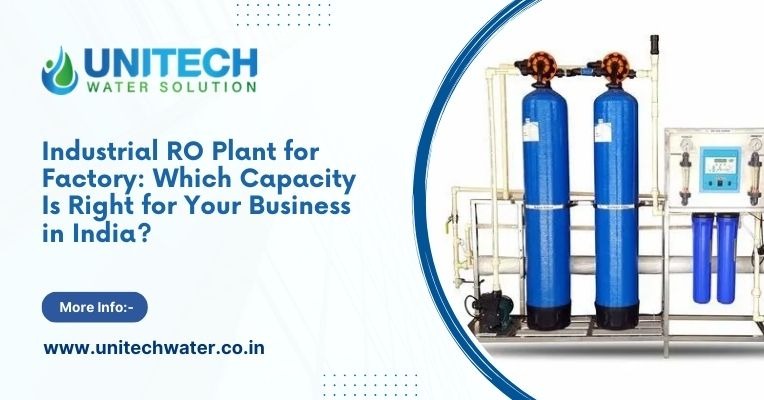
Choosing the right water treatment system for your factory is one of the most important decisions you will make. The wrong capacity can lead to water shortages, wasted money, or equipment breakdowns. The right one keeps your production running smoothly every single day.
This guide will help you understand the different capacity options available and how to choose the best fit for your business. Whether you are a small manufacturer or a large industrial unit, there is an industrial RO plant built for your exact needs.
What Is an Industrial RO Plant and Why Does Your Factory Need One?
Reverse Osmosis, or RO, is a water purification process that removes dissolved salts, chemicals, and impurities from water. An industrial RO water treatment system uses high-pressure membranes to push raw water through filters, producing clean and safe water on the other side.
Factories need treated water for many reasons:
- Boilers and cooling towers need soft, mineral-free water to prevent scaling and damage
- Food and beverage production requires safe water that meets BIS standards
- Pharmaceutical and chemical plants need ultra-pure water for their processes
- Textile and dyeing units require consistent water quality for accurate colour output
- Electronics manufacturing depends on pure water to avoid product defects
Without a proper industrial water purification plant India, factories often face equipment damage, product quality issues, and high maintenance costs. An RO system solves all of these problems at the source.
Understanding LPH: The Key to Choosing the Right Capacity
When you shop for an industrial RO plant, you will see capacities listed in LPH — Litres Per Hour. This tells you how much purified water the system can produce every hour.
To pick the right capacity, calculate your factory's daily water requirement and divide it by the number of operating hours per day.
For example, if your factory needs 10,000 litres per day and runs for 10 hours, you need at least a 1000 LPH system.
500 LPH Industrial RO Plant — Best for Small Units and Startups
A 500 LPH industrial RO plant is the perfect starting point for small businesses.
Who Should Choose This?
- Small food processing and packaged water units
- Drinking water startups and small beverage brands
- Small hotels, clinics, or nursing homes
- Offices and commercial buildings
- Small dairy and bakery units
What You Get
A 500 LPH system typically produces around 12,000 litres per day when running 24 hours. It is compact, easy to install, and has low power consumption. The investment is low, which means your return on investment comes faster compared to larger systems.
1000 LPH Industrial RO Plant — The Most Popular Choice for Mid-Size Businesses
The 1000 LPH industrial RO plant is the most commonly installed system across factories and commercial units in India.
Who Should Choose This?
- Medium-sized food and beverage factories
- Textile and garment units
- Pharmaceutical companies with moderate water needs
- Schools, colleges, and large commercial buildings
- Agricultural support units
Why It Is So Popular
A 1000 LPH system handles most mid-level production requirements without a heavy upfront investment. Spare parts are widely available across India. Most reputable industrial RO plant manufacturers offer this size with full automation and monitoring options built in.
2000 LPH Industrial RO Plant — For Growing Factories With Higher Demand
If your business is scaling up and your water needs are rising, a 2000 LPH industrial RO plant gives you the headroom you need.
Who Should Choose This?
- Large food processing and FMCG units
- Chemical manufacturing plants
- Medium to large hospitals
- Multi-floor commercial complexes
- Breweries and carbonated drink manufacturers
What to Expect
A 2000 LPH system can produce up to 48,000 litres per day. This supports multiple production lines at the same time. Many businesses also install a 2000 LPH plant as a backup alongside an existing smaller system to ensure zero downtime during peak production.
5000 LPH Industrial RO Plant — Designed for Large-Scale Industrial Use
A 5000 LPH industrial RO plant is built for factories that cannot afford even a few hours of water supply interruption.
Who Should Choose This?
- Large pharmaceutical manufacturing facilities
- Automobile and auto-component factories
- Paper and pulp industries
- Refineries and petrochemical units
- Large hotels and resort complexes
Industrial-Grade Build Quality
Systems at this capacity are built with stainless steel frames, multi-stage pre-filtration, and high-recovery membrane arrays. They run 24x7 continuously and handle variable raw water quality without any drop in output purity.
Energy efficiency matters at this scale. A well-designed industrial RO water treatment system at 5000 LPH will include energy recovery devices to lower your monthly power bills significantly.
10000 LPH Industrial RO Plant — The Powerhouse for Heavy Industry
A 10000 LPH industrial RO plant sits at the top end of the range. These systems can produce up to 2,40,000 litres of purified water every single day.
Who Should Choose This?
- Power plants and thermal stations
- Large-scale textile and processing units
- Municipal water supply projects
- Major export-oriented manufacturing plants
- Seawater and brackish water treatment facilities
Built for Maximum Reliability
At 10,000 LPH, the system design becomes highly customised. Most industrial RO plant manufacturer India companies will conduct a full site survey before recommending the exact membrane configuration, pre-treatment stages, and pump sizing.
PLC automation, remote SCADA monitoring, and redundant pump systems are standard at this level. The goal is to keep the plant running without manual intervention for long periods.
How to Calculate the Right Capacity for Your Factory
Not sure which size is right for you? Follow these simple steps:
Step 1 — Estimate Your Daily Water Requirement
List every process in your factory that uses water — production, cleaning, cooling, and staff use. Add it all up to get your total daily need in litres.
Step 2 — Factor in Operating Hours
Decide how many hours per day your RO plant will run. Most factories plan for 18 to 22 hours to allow time for maintenance.
Step 3 — Add a 20% Safety Buffer
Always size your plant slightly above your current need. Your water demand will grow as your business grows. A 20% buffer protects you from running short.
Step 4 — Test Your Raw Water Quality
High TDS input water or water with heavy metals will need a more powerful configuration to achieve the same output. Share a water analysis report with your supplier before finalising any capacity.
Industrial RO Plant Capacity Guide
Here is a simple overview to help you decide at a glance:
- 500 LPH — Startups, small businesses, offices, small clinics
- 1000 LPH — Mid-size factories, schools, beverage units
- 2000 LPH — Growing factories, hospitals, FMCG companies
- 5000 LPH — Large industrial units, pharma, auto sector
- 10000 LPH — Power plants, municipalities, heavy manufacturing
What to Look for in an Industrial RO Plant Manufacturer in India
Choosing the right system is only half the job. You also need to choose the right supplier. Here is what matters most:
- Experience and Proven Track Record
An established industrial RO plant manufacturer will have a portfolio of installations across multiple industries. Ask for references and case studies before signing any contract. - After-Sales Service and AMC
A reliable reverse osmosis plant supplier will offer Annual Maintenance Contracts and guaranteed response times for service calls. Factory downtime is expensive — fast support matters more than anything. - Quality of Components
The membranes, pumps, and pressure vessels in your plant determine its lifespan. Look for systems that use internationally certified membranes and pumps from reputed brands. - Certifications and Compliance
Make sure the manufacturer holds certifications such as ISO 9001, CE, and BIS approvals. These signal consistent manufacturing quality and compliance with Indian safety standards. - Customisation Ability
No two factories are the same. A good industrial water purification plant India supplier will assess your specific water source, production requirements, and site conditions before recommending any solution — not just quote a standard model off a catalogue.
Common Mistakes Factories Make When Buying an Industrial RO Plant
Avoid these pitfalls before you make a purchase:
- Underestimating future demand — Plan for growth, not just current needs
- Skipping a water quality test — Raw water TDS and contamination levels directly affect plant sizing
- Choosing price over quality — A cheap plant with poor membranes costs more in the long run
- Ignoring installation requirements — Space, drainage, and power supply all need advance planning
- Not checking service availability — A supplier with no local team can leave you stranded
Final Thoughts — Get the Right Plant the First Time
An industrial RO plant is a long-term asset for your factory. Getting the capacity right from day one saves money, prevents production losses, and keeps your water supply reliable for years to come.
Whether you need a compact 500 LPH industrial RO plant for a small unit or a high-capacity 10000 LPH industrial RO plant for a large facility, India has experienced manufacturers who can deliver exactly what you need.
Take the time to assess your water requirements, test your input water quality, and partner with a trusted industrial RO plant manufacturer India who offers complete installation, service, and long-term support.
Clean water is not just a utility for your factory — it is the foundation of consistent quality production.
Frequently Asked Questions
The right capacity depends on your factory's daily water requirement. Divide your total daily water need in litres by your operating hours to get the LPH requirement. Always add a 20% buffer for future growth. Capacities range from 500 LPH for small units to 10000 LPH for heavy industry.
LPH stands for Litres Per Hour. It measures how much purified water an industrial RO plant can produce every hour. A 1000 LPH plant produces 1,000 litres of treated water per hour. Choosing the correct LPH capacity ensures your factory never faces water shortages during production.
A 500 LPH industrial RO plant is best for small factories in India. It produces around 12,000 litres per day, has low power consumption, and requires minimal installation space. It suits small food processing units, packaged water startups, small hotels, clinics, offices, and dairy units with moderate daily water needs.
A 1000 LPH industrial RO plant produces approximately 24,000 litres of purified water per day when running for 24 hours. For factories operating 10 hours daily, output is around 10,000 litres. It is the most popular capacity for mid-size factories, textile units, and pharmaceutical companies across India.
A pharmaceutical factory in India typically needs a 2000 LPH to 5000 LPH industrial RO plant depending on production volume. Pharma units require ultra-pure water for manufacturing processes. Systems at this capacity include multi-stage pre-filtration, stainless steel frames, and high-recovery membrane arrays to meet strict pharmaceutical water quality standards.