


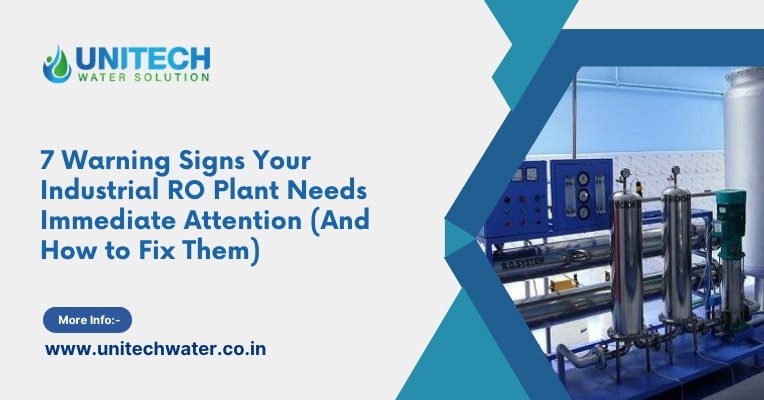
Running a proper ro plant maintenance service is not optional anymore — it is critical for keeping your operations running smoothly.
An industrial ro plant works continuously under high pressure to produce clean and safe water for manufacturing, commercial, pharmaceutical, food processing, and industrial applications. Over time, every system starts showing warning signs when something goes wrong.
Most businesses ignore these early signals until the system completely breaks down. By then, repair costs increase, production stops, and expensive component replacements become unavoidable.
This guide explains the most common industrial RO system problems, their causes, and the right solutions before they turn into major failures.
Sign #1 — Sudden Rise in TDS Levels
If your treated water TDS level starts increasing beyond normal limits, your ro plant maintenance services needs immediate attention.
High TDS in output water usually means the membrane is no longer rejecting dissolved solids effectively.
Common Causes:
- Membrane fouling or scaling
- Damaged membrane elements
- Torn O-rings inside pressure vessels
- Internal bypass leakage
What You Should Do:
Monitor TDS readings daily. If the output TDS remains high for several days, schedule an urgent RO membrane cleaning service or membrane inspection.
Ignoring high TDS can lead to permanent membrane damage and expensive RO membrane replacement costs.
At Unitech Water Solution, our engineers perform detailed membrane integrity testing to identify the exact issue before it spreads across the system.
Sign #2 — Water Production Has Reduced
If your industrial RO plant is producing significantly less water than usual, it is one of the clearest signs of declining RO system performance.
For example, a plant designed for 10,000 LPH dropping to 7,000 LPH indicates a serious operational issue.
Common Reasons:
- Choked sediment filters
- Dirty activated carbon filters
- Membrane biofouling
- Heavy scaling deposits
- High-pressure pump wear
Recommended Solution:
Start by replacing overdue pre-filter cartridges. If production remains low, book a professional RO plant service inspection for membrane cleaning, pump testing, and pressure evaluation.
Timely servicing improves plant recovery rate and extends membrane life.
Sign #3 — Abnormal Noise from High-Pressure Pump
A properly functioning pump should operate smoothly with minimal sound. Grinding, rattling, or vibration noises are serious warning signs.
Possible Issues:
- Air trapped in the pipeline
- Pump bearing failure
- Cavitation caused by low inlet pressure
- Loose fittings or pipe vibration
Immediate Action:
Stop operating the system until the pump is inspected. Continuing operation may lead to complete pump failure and unplanned production shutdown.
Professional water treatment plant repair services can prevent major pump replacement expenses.
Sign #4 — Frequent Pressure Fluctuations
Pressure stability is essential for every reverse osmosis plant. Sudden drops or inconsistent readings usually indicate system blockage or scaling.
Typical Causes:
- Dirty pre-filters
- Partially closed valves
- Scaling inside pressure vessels
- Internal leakage
What You Should Check:
- Inspect all filter stages
- Verify inlet valve positions
- Check membrane housing pressure
- Monitor pressure gauge readings daily
If scaling is detected, a complete RO membrane descaling and CIP cleaning service should be performed immediately.
Sign #5 — Reject Water Ratio Has Increased
Every industrial RO system produces purified water and reject water. When reject water suddenly increases, it means the recovery efficiency is dropping.
Common Reasons:
- Severe membrane scaling
- Incorrect recovery settings
- Antiscalant dosing pump failure
- Membrane blockage
Recommended Solution:
Inspect the antiscalant dosing system and verify chemical dosing levels. Recovery ratio calibration should also be checked during regular RO plant AMC maintenance visits.
Routine monitoring helps reduce water wastage and improves plant efficiency.
Sign #6 — Bad Smell, Taste, or Colour in Output Water
If treated water develops unusual odour, colour, or taste, your system may already be contaminated.
Possible Causes:
- Exhausted carbon filters
- Biological contamination
- Damaged RO membranes
- Dirty storage tanks
What You Should Do:
Stop using the output water immediately, especially in pharmaceutical, food processing, or industrial manufacturing applications.
Schedule urgent industrial water treatment plant servicing including sanitisation, flushing, and water quality testing.
Contaminated water can damage equipment, affect product quality, and create compliance risks.
Sign #7 — Your RO Plant Has Not Been Serviced in Over 6 Months
One of the biggest mistakes industries make is waiting for breakdowns before servicing their system.
Without regular maintenance:
- Membrane fouling increases
- Pump wear becomes severe
- Energy consumption rises
- Water recovery efficiency drops
Recommended RO Plant Maintenance Schedule:
- Pre-filter replacement every 3 months
- Membrane cleaning every 4–6 months
- Complete performance audit every 6 months
- Antiscalant refill every 30–45 days
- Pressure and flow meter calibration annually
A proper RO plant AMC contract ensures all maintenance activities are completed on time.
Unitech Water Solution provides customised AMC services for industrial RO plants across Gujarat and Surat.
Why Early RO Plant Maintenance Saves Money
Small warning signs become major failures when ignored.
A minor pressure drop today can turn into:
- Complete membrane failure
- High pump replacement cost
- Emergency shutdown
- Production losses
- Expensive water treatment repairs
Businesses that invest in regular industrial RO plant maintenance services experience:
- Lower repair costs
- Longer membrane life
- Better water quality
- Reduced downtime
- Improved operational efficiency
If your system is showing any of these warning signs, schedule a professional inspection immediately.
FAQs
Common warning signs include high TDS levels, low water production, pressure fluctuations, unusual pump noise, increased reject water, bad water quality, and delayed RO plant maintenance servicing.
High TDS in treated water is usually caused by damaged RO membranes, membrane fouling, scaling buildup, internal leakage, or worn-out sealing components inside the system.
Low water production is commonly caused by clogged pre-filters, membrane fouling, scaling deposits, high-pressure pump issues, or overdue industrial RO plant maintenance services.