


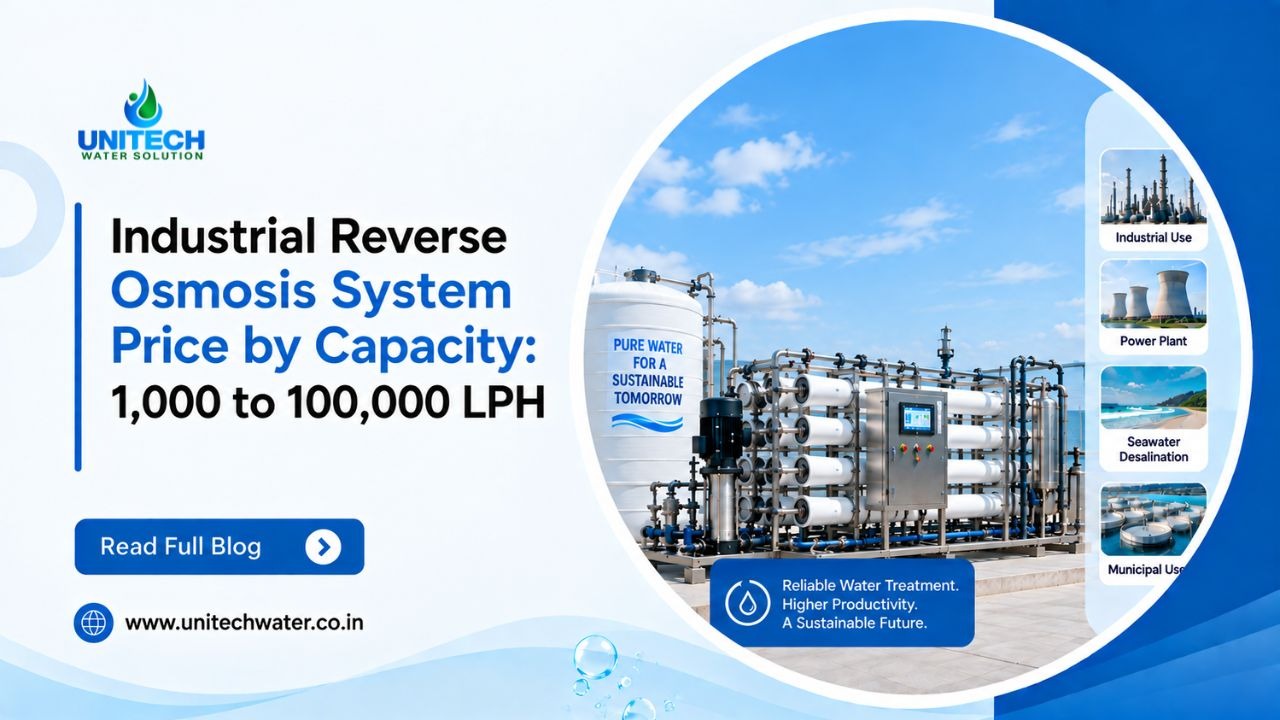
An Industrial Reverse Osmosis (RO) System price in India typically ranges from ₹1.5 lakh for a 1,000 LPH plant to ₹80 lakh–1.2 crore+ for a 100,000 LPH (100 KLD) plant, depending on feed water quality, automation level (manual, semi-automatic, or PLC/SCADA), material of construction (FRP vs stainless steel), and the number of pre-treatment and post-treatment stages included. Capacity is the single biggest price driver, followed by automation and construction material.
Introduction
If you are comparing an Industrial RO System price, you have probably already noticed something frustrating: every supplier quotes a different number for what looks like the "same" capacity. One vendor's 5,000 LPH plant costs ₹5 lakh, another quotes ₹11 lakh — for the same flow rate.
The reason is simple: LPH (Litres Per Hour) tells you how much water the plant produces, not what's inside it. A 5,000 LPH plant built with basic FRP vessels and a manual control panel is a very different product from a 5,000 LPH plant with SS 316 skids, PLC automation, and multi-stage pre-treatment — even though both are labelled "5,000 LPH."
This guide breaks downIndustrial RO System price by capacity, from small 1,000 LPH units used by mid-sized factories to large-scale 100,000 LPH (100 KLD) systems used by industrial parks, pharma plants, and export units — so you know exactly what you should be paying, and why.
What Determines Industrial RO System Price?
Before jumping into the price table, it helps to understand what actually moves the number up or down. Every industrial RO manufacturer in India prices a plant based on these core factors:
- Capacity (LPH): Higher flow rate needs bigger membranes, pumps, and vessels.
- Feed water TDS and quality: Borewell or brackish water with high TDS needs extra membrane stages and stronger pumps than municipal water.
- Automation level: Manual valve-operated systems cost less than semi-automatic or fully automatic PLC/SCADA-controlled systems.
- Material of construction (MOC): FRP (fibre-reinforced plastic) skids are budget-friendly; SS 304/SS 316 stainless steel skids cost more but last longer and suit pharma/food-grade use.
- Membrane brand and configuration: Imported membranes (DOW Filmtec, Toray, Hydranautics) cost more than domestic membranes but offer better rejection rates and lifespan.
- Pre-treatment package: Multi-grade filters, activated carbon filters, softeners, and antiscalant dosing systems add to the base price.
- Post-treatment add-ons: UV disinfection, ozonation, mineral dosing, or a booster/storage system increase the final cost.
- Recovery rate requirement: Systems designed for higher water recovery (to reduce reject water) need additional membrane stages, which raises cost.
- Installation, civil work, and commissioning: Site-specific piping, electrical work, and skilled commissioning are usually quoted separately from the machine price.
Industrial RO System Price by Capacity (1,000–100,000 LPH)
Here is a realistic price range for each common capacity slab, based on current Indian market rates for standard-to-fully-automatic configurations.
|
Capacity (LPH) |
Daily Output (approx., 8–10 hrs/day) |
Price Range (Approx., INR) |
Best Suited For |
|
1,000 LPH |
8,000–10,000 litres/day |
₹1.5 Lakh – ₹4 Lakh |
Small factories, schools, hostels |
|
2,000 LPH |
16,000–20,000 litres/day |
₹3.25 Lakh – ₹6.5 Lakh |
Mid-size industries, hotels, hospitals |
|
5,000 LPH |
40,000–50,000 litres/day |
₹5 Lakh – ₹11 Lakh |
Food processing units, pharma, packaging units |
|
10,000 LPH |
80,000–1,00,000 litres/day |
₹10 Lakh – ₹17 Lakh |
Beverage plants, industrial campuses |
|
20,000 LPH |
1.6–2 Lakh litres/day |
₹18 Lakh – ₹35 Lakh |
Textile units, large food plants, industrial parks |
|
30,000 LPH |
2.4–3 Lakh litres/day |
₹22 Lakh – ₹40 Lakh |
Engineering units, export-oriented factories |
|
50,000 LPH |
4–5 Lakh litres/day |
₹35 Lakh – ₹65 Lakh |
Large manufacturing plants, pharma, textile hubs |
|
100,000 LPH (100 KLD*) |
8–10 Lakh litres/day |
₹80 Lakh – ₹1.2 Crore+ |
Industrial estates, commercial townships, export units |
*Note: 100 KLD (Kilo Litres per Day) is sometimes used loosely for 100,000 LPH, but they aren't identical — see the clarification below.
Disclaimer: These are indicative market ranges as of 2026, compiled from multiple manufacturer price lists and market listings. Actual quotations vary by manufacturer, site conditions, feed water TDS, automation level, and current raw material and membrane import costs. Always request a customized quote based on your water analysis report.
LPH vs KLD: A Common Confusion in RO Plant Pricing
Many buyers get confused between LPH (Litres Per Hour) and KLD (Kilo Litres per Day) — and this mix-up directly affects the price you're comparing.
- LPH measures the plant's continuous production rate per hour.
- KLD measures the total output over a full day (24 hours), commonly used for STP/ETP and larger industrial water treatment sizing.
A "100 KLD RO plant" running 24 hours a day produces roughly 4,166 LPH, but most industrial RO plants don't run a full 24 hours — they typically run 8–10 hours per day. So a plant advertised for 100,000 LPH capacity and one advertised as "100 KLD" are not the same size — the 100,000 LPH plant produces far more water per day than a 100 KLD plant. Always confirm which unit your supplier is quoting before comparing prices.
Cost Breakdown: What's Included in the Price?
An Industrial RO System price usually covers these core components — understanding them helps you evaluate whether a quote is complete or missing hidden costs.
- Pre-treatment unit: Multi-grade filter (MGF), activated carbon filter (ACF), softener, antiscalant dosing system
- High-pressure pump: Centrifugal or vertical multistage pump to push water through the membrane
- RO membranes: Thin-film composite membranes (4" or 8" diameter depending on capacity)
- Membrane housing/pressure vessels: FRP or SS housings rated for the required operating pressure
- Control panel: Manual, semi-automatic, or PLC/SCADA-based automation
- Instrumentation: Flow meters, pressure gauges, TDS meters, low/high pressure switches
- Skid and piping: MOC frame (MS painted, FRP, or SS) with UPVC/SS piping
What's Usually Charged Separately
- Installation and commissioning charges
- Civil foundation/platform work
- Electrical wiring beyond the control panel
- Raw water storage tank and treated water storage tank
- Annual Maintenance Contract (AMC)
- Freight/transportation for large capacity plants
Automation Level and Its Impact on Price
The same LPH capacity can vary in price by 30–60% purely based on automation. Here's how it typically breaks down:
|
Automation Level |
Description |
Price Impact |
|
Manual |
Operator adjusts valves and monitors manually |
Lowest cost |
|
Semi-Automatic |
Auto flush, auto shut-off, basic sensors |
Moderate — 15–25% higher than manual |
|
Fully Automatic (PLC/SCADA) |
Complete automated control, remote monitoring, auto-cleaning cycles |
Highest — 40–60% higher than manual |
For continuous industrial operations (pharma, food & beverage, textiles), a fully automatic system is usually the better long-term investment — it reduces manual errors, cuts labour dependency, and protects membrane life through consistent operating parameters.
Industrial RO Plant Applications by Capacity
Choosing the right capacity isn't just about your current water need — it should also account for future expansion. Here's a general guide:
- 1,000–2,000 LPH: Small manufacturing units, schools, hostels, small hotels, clinics
- 5,000–10,000 LPH: Pharmaceutical units, packaged drinking water plants, beverage units, mid-sized hospitals
- 20,000–30,000 LPH: Textile dyeing units, food processing plants, industrial campuses with multiple utilities
- 50,000–100,000 LPH: Large manufacturing complexes, industrial estates, commercial townships, export-oriented production units, municipal/commercial water reuse projects
Total Cost of Ownership: Beyond the Purchase Price
The upfront Industrial RO System price is only part of the investment. Before finalizing a capacity and budget, factor in:
- Energy consumption: Industrial RO systems typically consume 2–5 kWh per cubic metre of treated water, depending on feed TDS and recovery rate.
- Membrane replacement: RO membranes generally need replacement every 2–3 years; for larger plants this can run into several lakhs depending on membrane count.
- Pre-filter replacement: Sediment, carbon, and cartridge filters need periodic replacement every 3–6 months.
- Chemical costs: Antiscalant and membrane cleaning chemicals are an ongoing operational cost.
- Water recovery/rejection: Standard RO systems recover 60–75% of feed water; the rest is reject water, which affects your effective water cost and may need a recycling or ZLD (Zero Liquid Discharge) setup in water-stressed regions.
- AMC (Annual Maintenance Contract): Often priced separately, covering preventive servicing, spare parts, and breakdown support.
A lower upfront price with poor-quality membranes or pumps often results in higher replacement and downtime costs within 2–3 years — so compare life-cycle cost, not just the invoice price.
How to Choose the Right Industrial RO System Capacity
Follow this simple sizing approach before requesting quotations:
- Calculate your daily water requirement based on production shifts, staff strength, or process water needs.
- Get your feed water tested for TDS, hardness, iron, and other contaminants — this decides the pre-treatment stages needed.
- Add a buffer of 15–20% to your current requirement to accommodate future expansion.
- Decide your automation needs based on whether the plant will run unattended or with dedicated operators.
- Confirm recovery rate expectations, especially if you're in a water-scarce or regulated zone.
- Request a detailed, itemized quotation — not just a lump-sum figure — so you can compare manufacturers on equal footing.
Why Choose Unitech Water Solution for Industrial RO Plant
Unitech Water Solution has been designing and manufacturing water treatment systems since 2004, and is an ISO 9001:2008 certified manufacturer based in Ahmedabad, Gujarat. As an authorized channel partner for DOW Filmtec RO, UF & NF membranes in India, we build industrial RO plants across the full capacity range — from 1,000 LPH units for small industries to 100,000 LPH+ systems for large industrial estates.
Our industrial RO plants are trusted by companies such as Aditya Birla, Sun Pharma, Welspun, Raymond, and Torrent Pharma, and we offer:
- Custom-engineered systems based on your feed water report
- Manual, semi-automatic, and fully automatic (PLC/SCADA) configurations
- FRP and SS 304/316 construction options
- Complete turnkey support — design, manufacturing, installation, commissioning, and after-sales service
- Genuine spares, membranes, and AMC support across India
To get an accurate quotation for your capacity requirement, share your water analysis report and daily consumption figures with our team, and we'll recommend the most cost-effective configuration for your plant.
Conclusion
There's no single "correct" Industrial RO System price for a given LPH rating — the real cost depends on feed water quality, automation, construction material, and the completeness of pre- and post-treatment stages. Use the capacity-wise price table above as a benchmark, but always request a detailed, itemized quotation based on your actual water analysis report before making a final decision.
Looking for an accurate quote for your capacity requirement?
Contact Unitech Water Solution for a customized Industrial RO Plant quotation based on your water source, production needs, and budget.
Frequently Asked Questions
A 1,000 LPH industrial RO plant typically costs between ₹1.5 lakh and ₹4 lakh, depending on the automation level, membrane brand, and material of construction (FRP vs stainless steel).
A 10,000 LPH industrial RO system generally costs between ₹10 lakh and ₹17 lakh, depending on whether it's a basic or fully automated PLC-controlled system.
A 100,000 LPH industrial RO plant typically costs between ₹80 lakh and ₹1.2 crore or more, based on automation, membrane configuration, and pre-treatment requirements. Note that "100 KLD" and "100,000 LPH" are different units — always confirm which one is being quoted.
Prices vary mainly due to differences in automation level, material of construction (FRP vs SS), membrane brand (imported vs domestic), pre-treatment package, and recovery rate design — not just the LPH rating alone.
Not always. Most manufacturers quote the machine/equipment price separately from installation, civil work, electrical wiring, and storage tanks. Always ask for an itemized quote to avoid hidden costs.
The main ongoing costs are energy consumption, membrane replacement (every 2–3 years), pre-filter replacement, cleaning chemicals, and AMC charges — these can add up to a significant part of the total cost of ownership.
Large-scale manufacturing units, pharmaceutical plants, textile processing units, industrial parks, and commercial townships with high daily water demand typically require RO plants in this capacity range.
Calculate your daily water requirement, get your feed water tested for TDS and contaminants, add a 15–20% buffer for future growth, and consult a manufacturer for a customized capacity and automation recommendation.