



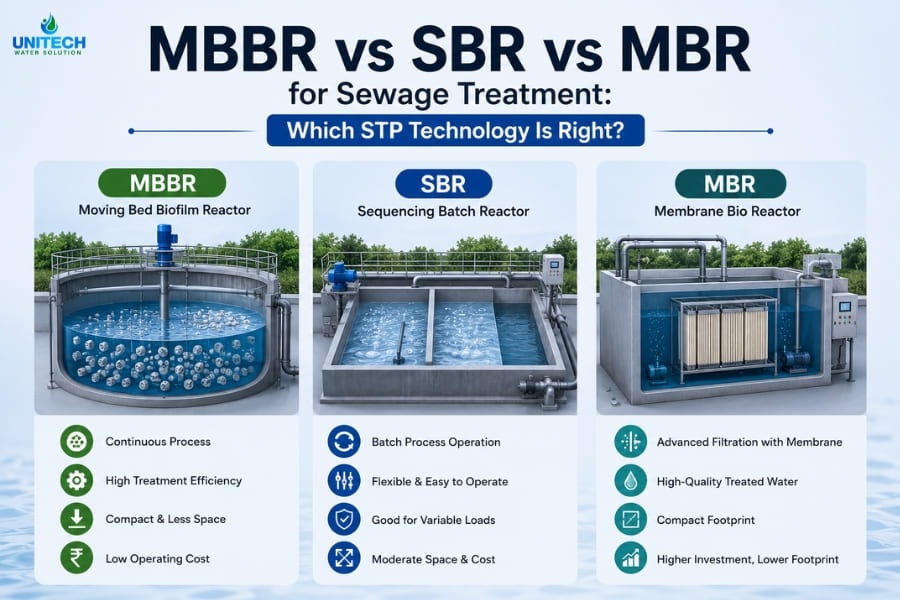
Choosing the right sewage treatment technology is an important decision when setting up a Sewage Treatment Plant (STP) for an apartment, hotel, hospital, commercial building, institution, or other facility. Among the commonly used biological treatment technologies, MBBR, SBR and MBR are three widely considered options.
Although all three can treat sewage effectively, they differ in their treatment process, footprint, automation requirements, treated-water quality, sludge handling, operating complexity and overall investment.
This MBBR vs SBR vs MBR comparison explains how each technology works and where it fits best, helping businesses and facility owners select an STP configuration based on actual wastewater treatment requirements.
What Are MBBR, SBR and MBR?
Before comparing the three technologies, it helps to understand their basic operating principles.
What Is MBBR?
MBBR (Moving Bed Biofilm Reactor) is a biological wastewater treatment process that uses specially designed carrier media inside an aeration tank. Microorganisms grow on the surface of the media and break down biodegradable organic matter present in sewage.
Continuous aeration keeps the media moving within the reactor while supplying oxygen to the microorganisms.
MBBR is commonly considered for:
- Residential buildings
- Hotels and resorts
- Hospitals
- Commercial facilities
- Educational institutions
- Industrial campuses
Its relatively simple operation and ability to handle varying organic loads make MBBR sewage treatment plants a practical choice for many applications.
What Is SBR?
SBR (Sequencing Batch Reactor) treats sewage in batches rather than continuously through separate biological treatment stages. Different treatment activities take place sequentially inside the same reactor.
A typical SBR cycle includes:
- Fill
- React
- Settle
- Decant
- Idle
Because biological treatment and settling can occur within the same reactor, an SBR sewage treatment plant can provide good treatment performance while reducing the need for separate process tanks.
SBR systems are often considered where:
- Consistent treated-water quality is required
- Space needs to be optimized
- Automated process control is acceptable
- Variable wastewater flow needs to be managed
What Is MBR?
MBR (Membrane Bioreactor) combines biological treatment with membrane filtration. Instead of relying primarily on conventional settling for solid-liquid separation, membranes provide a physical barrier that separates treated water from biomass and suspended solids.
An MBR sewage treatment plant can produce high-quality treated water suitable for applications where stringent reuse requirements exist, subject to appropriate treatment and disinfection.
MBR is commonly considered for:
- Space-constrained facilities
- High-quality water reuse
- Commercial developments
- Hospitals and institutions
- Facilities requiring advanced treatment
MBBR vs SBR vs MBR: Key Comparison
The most important differences relate to how each technology performs biological treatment and separates treated water from solids.
| Parameter | MBBR | SBR | MBR |
| Full Form | Moving Bed Biofilm Reactor | Sequencing Batch Reactor | Membrane Bioreactor |
| Biological Process | Biofilm-based | Suspended-growth | Biological + membrane separation |
| Operation | Generally continuous | Batch/sequence-based | Generally continuous |
| Footprint | Moderate | Relatively compact | Compact |
| Automation | Moderate | Higher | Higher |
| Solid Separation | Clarification | Settling within reactor | Membrane filtration |
| Treated Water Quality | Good | Good to very good | Very high |
| Membranes | Not normally required | Not normally required | Required |
| Maintenance | Moderate | Moderate to high | Higher |
| Energy Requirement | Moderate | Moderate | Generally higher |
| Reuse Potential | Depends on polishing | Depends on polishing | Strong potential |
| Typical Application | General sewage treatment | Compact/automated STPs | Advanced reuse & space-constrained sites |
The actual performance and operating cost depend on STP capacity, wastewater characteristics, treatment objectives, equipment configuration and operating conditions.
MBBR vs SBR: How Are They Different?
Both MBBR and SBR use biological treatment, but their operating approaches are different.
MBBR
MBBR uses attached-growth biofilm on carrier media. The reactor can operate continuously, making it suitable for facilities with relatively continuous sewage generation.
Key advantages include:
- Simple biological process
- Good tolerance to varying organic loads
- No need for complex batch sequencing
- Compact compared with some conventional biological systems
- Relatively straightforward operation
SBR
SBR uses a batch treatment cycle, allowing filling, biological reaction, settling and decanting to occur in the same reactor.
Its advantages include:
- Integrated biological treatment and settling
- Good control over treatment cycles
- Compact plant configuration
- Suitable for variable flow conditions
- Automated operation
The better option depends on factors such as flow pattern, available space, operator capability, automation requirements and treated-water quality targets.
MBBR vs MBR: What's the Difference?
The major difference between MBBR and MBR is the final solid-liquid separation process.
MBBR typically relies on a downstream settling or clarification stage to separate treated water from biological solids.
MBR uses membranes for solid-liquid separation.
MBBR may be preferable when:
- A cost-effective biological treatment process is required
- Moderate treated-water quality is sufficient
- Adequate space is available
- Simpler operation is preferred
MBR may be preferable when:
- High-quality treated water is required
- Water reuse is a major objective
- Available installation space is limited
- Very low suspended solids in treated water are required
MBR generally involves greater equipment complexity and membrane maintenance, so the higher treatment capability should be evaluated against the project's operating and investment requirements.
SBR vs MBR: Which Performs Better?
SBR and MBR can both deliver high-quality treatment, but they use fundamentally different methods.
SBR uses timed biological treatment and settling cycles. MBR combines biological treatment with membrane filtration.
SBR advantages
- Compact process configuration
- Automated treatment cycles
- Good biological treatment
- No membrane system
- Suitable for many commercial and institutional applications
MBR advantages
- Excellent solid-liquid separation
- High-quality treated water
- Smaller footprint
- Strong potential for water reuse
- Consistent effluent quality when properly operated
For facilities where treated-water reuse and limited space are major priorities, MBR may offer advantages. Where a simpler biological treatment process meets the required water-quality objectives, SBR can be a practical alternative.
Which Sewage Treatment Technology Is Right for You?
There is no single best STP technology for every project. The appropriate choice depends on the site's wastewater characteristics, available space, required treated-water quality, budget, automation level and intended reuse.
Choose MBBR when:
You need a reliable biological treatment system for general sewage treatment and want a relatively straightforward process that can handle continuous wastewater flow.
Choose SBR when:
You want a compact and automated biological treatment system with integrated treatment cycles and have a wastewater flow pattern that suits batch operation.
Choose MBR when:
High-quality treated water, water reuse and a compact footprint are major priorities, and the project can accommodate membrane operation and maintenance.
What Factors Should You Consider Before Selecting an STP?
Technology selection should happen after evaluating the actual project requirements, rather than selecting a process based only on its name or advertised treatment efficiency.
1. Sewage Flow Rate
Determine the average and peak wastewater flow. STP capacity should account for variations in daily wastewater generation.
2. Wastewater Characteristics
Parameters such as BOD, COD, TSS, pH, nitrogen and other contaminants help determine the appropriate treatment configuration.
3. Available Space
A limited site footprint may favor compact technologies such as SBR or MBR, depending on the overall plant design.
4. Treated Water Quality
If treated water will be reused for flushing, landscaping, cooling or other applications, the required treatment level should be established before selecting the technology.
5. Operating & Maintenance Requirements
Consider operator availability, automation, sludge management, membrane maintenance and spare-part requirements.
6. Long-Term Operating Cost
Don't compare technologies only by initial equipment cost. Evaluate energy consumption, chemical requirements, maintenance, sludge handling and replacement components over the plant's operating life.
MBBR vs SBR vs MBR: Quick Decision Guide
|
If Your Priority Is... |
Consider |
Reliable general sewage treatment |
MBBR |
Continuous biological treatment |
MBBR |
Compact automated treatment |
SBR |
Batch-based treatment control |
SBR |
High-quality treated water |
MBR |
Water reuse |
MBR |
Limited installation space |
SBR / MBR |
Simpler biological process |
MBBR |
These are general selection guidelines. The final STP configuration should be based on wastewater analysis, flow requirements, treated-water objectives and site conditions.
Need Help Selecting the Right STP Technology?
MBBR, SBR and MBR can all be effective when correctly designed for the application. The right choice comes down to your sewage flow, available space, treated-water requirement, reuse objective and operating conditions.
For a project-specific recommendation, share your wastewater flow, facility type and intended treated-water application with the Unitech Water Solutions team.