


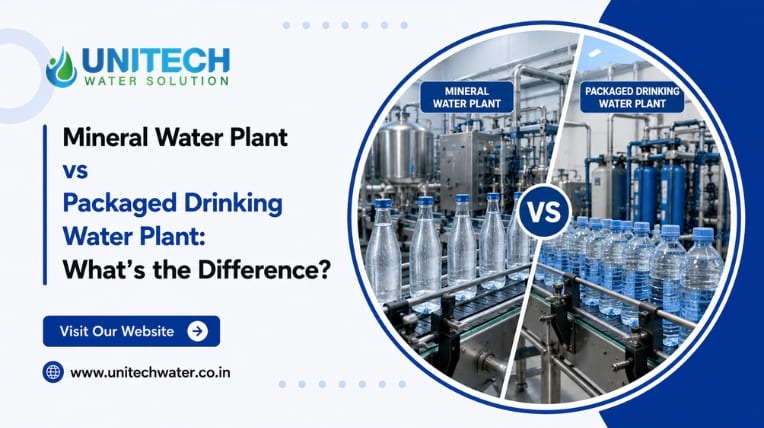
The main difference between a Mineral Water Plant and a Packaged Drinking Water Plant lies in the water source, treatment process, mineral composition, and BIS certification. A Mineral Water Plant bottles naturally occurring mineral water collected from protected underground sources while preserving its natural mineral content. In contrast, a Packaged Drinking Water Plant purifies water from approved sources such as borewells, municipal supply, rivers, or lakes using advanced treatment technologies like reverse osmosis (RO), filtration, UV sterilization, and ozonation to produce safe drinking water.
Although both plants manufacture bottled drinking water, they operate under different BIS standards, require different production processes, and serve different market segments. Choosing between a Packaged Drinking Water Plant and a Mineral Water Plant depends on factors such as your investment budget, available water source, production capacity, regulatory requirements, and target customers.
For entrepreneurs planning to enter the bottled water industry, understanding these differences is essential before investing in a Mineral Water Plant Project, selecting the right Water Plant Machinery, or choosing a reliable Mineral Water Plant Manufacturer.
In this guide, we'll compare both plant types, explain their treatment processes, applicable BIS standards, investment requirements, machinery, and business opportunities to help you choose the right solution for your business.
What Is a Mineral Water Plant?
A Mineral Water Plant is a manufacturing facility that processes natural mineral water obtained from protected underground sources such as springs, wells, or aquifers. Unlike ordinary drinking water, natural mineral water contains naturally occurring minerals like calcium, magnesium, potassium, sodium, and bicarbonates that contribute to its taste and nutritional value.
The primary objective of a Mineral Water Plant is to preserve these naturally occurring minerals while ensuring the water meets stringent safety and quality standards before bottling.
For this reason, the treatment process is carefully designed to remove impurities and microorganisms without significantly altering the natural mineral composition of the water.
Businesses planning to enter the premium bottled water segment often invest in a Mineral Water Plant because consumers associate natural mineral water with higher quality and added health benefits.
What Is Natural Mineral Water?
Natural mineral water originates from protected underground sources where the water naturally absorbs minerals while passing through geological rock formations over many years.
These naturally occurring minerals may include:
- Calcium
- Magnesium
- Potassium
- Sodium
- Bicarbonates
- Sulphates
Unlike purified drinking water, the mineral composition should remain naturally balanced and should not be artificially modified except where permitted under regulatory standards.
Because the source itself determines the water quality, selecting and protecting the water source is one of the most critical aspects of operating a Mineral Water Plant.
How Does a Mineral Water Plant Work?
Although natural minerals are preserved, the water still undergoes several treatment stages to ensure it is microbiologically safe for human consumption.
A typical Mineral Water Plant process includes:
- Raw water collection from a protected underground source
- Storage in hygienic tanks
- Preliminary filtration
- Activated carbon filtration (if required)
- Micron filtration
- UV sterilization
- Ozonation
- Bottle rinsing
- Filling
- Capping
- Labelling
- Packaging
The treatment process is designed to eliminate harmful microorganisms while retaining the water's natural mineral profile.
Many Mineral Water Plant Manufacturers also integrate automated bottling systems to improve production efficiency and maintain hygienic operations.
BIS Standard for Mineral Water
In India, natural mineral water is regulated under:
IS 13428
This standard specifies the requirements for:
- Source protection
- Water quality
- Treatment limitations
- Bottling process
- Packaging
- Labelling
- Microbiological safety
Manufacturers must comply with these standards before marketing natural mineral water commercially.
What Is a Packaged Drinking Water Plant?
A Packaged Drinking Water Plant is a manufacturing facility that treats water obtained from various sources—including borewells, municipal supplies, rivers, lakes, or other approved water sources—to produce safe drinking water suitable for human consumption.
Unlike natural mineral water, Packaged Drinking Water does not depend on naturally occurring minerals. Instead, the focus is on removing contaminants, harmful microorganisms, dissolved salts, unpleasant taste, odor, and suspended particles through advanced purification processes.
This makes a Packaged Drinking Water Plant the preferred choice for entrepreneurs because it offers greater flexibility in sourcing water while serving a much larger market.
What Is Packaged Drinking Water?
Packaged drinking water is purified water that has undergone comprehensive treatment before being filled into bottles, jars, or pouches for sale.
The raw water may come from:
- Borewell water
- Municipal water supply
- River water
- Lake water
- Groundwater
- Other approved sources
Since raw water quality varies significantly, advanced purification becomes essential before bottling.
Treatment Process in a Packaged Drinking Water Plant
The treatment process is more extensive than that used in a natural Mineral Water Plant because the objective is to remove contaminants and produce consistently safe drinking water.
A typical treatment process includes:
- Raw water storage
- Pressure sand filtration
- Activated carbon filtration
- Water softening (if required)
- Micron filtration
- Reverse Osmosis (RO)
- UV sterilization
- Ozonation
- Mineral balancing (where applicable)
- Bottle rinsing
- Filling
- Capping
- Labelling
- Packaging
Modern Water Treatment Plants use fully automated systems to ensure consistent product quality and compliance with regulatory standards.
BIS Standard for Packaged Drinking Water
Packaged drinking water is governed by:
IS 14543:
The standard specifies requirements related to:
- Water quality
- Treatment methods
- Hygienic manufacturing
- Packaging
- Labelling
- Microbiological testing
- Chemical parameters
Businesses manufacturing packaged drinking water must obtain BIS certification before commercial production begins.
Mineral Water Plant vs Packaged Drinking Water Plant
Although both businesses produce bottled water, they differ significantly in terms of water source, treatment technology, regulatory requirements, and target market.
The comparison below provides a quick overview.
|
Feature |
Mineral Water Plant |
Packaged Drinking Water Plant |
|
Water Source |
Natural underground springs or protected aquifers |
Borewell, municipal, river, lake, or groundwater |
|
Main Objective |
Preserve natural minerals |
Purify water for safe drinking |
|
Treatment Process |
Limited treatment to preserve minerals |
Comprehensive purification using RO, UV, Ozonation, and filtration |
|
Mineral Content |
Naturally occurring minerals retained |
Minerals removed during purification; may be rebalanced if required |
|
BIS Standard |
IS 13428 |
IS 14543 |
|
Water Quality |
Naturally mineral-rich |
Purified drinking water |
|
Initial Investment |
Higher due to source protection and compliance |
Moderate and suitable for wider business adoption |
|
Market Position |
Premium bottled water segment |
Mass-market packaged drinking water |
|
Raw Water Flexibility |
Limited to approved natural sources |
Multiple approved water sources |
|
Business Opportunity |
Premium niche market |
Broad commercial market with high demand |
Need Expert Guidance for Your Water Plant Project?
Choosing between a Mineral Water Plant and a Packaged Drinking Water Plant depends on several factors, including your water source, production capacity, budget, BIS certification requirements, and long-term business goals. Selecting the wrong setup can lead to unnecessary investment and operational challenges.
At Unitech Water Solutions, our experts help entrepreneurs and businesses evaluate their requirements and recommend the most suitable solution—from Water Treatment Plants and Water Plant Machinery to complete Turnkey Mineral Water Projects.
Talk to our specialists today for personalized guidance on selecting the right water plant for your business.
Key Differences Explained
While both businesses manufacture bottled drinking water, understanding the practical differences helps entrepreneurs make informed investment decisions.
Water Source
The biggest distinction lies in the origin of the water.
A Mineral Water Plant relies on naturally protected underground water sources rich in naturally occurring minerals. These sources require extensive geological evaluation, protection, and regular monitoring.
A Packaged Drinking Water Plant, however, offers much greater flexibility. Water can be sourced from borewells, municipal supplies, rivers, lakes, or other approved sources, making it easier to establish operations in different locations.
Water Treatment Process
The treatment objectives also differ considerably.
A Mineral Water Plant focuses on preserving the natural mineral composition while ensuring microbiological safety through filtration, UV treatment, and ozonation.
In contrast, a Packaged Drinking Water Plant uses a comprehensive purification process that typically includes reverse osmosis (RO), filtration, UV sterilization, and ozonation to produce safe and consistent drinking water regardless of the source quality.
Mineral Composition
Natural mineral water retains its original mineral profile, which contributes to its distinctive taste and premium positioning.
Packaged drinking water undergoes purification that removes dissolved impurities and, in many cases, minerals as well. Depending on the production process, certain minerals may be adjusted afterward to improve taste and meet applicable quality standards.
Regulatory Standards
The regulatory framework is another important difference.
- Mineral Water Plant → BIS IS 13428
- Packaged Drinking Water Plant → BIS IS 14543
Each standard has specific requirements related to source protection, treatment, testing, packaging, and labelling.
Investment and Business Opportunity
Entrepreneurs should also consider investment requirements and market demand.
A Mineral Water Plant generally requires a higher initial investment due to the need for protected natural water sources and stricter compliance requirements. It primarily serves the premium bottled water segment.
A Packaged Drinking Water Plant is more flexible in terms of raw water sourcing and caters to a much broader consumer market, making it a popular choice for startups and businesses entering the bottled water industry.
Which Plant Is Better for Entrepreneurs?
Choosing between a Mineral Water Plant and a Packaged Drinking Water Plant depends on your investment capacity, water source, target market, and long-term business objectives. Both business models have strong growth potential, but they cater to different market segments.
A Packaged Drinking Water Plant is generally considered the better option for first-time entrepreneurs because it offers greater flexibility in sourcing raw water and serves a broader customer base. The demand for packaged drinking water continues to rise across residential, commercial, institutional, and industrial sectors, making it an attractive business opportunity.
On the other hand, a Mineral Water Plant targets the premium bottled water market. Since it requires access to naturally protected mineral water sources and compliance with stricter regulations, the initial investment is typically higher. However, businesses can command premium pricing by positioning their products as natural mineral water.
Choose a Packaged Drinking Water Plant if You:
- Want to start with moderate investment
- Have access to borewell or municipal water
- Plan to serve retail and commercial markets
- Need flexibility in production capacity
- Want faster market entry
Choose a Mineral Water Plant if You:
- Have access to a certified natural mineral water source
- Target the premium bottled water segment
- Want to build a premium beverage brand
- Can invest in higher regulatory compliance
- Aim for long-term brand positioning
For many startups, investing in a Turnkey Mineral Water Project allows them to receive complete support—from plant design and equipment selection to installation, commissioning, and operator training.
Machinery Required for Both Plants
Although the treatment processes differ, many of the production and packaging machines used in both plants are similar. Selecting high-quality Water Plant Machinery improves production efficiency, product quality, and operational reliability.
Common Machinery Used
-
Raw Water Storage Tanks
Store incoming raw water before treatment.
-
Water Treatment Plant
Removes physical, chemical, and biological impurities to ensure safe drinking water.
-
Mineral Water Filling Machine
Automatically fills purified water into PET bottles while maintaining hygiene and production accuracy.
-
Automatic PET Bottle Filling Machine
Integrates bottle rinsing, filling, and capping into a single automated system, increasing productivity and minimizing human contact.
-
Blow Moulding Machine
Manufactures PET bottles from preforms, allowing businesses to produce bottles in-house and reduce packaging costs.
-
Labelling Machine
Applies labels accurately to bottles, improving product presentation and ensuring compliance with packaging standards.
-
Shrink Wrapping Machine
Bundles bottles into transport-ready packs, protecting products during storage and distribution.
-
Additional Equipment
Depending on production capacity, businesses may also require:
- Ozonation System
- UV Sterilization Unit
- Air Compressor
- Bottle Conveyor
- Bottle Inspection System
- Batch Coding Machine
- Quality Testing Laboratory
- Packaging Conveyor
Choosing reliable Water Plant Machinery from an experienced manufacturer helps minimize downtime while improving production efficiency and product consistency.
How to Choose the Right Plant for Your Business
Before investing in a Mineral Water Plant Project or Packaged Drinking Water Plant, carefully evaluate the following factors.
Budget
Investment varies depending on:
- Plant capacity
- Automation level
- Water source
- Packaging line
- Infrastructure
Start with a system that aligns with your business goals while allowing room for future expansion.
Water Source Availability
The quality and availability of raw water play a major role in selecting the right business model.
If you have access to a certified natural mineral water source, a Mineral Water Plant may be suitable. Otherwise, a Packaged Drinking Water Plant offers greater flexibility by allowing treatment of approved water sources.
Production Capacity
Estimate your expected daily production.
Common plant capacities include:
Selecting the right capacity ensures efficient resource utilization while supporting future business growth.
Target Market
Identify your primary customer segment.
Examples include:
- Retail stores
- Supermarkets
- Hotels
- Restaurants
- Hospitals
- Educational institutions
- Corporate offices
- Industrial clients
Understanding market demand helps determine the appropriate plant configuration and production volume.
Future Expansion
Choose equipment that allows future upgrades as demand increases.
Modern Fully Automatic Mineral Water Plant solutions can be expanded by increasing treatment capacity, packaging lines, and automation levels without replacing the complete production system.
Why Choose Unitech Water Solutions?
Establishing a successful bottled water business requires more than purchasing machinery—it requires the right technical expertise, quality equipment, and long-term support.
With over 20 years of industry experience, Unitech Water Solutions has helped businesses across India establish reliable and profitable bottled water manufacturing facilities.
Our Solutions Include:
- Mineral Water Plant
- Packaged Drinking Water Plant
- Mineral Water Bottling Plant
- Water Treatment Plants
- Water Plant Machinery
- Fully Automatic Mineral Water Plant
- Turnkey Mineral Water Project
- Bottle Filling and Packaging Solutions
Why Businesses Choose Us:
✔ Established in 2004
✔ ISO-certified manufacturing processes
✔ Customized turnkey solutions
✔ Advanced automation technology
✔ High-quality machinery and components
✔ Installation and commissioning support
✔ Operator training
✔ Genuine spare parts
✔ Annual Maintenance Services
✔ PAN India technical support
Whether you're planning a new Packaged Drinking Water Plant or upgrading an existing Mineral Water Plant, our team delivers customized solutions designed to maximize productivity, efficiency, and long-term profitability.
Conclusion
Although Mineral Water Plants and Packaged Drinking Water Plants both produce bottled drinking water, they serve different purposes and operate under different regulatory standards. A Mineral Water Plant focuses on preserving naturally occurring minerals from protected underground sources and caters to the premium bottled water market. In contrast, a Packaged Drinking Water Plant purifies water from approved sources using advanced treatment technologies, making it suitable for large-scale commercial distribution.
Before making an investment, evaluate your available water source, budget, production capacity, target market, and long-term business objectives. Selecting the right Water Plant Machinery, obtaining the necessary BIS certifications, and partnering with an experienced manufacturer are critical steps toward building a successful bottled water business.
Start Your Water Business with Unitech Water Solutions
Whether you're planning to establish a Mineral Water Plant, a Packaged Drinking Water Plant, or a complete Turnkey Mineral Water Project, Unitech Water Solutions offers end-to-end solutions tailored to your business needs.
From plant design and manufacturing to installation, commissioning, operator training, and after-sales support, our experienced team is committed to helping you build an efficient, compliant, and profitable bottled water business.
Contact Unitech Water Solutions today to discuss your project requirements and receive expert guidance on selecting the ideal water treatment and bottling solution for your business.