


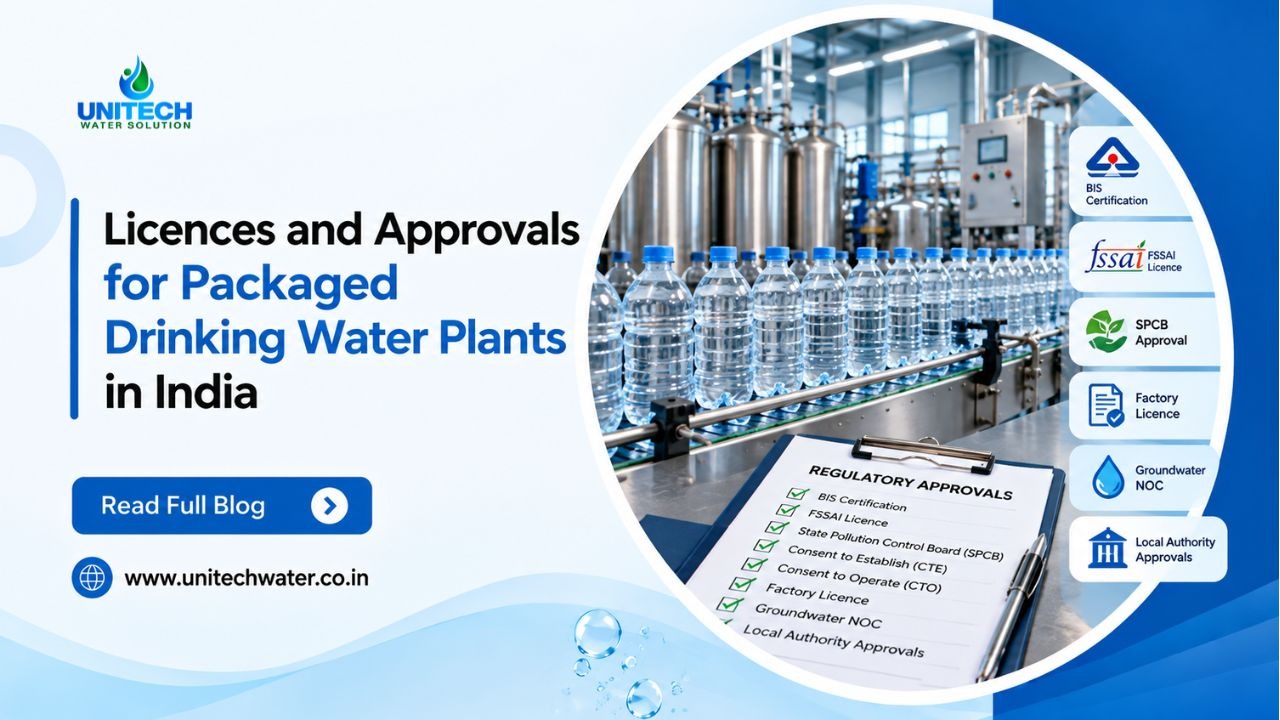
Starting a packaged drinking water business in India involves more than installing an RO plant and buying bottling machinery. You also need to meet food safety standards, complete the required licensing process, test your water quality, and secure the approvals that apply to your location and water source.
Getting a packaged drinking water plant license may feel complicated at first because different authorities handle different requirements. FSSAI manages food safety licensing, while local authorities, pollution control boards, and groundwater regulators may also be involved, depending on your plant's location and operations.
There is also an important change entrepreneurs should understand: BIS certification is no longer universally mandatory for packaged drinking water under the former FSSAI requirement. However, manufacturers must follow the applicable FSSAI rules and testing scheme.
This guide explains the main approvals, application documents, water testing obligations, and potential costs. It will help you plan your project before investing in machinery or beginning commercial production.
Which Licences and Approvals Does a Packaged Drinking Water Plant Need?
A packaged drinking water plant may require several approvals, depending on its location, water source, production activity, and business structure. Start with the food safety licence, then confirm the other requirements with the relevant authorities.
|
Licence or approval |
Purpose |
Who should check it? |
|
FSSAI registration or licence |
Authorises the applicable food business activity |
Every manufacturer |
|
Water quality testing |
Checks source water and finished product quality |
Every manufacturer |
|
Groundwater NOC |
Regulates groundwater extraction where applicable |
Businesses using borewells or groundwater |
|
Pollution control consent |
Addresses applicable environmental requirements |
Plants covered by state pollution rules |
|
Local trade or factory approvals |
Covers local business and premises requirements |
As required by local and state rules |
|
Business registration |
Establishes the legal business entity |
Based on the chosen business structure |
|
Fire and building approvals |
Addresses site safety and permitted use |
Where applicable |
Important: This is a planning checklist, not a universal list of compulsory approvals. Requirements differ by state, district, site, and source of water.
1. FSSAI Licence for Packaged Drinking Water Plant
The FSSAI licence is a central part of the compliance process for a packaged drinking water manufacturer. Applications are handled through the Food Safety Compliance System (FoSCoS), which provides the relevant eligibility criteria, document lists, and application process.
How do you choose the correct FSSAI licence?
The correct registration or licence depends on the applicable eligibility rules for your business activity. Do not choose a category based only on the size of your RO machine or the number of bottles you plan to produce.
Use the officialFoSCoS portal to check the current category and eligibility criteria for manufacturing packaged drinking water.
Packaged drinking water and mineral water fall under high-risk food categories. FSSAI's November 2024 order introduced mandatory pre-licence or pre-registration inspections for the relevant manufacturers and processors. Plan for inspection when scheduling your launch.
Documents required for a packaged drinking water plant license
Prepare these documents before beginning the application. The exact list depends on your application category and the current FoSCoS requirements.
- Completed application form, including Form B where applicable.
- Identity and address proof of the proprietor or authorised signatory.
- Business constitution documents, such as a partnership deed or company incorporation documents.
- Proof of possession of the premises, such as a rent agreement or ownership document.
- Factory layout showing production areas and their dimensions.
- List of machinery, equipment, installed capacity, and relevant technical details.
- Chemical and bacteriological analysis of the source water from a recognised laboratory, as required.
- Pesticide residue test report for the water, as specified in the application requirements.
- Food Safety Management System (FSMS) plan or relevant declaration.
- Applicable local-body NOCs and other supporting documents.
- Recall plan and details of the responsible person, where required.
The officialFoSCoS State Licence document checklist provides further details.
2. BIS Certification for Packaged Drinking Water: Current Rules
This is one area where outdated online articles can mislead new business owners.
Is BIS certification mandatory in India?
As of October 2026, the former mandatory BIS certification requirement under the relevant FSSAI sales regulations has been removed for packaged drinking water and packaged natural mineral water. FSSAI's testing scheme, effective from 1 January 2026, now sets out testing and record-keeping requirements for these products.
The applicable Indian Standards remain relevant to product quality, but the distinction is important: a product standard and a compulsory certification requirement are not the same thing.
|
Question |
Current position |
|
Is the old blanket BIS requirement still in force under FSSAI rules? |
No; it was removed in October 2024 |
|
Must manufacturers follow applicable food safety standards? |
Yes |
|
Is routine water quality testing still required? |
Yes |
|
Should you check the latest BIS and FSSAI notifications? |
Yes, before applying or investing |
BIS lists IS 14543 for packaged drinking water and IS 13428 for packaged natural mineral water among standards whose compulsory certification status has been removed in the relevant scheme. Check the latest official notifications for your exact product and circumstances.
Practical tip: Do not pay a consultant for a supposed mandatory BIS licence without first verifying the current requirement. A voluntary certification or a separate buyer requirement may be a different matter.
3. Water Testing and Quality Requirements
Water testing is not a one-time task completed before opening the plant. Manufacturers must maintain a testing schedule, keep records, and respond to any non-compliant results.
What water tests should you plan for?
FSSAI's testing scheme requires source water to be tested for the prescribed parameters before use, through an FSSAI-notified NABL-accredited laboratory meeting the specified requirements. It also sets out testing frequencies for finished products and packaging materials.
Your compliance plan should cover:
- Source water: Test the raw water against the applicable packaged drinking water standard before using it.
- Microbiological quality: Follow the prescribed checks for harmful microorganisms.
- Chemical parameters: Test the relevant substances and residues at the required intervals.
- Packaging materials: Maintain the required checks and records for bottles, jars, caps, and other packaging.
- Batch records: Keep test reports and production records available for inspection.
The current scheme includes monthly controls for specified microbiological parameters and certain chemical parameters, while broader testing requirements apply at six-monthly intervals. The precise schedule varies by parameter and packaging type. Review the officialFSSAI testing scheme before setting up your quality-control calendar.
4. State and Local Approvals You May Need
FSSAI approval does not automatically replace environmental, groundwater, or local permissions. Check these requirements before finalising your factory site.
Groundwater extraction permission
If your plant will use groundwater from a borewell, determine whether you need a No Objection Certificate (NOC) from the Central Ground Water Authority (CGWA) or the relevant state groundwater authority.
Requirements can vary by location and groundwater status. Do not assume that an existing borewell or land ownership automatically permits commercial extraction.
Pollution control consent
Contact your State Pollution Control Board or Pollution Control Committee to determine whether your proposed plant requires Consent to Establish, Consent to Operate, or other environmental permissions.
The answer depends on the applicable state rules, project classification, and activities at the premises. Explain your treatment process, wastewater generation, and proposed disposal arrangements when seeking guidance.
Local business and factory permissions
Depending on the site and business structure, you may also need:
- Local municipal or panchayat trade permission.
- Approved building use and relevant occupancy documents.
- Factory registration or licence, where applicable.
- Fire safety approval, where required.
- GST registration and other tax registrations applicable to your business.
Before signing a long-term lease, confirm that the premises can legally support the proposed manufacturing activity. This simple check can prevent costly changes later.
5. Packaged Drinking Water Plant Licence Cost
The total approval budget depends on the application category, testing scope, location, and permissions involved. There is no single licence cost that applies to every packaged drinking water plant.
What expenses should you include?
|
Expense category |
What affects the cost? |
|
FSSAI application fee |
Applicable registration or licence category and current fee schedule |
|
Water testing |
Number of parameters, laboratory, and testing frequency |
|
Groundwater permissions |
Applicable authority, application requirements, and site conditions |
|
Pollution control consent |
State rules and project classification |
|
Local permissions |
Local authority and type of approval |
|
Professional assistance |
Whether you use a consultant or handle applications yourself |
|
Document preparation |
Drawings, technical reports, and supporting records |
Check the current official fee schedule before budgeting. Treat consultant charges separately from government fees, and request an itemised estimate for testing and other approvals.
For a reliable estimate, identify your state, source of water, production activity, premises, and applicable licence category first.
Conclusion
Planning a packaged drinking water plant in India? Unitech Water Solution can help you explore suitable water treatment systems and production configurations for your project.
Discuss your required capacity, water source, and site requirements with the team, then confirm the applicable licences and approvals with the relevant authorities before proceeding.
Frequently Asked Questions
A packaged drinking water manufacturer must obtain the applicable FSSAI registration or licence before operating, based on its eligibility. The manufacturer must also meet applicable food safety, testing, hygiene, and record-keeping requirements.
Check the current eligibility criteria through the officialFoSCoS portal before submitting an application.
The former blanket requirement for mandatory BIS certification under the relevant FSSAI sales regulations was removed in October 2024. FSSAI's testing scheme became effective on 1 January 2026. Manufacturers must still comply with applicable product standards and testing rules. Check current notifications for any separate certification or contractual requirement affecting your product.
Typical documents include the application form, identity proof, premises documents, factory layout, machinery list, source water analysis, pesticide residue report, and food safety management information. Companies may also need incorporation and authorised-signatory documents. The exact list depends on the selected business category and application type. Refer to the official FoSCoS checklist before filing.
There is no universal fee for every plant. The total depends on the FSSAI category, testing requirements, groundwater permissions, pollution control consent, and local approvals. Professional fees and document preparation can add to the budget. Verify government fees with the relevant authorities and obtain separate estimates for laboratory testing and consultancy.
Groundwater permission may be required when a plant extracts water from a borewell or another regulated groundwater source. The applicable authority and conditions depend on the location and groundwater regulations. Confirm the requirements with the CGWA or relevant state authority before installing or using an extraction system.
The timeline varies with the licence category, document completeness, inspection requirements, laboratory reports, and other permissions. Packaged drinking water manufacturers are subject to mandatory pre-licence or pre-registration inspection under the relevant FSSAI high-risk category rules. Build time for corrections and follow-up into your launch plan instead of relying on a fixed approval deadline.
Do not assume that submitting an application gives you permission to manufacture and sell packaged drinking water. Confirm the applicable authorisation requirements and wait until the necessary approvals are in place. Also complete the required testing and establish compliant production and packaging controls before launching your product.