



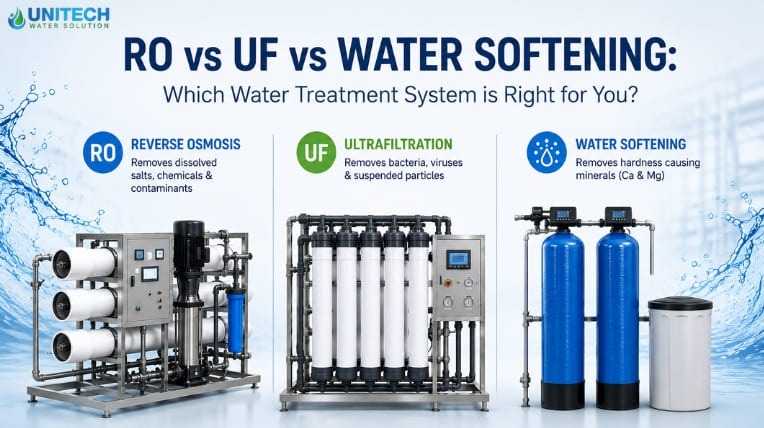
Choosing the right Water Treatment System can be confusing, especially when you're comparing RO vs UF vs Water Softening. While these technologies are often discussed together, they are designed to solve different water quality problems. Reverse Osmosis (RO) removes dissolved salts and reduces Total Dissolved Solids (TDS), Ultra Filtration (UF) removes suspended particles and microorganisms without reducing TDS, and Water Softening eliminates hardness-causing minerals such as calcium and magnesium to prevent scale formation.
Understanding the difference between these systems is important because selecting the wrong technology can lead to poor water quality, unnecessary operating costs, or equipment damage. For example, installing an RO system where only hard water treatment is required may increase maintenance costs, while using only a water softener for high-TDS water won't improve drinking water quality.
In this guide, we'll compare RO vs UF vs Water Softening, explain how each Water Purification System works, highlight their applications, and help you determine which solution is best for your home, commercial facility, or industrial operation.
What is Reverse Osmosis (RO)?
Reverse Osmosis (RO) is one of the most effective water purification technologies used to remove dissolved salts, heavy metals, chemicals, bacteria, viruses, and other impurities from water. It works by forcing water through a semi-permeable RO membrane, allowing only purified water molecules to pass while rejecting contaminants.
An Industrial RO Plant is commonly installed where raw water has high TDS levels or where purified process water is essential for manufacturing, food processing, pharmaceuticals, hospitality, and packaged drinking water production.
RO is Best For:
- High TDS Borewell Water
- Industrial Water Purification
- Packaged Drinking Water Plants
- Food & Beverage Manufacturing
- Pharmaceutical Industries
- Commercial Drinking Water Applications
Advantages of RO
- Removes dissolved salts and minerals
- Reduces TDS significantly
- Produces high-quality drinking water
- Removes bacteria, viruses, and heavy metals
- Suitable for industrial and commercial applicati
What is Ultra Filtration (UF)?
Ultra Filtration (UF) is a membrane-based Water Treatment System designed to remove suspended solids, bacteria, algae, and larger microorganisms from water. Unlike Reverse Osmosis, UF does not reduce TDS because dissolved minerals pass through the membrane.
Since the natural mineral content remains unchanged, Ultra Filtration Plants are widely used where the incoming water already has acceptable TDS levels but requires improved microbiological quality and particle removal.
UF systems are frequently installed as standalone treatment units or as pretreatment before RO systems to improve membrane life and overall system performance.
UF is Best For:
- Municipal Water Supply
- Surface Water Treatment
- Pretreatment Before RO
- Food Processing Industries
- Hotels & Commercial Buildings
- Process Water Applications
Advantages of UF
- Removes bacteria and suspended particles
- Retains natural minerals
- Lower operating cost than RO
- Minimal water wastage
- Simple maintenance
One important point to remember in the RO vs UF comparison is that a UF system cannot remove dissolved salts or reduce high TDS water. If your water source contains excessive dissolved minerals, an Industrial RO Plant remains the more suitable option.
What is Water Softening?
Unlike RO and UF systems, a Water Softening Plant is specifically designed to remove hardness-causing minerals such as calcium and magnesium through an ion exchange process. Instead of reducing TDS or filtering microorganisms, it replaces hardness minerals with sodium ions, preventing scale formation in pipelines, boilers, cooling towers, and industrial equipment.
Hard water can significantly reduce equipment efficiency and increase maintenance costs due to scale buildup. Installing a Water Softening Plant helps extend equipment life while improving operational efficiency in commercial and industrial facilities.
Water Softening is Best For:
- Hard Borewell Water
- Boilers
- Cooling Towers
- Manufacturing Industries
- Hotels & Hospitals
- Laundry Applications
Advantages of Water Softening
- Removes water hardness
- Prevents scale formation
- Improves equipment efficiency
- Reduces maintenance costs
- Extends equipment lifespan
It's important to note that a Water Softening Plant does not remove dissolved salts, bacteria, or suspended impurities. Its primary function is to treat hard water by eliminating calcium and magnesium that cause scaling.
RO vs UF vs Water Softening: Quick Comparison
Choosing between RO vs UF vs Water Softening becomes much easier when you compare what each technology is designed to do.
|
Feature |
Reverse Osmosis (RO) |
Ultra Filtration (UF) |
Water Softening |
|
Removes TDS |
✔ Yes |
✘ No |
✘ No |
|
Removes Hardness |
Partial |
✘ No |
✔ Yes |
|
Removes Bacteria & Viruses |
✔ Yes |
✔ Most Microorganisms |
✘ No |
|
Removes Suspended Particles |
✔ Yes |
✔ Yes |
✘ No |
|
Primary Purpose |
Water Purification |
Particle & Microbial Filtration |
Hardness Removal |
|
Best Water Source |
High-TDS Borewell Water |
Municipal or Surface Water |
Hard Water |
|
Typical Applications |
Drinking Water, Industrial Processes |
Pretreatment & Commercial Use |
Boilers, Cooling Towers, Process Water |
This comparison highlights that there is no single "best" Water Treatment System. The right solution depends entirely on your water quality, treatment objectives, and application requirements.
Which Water Treatment System Should You Choose?
Selecting between RO vs UF vs Water Softening should always begin with a proper water quality analysis rather than assumptions. Each technology addresses a different issue, and understanding your water source is the key to choosing the most effective treatment solution.
Choose Reverse Osmosis (RO) if…
- Your water has high TDS levels.
- You require purified drinking or processed water.
- Dissolved salts, heavy metals, and chemical contaminants need to be removed.
- You're installing a system for industrial or commercial water purification.
Choose Ultra Filtration (UF) if…
- Your water has acceptable TDS but contains suspended impurities or microorganisms.
- You want to retain natural minerals.
- You're looking for a low-maintenance filtration solution.
- UF will be used as pretreatment before an RO system.
Choose Water Softening if…
- Your water contains excessive hardness.
- Scale formation is damaging boilers, cooling towers, or pipelines.
- You want to improve equipment efficiency and reduce maintenance costs.
- Hardness removal is your primary objective.
Can RO, UF & Water Softening Work Together?
Yes. In many commercial and industrial applications, these technologies are not alternatives—they complement each other. Since each system addresses a different water quality issue, combining them often produces better results than relying on a single treatment method.
A typical water treatment sequence is:
Raw Water → Water Softening → Ultra Filtration (UF) → Reverse Osmosis (RO) → Treated Water Storage
Here's how each stage contributes to the overall treatment process:
- Water Softening removes hardness-causing minerals such as calcium and magnesium, protecting downstream equipment from scale formation.
- Ultra Filtration (UF) filters suspended particles, bacteria, and other contaminants, reducing the load on the RO membrane.
- Reverse Osmosis (RO) removes dissolved salts, heavy metals, and other dissolved impurities to produce high-quality purified water.
This integrated approach is widely used in industries such as food processing, pharmaceuticals, beverage manufacturing, hotels, hospitals, and packaged drinking water plants because it improves treatment efficiency, extends equipment life, and reduces maintenance costs.
Still Confused About Which Water Treatment System You Need?
Choosing the right Water Treatment System isn't about selecting the most advanced technology—it's about selecting the one that matches your water quality and application.
At Unitech Water Solutions, we analyze your raw water, TDS level, hardness, and treatment objectives before recommending the most suitable solution. Whether you need an Industrial RO Plant, Ultra Filtration Plant, or Water Softening Plant, our experts can design a customized system that delivers reliable performance and long-term value.
Final Verdict: Which Water Treatment System is Right for You?
The comparison of RO vs UF vs Water Softening shows that each technology serves a different purpose. Rather than asking which one is "better," the more important question is which one solves your specific water quality problem.
|
If Your Water Problem Is… |
Recommended Solution |
|
High TDS and dissolved salts |
Industrial RO Plant |
|
Suspended particles and microorganisms |
Ultra Filtration Plant |
|
Hard water causing scale formation |
Water Softening Plant |
|
Multiple water quality issues |
Combined Water Treatment System |
As a general rule:
- Choose Reverse Osmosis (RO) when water purification and TDS reduction are required.
- Choose Ultra Filtration (UF) when you need to remove suspended impurities while retaining natural minerals.
- Choose Water Softening when hardness is damaging equipment and reducing operational efficiency.
- Consider a combined treatment system if your water contains multiple contaminants.
The most effective solution is always based on a detailed water analysis rather than assumptions.
Why Choose Unitech Water Solutions?
With more than 16 years of experience, Unitech Water Solutions designs and manufactures customized Water Treatment Systems for commercial and industrial applications across India.
We provide complete solutions, including:
- Industrial RO Plants
- Ultra Filtration Plants
- Water Softening Plants
- Filtration Systems
- Complete Turnkey Water Treatment Projects
Why Customers Choose Us
- ✔ Customized Water Treatment Solutions
- ✔ Advanced Treatment Technologies
- ✔ Turnkey Project Execution
- ✔ Installation & Commissioning
- ✔ PAN India Technical Support
- ✔ Experienced Engineering Team
- ✔ Reliable After-Sales Service
Our experts evaluate your water quality and recommend the most suitable treatment process based on performance, operating costs, and future scalability.
Need Help Choosing the Right Water Treatment System?
Every water source has a unique composition, and selecting the wrong treatment technology can lead to unnecessary operating costs, poor water quality, and reduced equipment life.
At Unitech Water Solutions, we help businesses identify the right solution through detailed water analysis and customized system design. Whether you need an Industrial RO Plant, Ultra Filtration Plant, or Water Softening Plant, our engineers will recommend a solution tailored to your application and water quality.
Frequently Asked Questions
Not necessarily. RO is ideal for reducing TDS and dissolved salts, while UF is better suited for removing suspended particles and microorganisms when TDS levels are already acceptable. The right choice depends on your water quality and application.
No. A Water Softening Plant removes hardness-causing minerals such as calcium and magnesium but does not reduce Total Dissolved Solids (TDS). If TDS reduction is required, an Industrial RO Plant is the appropriate solution.
No. Ultra Filtration removes suspended particles, bacteria, and larger impurities but does not remove calcium and magnesium that cause water hardness. A Water Softening Plant is specifically designed for hardness removal.
Yes. In many industrial applications, a Water Softening Plant is installed before an Industrial RO Plant to protect RO membranes from scaling and improve overall system performance.
It depends on the water analysis. If borewell water has high TDS, an Industrial RO Plant is generally recommended. If the main issue is hardness, a Water Softening Plant may be sufficient. Where both high TDS and hardness are present, a combination of Water Softening, Ultra Filtration, and RO often provides the best results.