



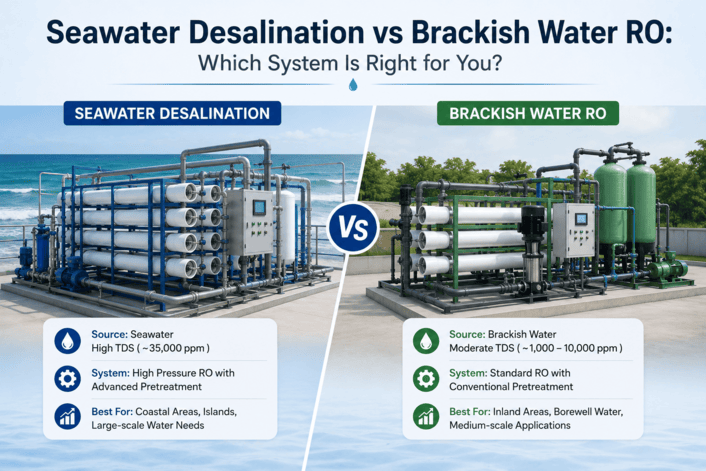
Choosing between seawater desalination vs brackish water RO depends mainly on the quality of your feed water, required treated-water capacity, salinity, operating conditions, and intended application.
Both systems use reverse osmosis (RO) membranes to remove dissolved salts and other contaminants, but seawater contains significantly higher salt concentrations than brackish water. As a result, a seawater RO plant (SWRO) generally requires higher operating pressure, more intensive pretreatment and greater energy input than a brackish water RO plant (BWRO).
Understanding the difference between SWRO and BWRO can help industries, commercial facilities and infrastructure projects select the appropriate desalination system.
What Is Seawater RO?
Seawater RO (SWRO) is a reverse osmosis desalination process designed to treat seawater and convert it into freshwater.
Seawater contains high concentrations of dissolved salts, with TDS commonly far higher than typical freshwater or brackish sources. The RO membrane must therefore operate under sufficiently high pressure to overcome the naturally high osmotic pressure of seawater.
A typical seawater desalination system can include:
- Seawater intake
- Screening
- Pretreatment
- Cartridge filtration
- High-pressure pump
- RO membrane system
- Energy recovery equipment
- Post-treatment
- Treated-water storage
SWRO systems are used for applications where seawater is the primary available water source, including coastal industrial facilities, municipalities, infrastructure projects and other water-supply applications.
What Is Brackish Water RO?
A brackish water RO plant treats water that contains more dissolved salts than freshwater but considerably less salinity than seawater.
Brackish water can originate from:
- Brackish groundwater
- Wells
- Surface-water sources
- Coastal aquifers
- Certain industrial water sources
Because the salinity and osmotic pressure are generally lower than seawater, BWRO systems typically operate at lower pressures than SWRO systems.
A typical BWRO system may include:
- Feed-water tank
- Pretreatment
- Multimedia filtration
- Cartridge filtration
- High-pressure pump
- RO membranes
- Post-treatment
- Storage and distribution
The exact configuration depends on the feed-water analysis and required treated-water quality.
Seawater Desalination vs Brackish Water RO: Key Differences
The fundamental difference between SWRO vs BWRO is the salinity of the feed water and the resulting operating requirements.
|
Factor |
Seawater RO (SWRO) |
Brackish Water RO (BWRO) |
|
Feed Water |
Seawater |
Brackish water |
|
Salinity |
Very high |
Moderate |
|
TDS |
Typically very high |
Lower than seawater |
|
Osmotic Pressure |
High |
Lower |
|
Operating Pressure |
Higher |
Lower |
|
Energy Requirement |
Generally higher |
Generally lower |
|
Pretreatment |
More demanding |
Usually less demanding |
|
Membrane Stress |
Higher |
Lower |
|
Recovery |
Feed-water dependent |
Feed-water dependent |
|
Typical Application |
Coastal/desalination projects |
Groundwater and brackish sources |
|
Main Challenge |
High salinity and fouling |
Variable water quality and scaling |
Actual operating pressure, recovery and energy consumption depend on feed-water chemistry, temperature, membrane selection, system design and required recovery.
Difference Between SWRO and BWRO Feed Water
Feed-water quality is the first factor to consider when selecting between these systems.
Seawater
Seawater has high salinity and high dissolved-solids concentration. Its elevated osmotic pressure means the RO system requires significantly higher pressure to separate freshwater from the dissolved salts.
Seawater can also contain:
- Suspended solids
- Organic matter
- Microorganisms
- Algae
- Colloidal particles
Therefore, pretreatment is particularly important for protecting the RO membranes.
Brackish Water
Brackish water has lower salinity than seawater, but its chemistry can vary significantly depending on the source.
It may contain:
- Dissolved salts
- Hardness
- Iron
- Silica
- Suspended solids
- Organic matter
- Microbiological contaminants
A water analysis is therefore essential before designing a brackish water reverse osmosis system.
SWRO vs BWRO: Operating Pressure
One of the most important technical differences between seawater RO vs brackish water RO is operating pressure.
Because seawater has greater salinity and therefore higher osmotic pressure, the RO system needs substantially higher feed pressure to drive water through the membrane.
BWRO systems generally require lower pressure because the osmotic pressure of brackish water is lower.
This difference affects:
- High-pressure pump selection
- Energy consumption
- System design
- Operating cost
- Membrane configuration
- Equipment sizing
For this reason, an SWRO system should not simply be treated as a larger version of a conventional BWRO plant.
Energy Consumption: SWRO vs BWRO
Energy is an important consideration when evaluating a seawater desalination plant.
SWRO generally consumes more energy because of:
- Higher feed-water salinity
- Higher osmotic pressure
- Higher operating pressure
- More demanding pretreatment
- Seawater intake requirements
Modern SWRO systems can incorporate energy recovery devices to recover hydraulic energy from the high-pressure reject stream and improve overall energy efficiency.
BWRO generally requires less energy because its operating pressure is lower, although actual energy consumption depends on the feed-water TDS, recovery, temperature, membrane configuration and plant design.
Pretreatment Requirements
Pretreatment protects RO membranes from contaminants that can cause fouling, scaling or premature performance loss.
SWRO Pretreatment
Seawater desalination typically requires careful pretreatment because seawater may contain suspended particles, microorganisms, organic matter and other contaminants.
Depending on the feed-water quality, pretreatment can involve:
- Screening
- Coagulation/flocculation
- Media filtration
- Ultrafiltration
- Cartridge filtration
- Disinfection or other conditioning
The objective is to provide suitable feed water to the RO membranes.
BWRO Pretreatment
BWRO pretreatment depends heavily on the source.
For groundwater, treatment may need to address:
- Iron
- Manganese
- Hardness
- Turbidity
- Suspended solids
- Silica
A suitable pretreatment system is selected after analyzing the feed water.
Membrane Fouling and Scaling
Membrane fouling and scaling are concerns in both systems, but the nature and severity can differ.
Fouling can occur when suspended solids, organic matter or microorganisms accumulate on the membrane surface.
Scaling occurs when dissolved minerals precipitate on the membrane.
Common scaling concerns can involve compounds containing:
- Calcium
- Magnesium
- Silica
- Sulphates
- Carbonates
Proper pretreatment, antiscalant dosing where appropriate, operating control and regular membrane cleaning can help maintain RO performance.
Read the full guide:How to Increase Industrial RO Plant Life
Recovery Rate in SWRO and BWRO
Recovery rate represents the proportion of feed water converted into treated permeate.
For example, if 100 units of feed water produce 40 units of permeate, the recovery is 40%.
Recovery depends on:
- Feed-water chemistry
- TDS
- Scaling potential
- Membrane characteristics
- Operating pressure
- Temperature
- Desired water quality
SWRO and BWRO should therefore not be compared solely on a fixed recovery percentage. The practical recovery target should be determined from the feed-water analysis and system design.
Which System Has Lower Operating Cost?
In general, BWRO tends to have lower operating energy requirements than SWRO because it operates at lower pressure.
However, total operating cost includes more than electricity.
Important cost factors include:
- Feed-water pumping
- High-pressure pumping
- Pretreatment chemicals
- Cartridge filters
- Membrane replacement
- Cleaning chemicals
- Maintenance
- Energy recovery
- Reject-water management
- Post-treatment
For SWRO, seawater intake and brine management can also add significant infrastructure and operating considerations.
Therefore, the lowest-cost system is not determined simply by selecting the technology with the lower pressure requirement.
Seawater RO vs Brackish Water RO: Applications
Seawater RO Applications
A seawater desalination plant is suitable when seawater is the available source and freshwater production is required.
Typical applications include:
- Coastal industries
- Municipal water supply
- Ports and infrastructure
- Resorts
- Large commercial developments
- Water-stressed coastal locations
- Industrial facilities
BWRO Applications
A brackish water RO plant is commonly considered for:
- Brackish groundwater
- Industrial water treatment
- Commercial facilities
- Institutional facilities
- Process-water production
- Water reuse applications
The application alone should not determine the technology. Feed-water characteristics remain the primary design consideration.
Seawater Desalination vs Brackish Water RO: Which One Should You Choose?
The decision starts with one simple question:
What is your feed-water source?
Choose SWRO when:
- Seawater is the primary water source
- High salinity must be reduced
- Freshwater production is required from seawater
- The project can accommodate higher-pressure equipment
- Energy recovery and appropriate pretreatment can be incorporated
Choose BWRO when:
- The available source is brackish groundwater or similar water
- Salinity is significantly lower than seawater
- Lower-pressure RO treatment is appropriate
- The feed water has been analyzed and characterized
- The required freshwater output can be achieved through BWRO
If the source is unclear, water testing should be completed before selecting the RO technology.
SWRO vs BWRO: Quick Decision Table
|
Your Water Source / Requirement |
More Suitable System |
|
Open seawater |
SWRO |
|
High-salinity seawater |
SWRO |
|
Brackish groundwater |
BWRO |
|
Moderate-TDS groundwater |
BWRO |
|
Coastal saline water |
SWRO or BWRO depending on analysis |
|
High-pressure desalination requirement |
SWRO |
|
Lower-salinity feed water |
BWRO |
This is a preliminary selection guide. Final equipment selection should be based on laboratory water analysis, required capacity, recovery target and treated-water specifications.
Need Help Choosing Between SWRO and BWRO?
The right desalination system depends on more than TDS alone. Feed-water chemistry, salinity, capacity, recovery, pretreatment, energy requirements and intended water use all influence the final design.
If you're planning a seawater desalination plant or brackish-water RO project, share your water test report and required capacity with the Unitech Water Solutions team.