



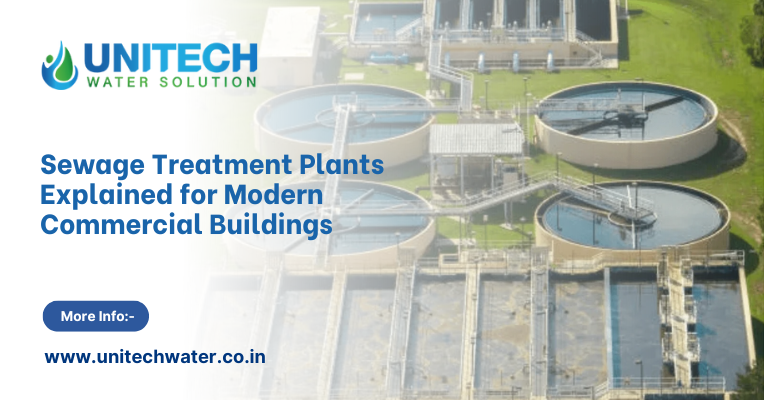
A Sewage Treatment Plant (STP) is the most effective solution to manage wastewater in a safe, hygienic, and eco-friendly manner. It treats sewage water, removes harmful pollutants, and makes the water suitable for reuse or safe discharge.
With rapid urban growth and increasing pressure on water resources, wastewater management has become a serious concern for commercial buildings. Offices, hotels, hospitals, shopping malls, and industrial facilities generate large volumes of wastewater every day. If this wastewater is not treated properly, it can cause environmental pollution, health risks, and legal complications.
In today’s time, installing a sewage treatment plant is not just a legal requirement—it is also a smart investment for long-term sustainability and cost savings.
At Unitech Water Solutions, we design and supply efficient and reliable sewage treatment plants for commercial and industrial projects across India. Our systems are built to meet environmental standards while delivering consistent performance.
This guide explains what a sewage treatment plant is, how it works, its cost, types, benefits, and why wastewater recycling is important, all in a simple and easy-to-understand way.
What Is a Sewage Treatment Plant?
A sewage treatment plant is a system that treats wastewater generated from washrooms, toilets, kitchens, and utility areas. This wastewater contains organic waste, harmful bacteria, chemicals, and suspended solids. The main purpose of an STP is to remove these pollutants and make the water safe for reuse or disposal.
Modern sewage treatment plants are compact, efficient, and designed to follow pollution control board guidelines. These systems are commonly installed in commercial buildings, residential complexes, and industrial units.
For commercial properties, an STP is not only mandatory but also helps reduce water consumption and operating costs.
Why Sewage Treatment Is Important for Commercial Buildings
Commercial buildings use a large amount of water every day. Activities such as toilet usage, cleaning, food preparation, and cooling systems generate significant wastewater. If untreated sewage is released into the environment, it can pollute water bodies and soil.
Installing an STP plant for commercial buildings helps manage wastewater responsibly and avoids environmental damage.
Key reasons why sewage treatment is important:
- Ensures safe and hygienic wastewater disposal
- Reduces dependence on fresh water sources
- Helps reuse treated water within the premises
- Prevents environmental pollution
- Avoids penalties and legal issues
- Supports sustainable building practices
Proper sewage treatment improves the overall efficiency and reputation of commercial facilities.
How Does a Sewage Treatment Plant Work?
The STP plant working process follows a step-by-step treatment cycle. While different technologies are available, the basic process remains similar.
1. Collection and Screening
Wastewater from toilets, washrooms, kitchens, and utility areas is collected through pipelines. This wastewater first passes through screening units where large waste materials such as plastic, cloth, paper, and debris are removed. This step protects downstream equipment from damage.
2. Equalization Tank
After screening, wastewater flows into an equalization tank. This tank helps maintain a uniform flow and load of wastewater. Sudden changes in water volume or quality are balanced here, ensuring smooth operation of the water treatment plant.
3. Biological Treatment
This is the most important stage of the sewage treatment plant. In this process, microorganisms break down organic waste present in the sewage.
Common biological treatment methods include:
- Activated Sludge Process (ASP)
- MBBR (Moving Bed Biofilm Reactor)
- SBR (Sequencing Batch Reactor)
These bacteria consume organic matter and convert it into harmless by-products. This process significantly reduces pollution levels in the water.
4. Clarification
After biological treatment, the water enters a clarifier tank. Here, solid particles and biological sludge settle at the bottom. Clear treated water flows out from the top, while settled sludge is removed for further treatment or disposal.
5. Disinfection
The treated water is disinfected to remove harmful bacteria and pathogens. Disinfection is done using methods such as chlorine dosing, UV treatment, or ozone systems. This step ensures that the water is safe for reuse or discharge.
6. Treated Water Output
The final treated water meets environmental standards and can be reused for non-drinking purposes or safely released into drains or water bodies.
Wastewater Recycling System – A Smart Water Solution
A wastewater recycling system allows treated sewage water to be reused within the building premises. This is especially useful for commercial buildings with high water consumption.
Common uses of recycled water include:
- Gardening and landscaping
- Toilet flushing
- Cooling towers
- Floor washing and cleaning
- Construction and utility use
Benefits of Wastewater Recycling
- Reduces fresh water consumption
- Lowers water bills significantly
- Ensures sustainable water usage
- Supports green building certifications
- Reduces pressure on municipal water supply
Integrating a recycling system with a sewage treatment plant provides long-term cost savings and environmental benefits.
Types of Sewage Treatment Plants Used in India
Different STP technologies are used based on site conditions, wastewater load, and available space.
Common types of sewage treatment plants:
MBBR (Moving Bed Biofilm Reactor)
Compact, efficient, and easy to operate. Suitable for commercial buildings.
SBR (Sequencing Batch Reactor)
Highly effective with better control and treatment quality.
Activated Sludge Process (ASP)
Traditional and widely used method for large installations.
Compact Package STP Systems
Pre-fabricated systems ideal for space-constrained sites.
An experienced STP plant supplier in Indiahelps select the right technology based on project needs.
Sewage Treatment Plant Cost – Approximate Price Overview
The sewage treatment plant cost depends on several factors such as capacity, technology, automation, and site conditions.
Key factors affecting STP cost:
- Plant capacity (KLD)
- Treatment technology
- Level of automation
- Construction material
- Installation and civil work
- Power consumption
- Maintenance requirements
Approximate Cost Comparison:
|
Feature |
Basic System |
Standard System |
Advanced System |
|
Capacity |
Up to 50 KLD |
50–200 KLD |
200+ KLD |
|
Cost Range |
₹4–8 lakh |
₹8–25 lakh |
₹25 lakh+ |
|
Technology |
ASP |
MBBR / SBR |
MBR / Hybrid |
|
Automation |
Manual |
Semi-auto |
Fully automated |
|
Water Reuse |
Limited |
Gardening, flushing |
Industrial & cooling |
|
Best For |
Small buildings |
Commercial projects |
Large complexes |
Applications of Sewage Treatment Plants
Sewage treatment plants are widely used across different commercial and industrial sectors:
- Office complexes
- Hotels and resorts
- Hospitals and healthcare facilities
- Shopping malls and retail centers
- Educational institutions
- Industrial and manufacturing units
An STP plant ensures safe wastewater management for all types of commercial properties.
Importance of Choosing the Right STP Plant Supplier in India
Choosing the right STP plant supplier in India is critical for system reliability and compliance.
A professional supplier provides:
- Customized plant design
- Quality-certified equipment
- Easy-to-operate systems
- Technical guidance
- After-sales service and maintenance
At Unitech Water Solutions, we focus on delivering long-lasting and efficient sewage treatment systems that meet regulatory standards.
Benefits of Installing a Modern Sewage Treatment Plant
Installing a modern STP offers multiple long-term advantages:
- Environment-friendly wastewater management
- Compliance with pollution control norms
- Reduced dependence on fresh water
- Lower operational costs
- Improved sustainability rating
- Reliable and automated operation
A properly designed sewage treatment plant supports both business efficiency and environmental responsibility.
Why Choose Unitech Water Solutions?
Unitech Water Solutions is a trusted name in sewage and wastewater treatment solutions across India.
Our key strengths include:
- Advanced STP system designs
- Proven treatment technologies
- Customized solutions for commercial buildings
- High-quality materials and components
- Reliable technical and after-sales support
- Focus on performance, durability, and compliance
We work closely with clients to deliver solutions that meet both operational and environmental goals.
Final Thoughts
A well-designed Sewage Treatment Plant is an essential part of modern commercial infrastructure. It helps manage wastewater efficiently, reduces environmental impact, and supports water reuse.
By understanding the STP working process, cost factors, and benefits of wastewater recycling, commercial property owners can make informed decisions.
With Unitech Water Solutions, you gain a dependable partner committed to delivering efficient, sustainable, and long-lasting sewage treatment systems.
Frequently Asked Questions
The capacity depends on daily water usage and building occupancy.
Yes, most commercial buildings are required to install STPs as per local regulations.
Yes, treated water can be reused for non-drinking purposes.
Capacity, technology, automation, and installation scope.
Regular monitoring and routine maintenance ensure long-term performance.