



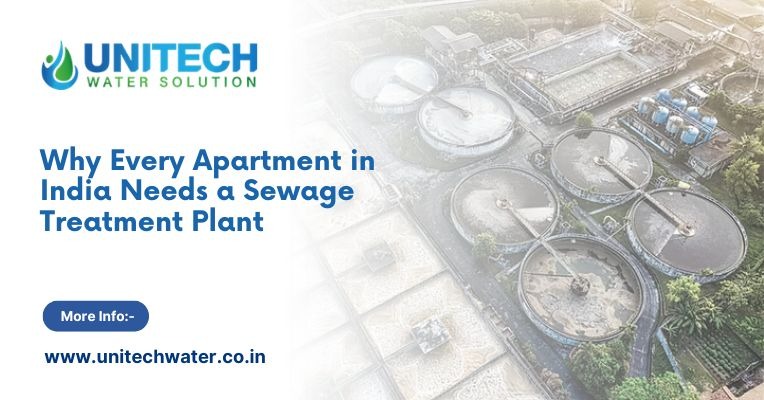
Walk into any modern residential society in Bengaluru, Mumbai, or Pune — and somewhere on the ground floor or basement, you will find a compact machine quietly doing one of the most important jobs in the building. It is treating the wastewater your building produces every single day.
This is the Sewage Treatment Plant — or STP. And if your apartment complex does not have one yet, chances are high that it will need one very soon.
In this blog, we break down exactly why STPs have become non-negotiable for residential buildings across India, what the government says about it, and how finding the right sewage treatment plant manufacturer in India can make all the difference.
India's Water Crisis Is Closer to Home Than You Think
India is the world's most populous country — and its water stress levels are climbing every year. Cities like Chennai, Hyderabad, and Delhi have already faced severe water shortages. And yet, millions of litres of perfectly treatable wastewater flow into drains every day — untreated.
According to the Central Pollution Control Board, a massive portion of India's urban sewage is discharged into rivers and groundwater without treatment. This pollutes the very water sources we depend on for drinking and daily use.
Apartments — especially large housing societies — are a big part of this problem. A mid-sized apartment of 200 flats can produce anywhere from 60,000 to 1,20,000 litres of wastewater every single day. Without a proper sewage treatment plant for residential use, all of that goes straight into the civic drain — and eventually into the environment.
What Exactly Is a Sewage Treatment Plant?
A Sewage Treatment Plant (STP) is a system that treats the wastewater generated from toilets, kitchens, bathrooms, and washing areas in a building. It removes harmful bacteria, suspended solids, and biological contaminants from the water — making it safe for reuse.
The treated water can then be reused for:
- Garden irrigation and landscaping
- Car washing within the society
- Toilet flushing (grey water reuse)
- Construction purposes on-site
- Groundwater recharge
Modern packaged sewage treatment plants are compact, fully automated, and designed to fit inside the basement or mechanical floor of any apartment building — without any foul odour or noise.
Why Is the Government Making STPs Mandatory?
This is not just a good idea anymore — it is the law.
In most Indian states, buildings with more than a certain number of units or with a built-up area above 20,000 square metres are legally required to install sewage treatment plants. Several state pollution control boards, including Maharashtra, Karnataka, Tamil Nadu, and Delhi, have made this mandatory for residential projects.
The National Green Tribunal (NGT) has also issued multiple orders directing residential societies to install STPs and ensure treated water is reused — not just discharged. Societies failing to comply face heavy fines and can even be denied Occupancy Certificates.
For new builders and developers, this means an STP is no longer optional. It is a core part of getting your project approved. And for existing apartment complexes, retrofitting an STP has become an urgent compliance requirement.
5 Real Benefits Residents Feel Every Day
Installing a sewage treatment plant is not just about rules and compliance. There are real, tangible benefits that residents experience in their daily lives.
1. Lower Water Bills
Treated water from an STP can replace fresh water for flushing, gardening, and car washing. This reduces the society's dependency on tanker water or municipal supply — saving tens of thousands of rupees every month in large complexes.
2. No More Waterlogging or Drain Overflow
One of the biggest complaints in older housing societies is clogged external drains and sewage overflow during rains. A working STP processes wastewater on-site, reducing the burden on civic drainage networks significantly.
3. Better Property Value
Homebuyers today are more aware than ever. A certified, functioning STP adds credibility to your society and can positively impact resale value. It signals responsible infrastructure management.
4. Healthier Environment Inside the Campus
Untreated wastewater is a breeding ground for mosquitoes, pathogens, and foul odour. An STP eliminates this completely, making your society's outdoor spaces cleaner and safer for children and elderly residents.
5. Supporting India's Water Recycling Goals
Every litre of recycled water is a litre saved from the depleting groundwater table. When your apartment recycles wastewater, you are directly contributing to India's water security — and that is something to be proud of.
How Does a Modern Packaged STP Work?
You might be wondering — how does all of this actually work inside a building? Modern packaged sewage treatment plants use a multi-stage treatment process that is surprisingly clean and efficient.
Here is how it works, step by step:
- Stage 1 – Screening: Large solids like wipes and debris are filtered out before entering the treatment tank.
- Stage 2 – Equalization: The wastewater flow is balanced so the system does not get overloaded during peak usage hours like mornings and evenings.
- Stage 3 – Biological Treatment (SBR/MBR): Microorganisms break down organic matter, BOD (Biochemical Oxygen Demand), and nutrients like nitrogen and phosphorus.
- Stage 4 – Ultra Filtration: An ultra filtration plant for water treatment is used to remove any remaining suspended particles, fine solids, and microbes — producing crystal-clear treated water.
- Stage 5 – Disinfection: Chlorine or UV treatment kills any remaining bacteria and pathogens, making the treated water safe for reuse.
The entire process happens automatically, requires minimal manual intervention, and produces treated water that meets the CPCB norms for reuse.
What Should You Look For in an STP Manufacturer?
Choosing the right STP manufacturer is as important as choosing the STP itself. Here is what to check before you sign any contract:
- Experience in residential projects: A good STP manufacturer India should have proven experience specifically with residential complexes — not just industrial plants. Residential wastewater has different characteristics and flow patterns.
- Customised plant capacity: Your STP should be designed for your building's exact daily water output. A system that is too small will underperform. A system that is too large will waste energy and money.
- After-sales service and AMC: What happens when the system needs maintenance? Look for manufacturers who offer Annual Maintenance Contracts and 24/7 technical support.
- CPCB and MoEFCC compliance: The system must be certified and compliant with India's environmental regulations. Always ask for documentation before purchase.
- Compact, odour-free design: The best packaged sewage treatment plants are built to fit within tight basement spaces without creating any smell or noise complaints from residents.
The Role of Water Filtration and RO Systems in Modern STPs
Many people confuse water filtration systems with sewage treatment plants — they are different but deeply connected.
In many modern residential setups, treated STP water is passed through an additional water filtration stage before being reused. This may include:
- Activated carbon filters to remove colour and odour
- Ultra filtration membranes for microbe removal
- RO plant systems for producing drinking-grade water from treated water (in some advanced setups)
Is Retrofitting an STP in an Existing Society Possible?
Absolutely — and this is one of the most common questions we get.
Many older residential societies built before STP mandates are now under pressure from their local pollution control boards to install treatment systems. The good news is that modern packaged sewage treatment plants are specifically engineered for tight, constrained spaces.
A skilled STP manufacturer can conduct a site survey, understand your space constraints, and design a plant that fits your basement, parking area, or open utility zone without disrupting daily life during installation.
Unitech Water Solution has successfully installed sewage treatment systems in both new residential projects and existing housing societies across Gujarat and other states — with minimal disruption and full compliance documentation.
Signs Your Apartment Urgently Needs an STP
Not sure if your society needs immediate action? Here are some warning signs:
- Your society pays for expensive water tankers regularly
- You frequently notice foul odours near drainage areas
- The local municipal body has sent compliance notices
- Drains overflow or block during the monsoon season
- Your building was constructed before 2010 and has no STP installed
- You have received a notice from the State Pollution Control Board
If even two or three of these apply to your society, it is time to speak to a qualified STP manufacturer and get a site assessment done.
The Future Is Already Here — and It Is Called Sustainable Living
India is changing fast. Cities are growing. Water is becoming scarcer. And the residents who think ahead — who invest in the right infrastructure today — are the ones who will face fewer problems tomorrow.
A sewage treatment plant is not just a compliance box to tick. It is a long-term investment in water security, cost savings, and the health of everyone in your building.
Whether you are a builder planning a new project, an RWA chairman looking to upgrade your society, or a developer seeking a trusted sewage treatment plant manufacturer India, Unitech Water Solution is ready to help.
With over 16 years of experience, 5,874+ completed projects, and deep expertise across STPs, RO plants, water filtration systems, and ultra filtration plants, Unitech Water Solution is one of India's most trusted names in water treatment.
Frequently Asked Questions
Yes. In most Indian states, apartments above 20,000 sq. metres are legally required to install a sewage treatment plant. The National Green Tribunal (NGT) and state pollution control boards enforce this. Non-compliant societies face heavy fines and may be denied their Occupancy Certificate.
A residential sewage treatment plant treats wastewater from toilets, kitchens, and bathrooms. It removes bacteria, solids, and contaminants — making water safe for reuse in gardening, flushing, and car washing. Modern packaged systems are compact, odour-free, and fully automated.
Yes. Modern packaged sewage treatment plants are specifically engineered for retrofitting in existing buildings. A qualified manufacturer surveys your site, assesses space constraints, and installs a system in your basement or utility area — with minimal disruption to daily residents.