



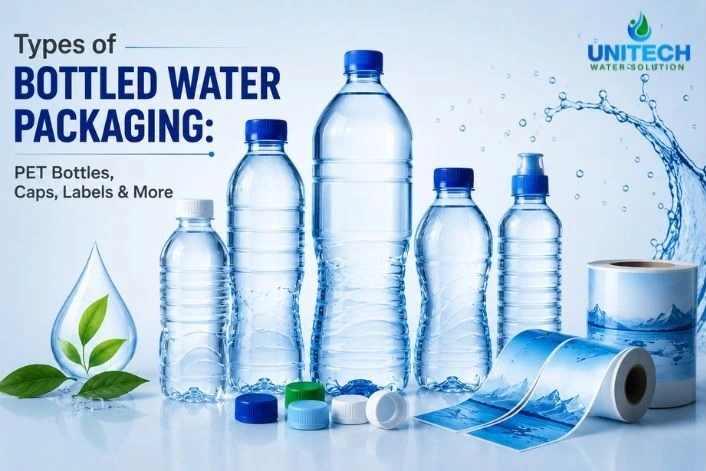
Bottled water packaging includes the bottle, closure, label, secondary packaging, and other materials used to protect, identify, transport, and distribute packaged water. Among the different types of bottled water packaging, PET bottles are widely used because they are lightweight, practical for transportation, and compatible with automated bottling lines.
Packaging is not limited to the bottle itself. A complete water bottle packaging system can include PET preforms, bottles, caps, labels, shrink film, cartons, and other materials depending on the product format and distribution requirements.
For bottled water manufacturers, packaging selection affects product protection, production-line compatibility, transportation, branding, and overall handling efficiency. Understanding each component helps businesses select the right packaging configuration for their production line.
What Are the Main Types of Bottled Water Packaging?
The main components of bottled water packaging include:
- PET bottles
- Bottle caps and closures
- Labels
- Shrink film
- Cartons or secondary packaging
Each component performs a different function within the overall packaging process.
PET Bottle Packaging for Bottled Water
PET bottle packaging is widely used for packaged water because PET can be formed into different bottle shapes and sizes while remaining suitable for automated production and distribution.
PET bottles are commonly produced using PET preforms. In an integrated production setup, the preforms are heated and expanded through a bottle blowing machine to create bottles with the required shape and capacity.
Common PET Bottle Formats
Depending on the target market, bottled water manufacturers may use different bottle sizes, such as:
- Small single-serve bottles
- Medium-size bottles
- Standard retail bottles
- Large bottles
The appropriate size depends on the intended market, distribution channel, consumption pattern, and production line configuration.
Why PET Bottles Are Used
PET bottles offer several practical benefits:
- Lightweight construction
- Easy transportation
- Compatibility with automated filling
- Flexible bottle designs
- Efficient storage
- Suitable for high-volume production
Bottle design should also be compatible with the filling, labelling, and packaging equipment used in the production line.
Bottle Caps and Closures
Caps are an essential component of water bottle packaging because they create the closure between the bottle and its contents.
A properly selected closure should be compatible with the bottle neck and capping equipment while maintaining package integrity during storage and transportation.
Important Closure Considerations
- Bottle neck compatibility
- Cap dimensions
- Sealing performance
- Capping machine compatibility
- Tamper-evident requirements
- Handling and transportation
In an automated bottling line, caps are typically fed and positioned automatically before the capping stage.
Bottled Water Labels
Bottled water labeling serves both branding and product-information purposes. A label can identify the brand and communicate required information to customers and distribution partners.
Depending on the product and applicable requirements, labels may include information such as:
- Product name
- Brand
- Quantity
- Manufacturer details
- Batch information
- Manufacturing information
- Applicable regulatory information
Label design must also be compatible with the selected bottle shape and labelling technology.
For high-volume production, an Automatic Sticker Labelling Machine can apply labels consistently as bottles move through the production line.
What Is Shrink Wrapping in Bottled Water Packaging?
Shrink wrapping is a secondary packaging method used to group multiple bottles into a single pack.
The bottles are arranged into the required configuration, covered with shrink film, and passed through a heating system that causes the film to contract around the bottles.
Shrink Wrapping Process
Bottle Grouping → Film Application → Heat Shrinking → Pack Formation → Conveyor Transfer
Shrink wrapping can help with:
- Grouping bottles
- Transportation
- Warehouse handling
- Retail distribution
- Pack stability
Businesses with higher production requirements can integrate an Automatic Shrink Wrapping Machine into the packaging line.
Types of Bottled Water Packaging for Different Applications
Different distribution models may require different packaging formats.
Individual Bottle Packaging
Single bottles are suitable for:
- Retail sales
- Hotels
- Restaurants
- Events
- Institutional consumption
Multipack Packaging
Multiple bottles are grouped using shrink film or another secondary packaging method.
This format is commonly useful for:
- Retail distribution
- Wholesale supply
- Supermarkets
- Institutional buyers
Carton Packaging
Cartons can provide additional protection during storage and transportation and may be selected for particular product formats or markets.
The appropriate packaging format depends on the product, distribution model, handling requirements, and production-line capabilities.
How Does Bottled Water Packaging Fit Into the Production Line?
Packaging is one stage within a larger bottled water production process.
A typical sequence is:
Water Treatment → Bottle Preparation → Bottle Rinsing → Filling → Capping → Labelling → Secondary Packaging → Dispatch
The packaging stages begin after the bottles have been filled and capped.
Filling
Treated water is transferred into bottles through the filling system.
Capping
Caps are applied to close the bottles.
Labelling
Labels are applied according to the product and packaging requirements.
Shrink Wrapping
Multiple bottles can then be grouped into packs for transportation and distribution.
This means packaging equipment must be compatible with the speed and configuration of the upstream bottling equipment.
What Should You Consider When Choosing Bottled Water Packaging?
Choosing between different bottled water packaging types requires more than selecting the bottle design.
Bottle Size
Choose bottle sizes based on target customers and distribution channels.
Packaging Quantity
Determine whether your business needs single-bottle packaging, multipacks, cartons, or a combination.
Production Speed
Packaging equipment must match the output of the filling line to avoid bottlenecks.
Bottle Design
The bottle shape should be compatible with the filling, labelling, and packaging equipment.
Distribution Requirements
Packaging should withstand transportation, storage, loading, and unloading.
Branding
Labels and packaging should provide sufficient space for brand identity and required product information.
Bottled Water Packaging Machinery
A complete packaging line can include:
- Bottle conveyors
- Automatic labelling machines
- Sticker labelling machines
- Shrink wrapping machines
- Batch coding equipment
- Carton packing equipment
- Packaging conveyors
The selection depends on production capacity, packaging format, bottle size, and automation requirements.
For businesses planning a complete bottled water operation, packaging equipment should be integrated with the broader packaged drinking water plant rather than treated as an isolated production stage.
Choosing the Right Bottled Water Packaging System
The right packaging configuration depends on:
- Bottle size
- Bottle material
- Production capacity
- Distribution model
- Packaging format
- Automation level
- Labelling requirements
- Transportation requirements
- Future production plans
A small operation may require a simpler packaging setup, while a high-volume production facility may integrate automated labelling, shrink wrapping, conveyors, and other packaging equipment.
The goal is to create a packaging process that keeps pace with bottle filling while maintaining consistent presentation and handling efficiency.
Need the Right Bottled Water Packaging Setup?
Choose suitable labelling, shrink wrapping and packaging equipment based on your bottle format and production capacity.