



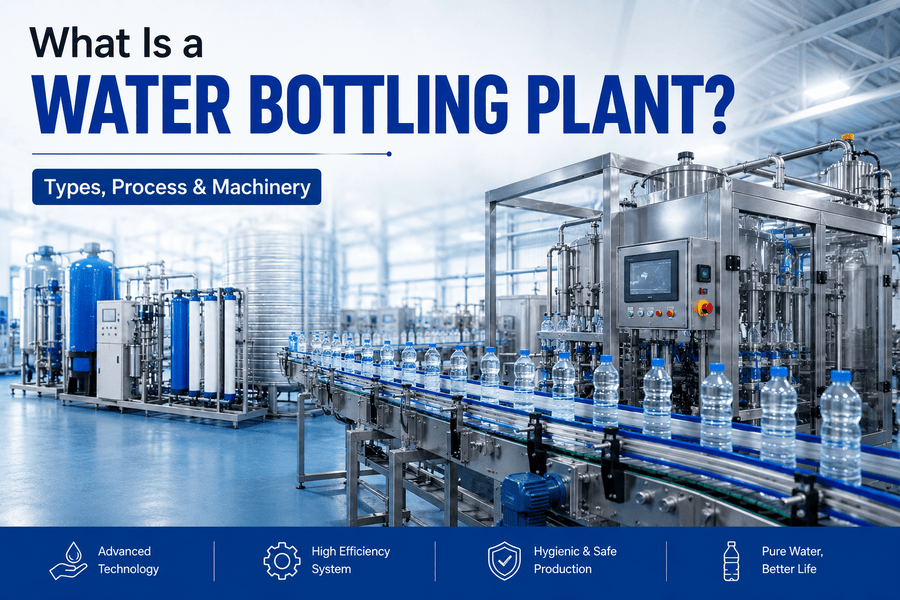
A water bottling plant is a production facility where treated water is processed, filled into bottles, sealed, labelled, and prepared for distribution. The complete setup combines water purification equipment with bottle handling, filling, capping, labelling, and packaging machinery to produce packaged water at a defined production capacity.
In simple terms, a water bottling plant takes water from an approved source, treats it according to the required quality standards, and converts it into packaged bottles ready for retail, institutional, commercial, or other distribution channels.
The water bottling process can range from semi-automatic operations requiring manual intervention to fully automated production lines capable of handling high-volume bottled water production. The right configuration depends on the required capacity, bottle sizes, level of automation, water quality, and packaging requirements.
For businesses planning a bottled water operation, understanding the treatment process, production stages, and required water bottling machinery is important before selecting a plant configuration.
How Does a Water Bottling Plant Work?
A typical water bottling plant combines water treatment and packaging operations into a coordinated production line.
The general process of water bottling plant is:
Raw Water → Pre-Treatment → Purification → Bottle Preparation → Bottle Rinsing → Filling → Capping → Labelling → Packaging
.png)
Each stage performs a specific function.
1. Raw Water Collection
The process begins with water from a suitable source such as borewell water, municipal supply, or another approved source. The characteristics of the source water determine the treatment technologies required.
Water analysis is important at this stage because parameters such as TDS, hardness, turbidity, pH, and microbial quality can influence the overall treatment configuration.
2. Water Purification
Before water reaches the bottling line, it undergoes the required treatment process. Depending on source-water characteristics and product requirements, the treatment system may include filtration, activated carbon treatment, Reverse Osmosis, UV treatment, ozonation, or other processes.
The objective is to produce water with consistent quality before it enters the filling stage.
3. Bottle Preparation
PET bottles may be supplied ready for use or produced within the facility using PET preforms and a bottle blowing machine.
Where bottle blowing is integrated into the production line, preforms are heated and formed into bottles according to the required size and design.
4. Bottle Rinsing
Before filling, bottles are rinsed to remove particles or contaminants that may affect product quality.
Automated rinsing systems can handle bottles continuously as they move through the production line.
5. Water Filling
The treated water is transferred into bottles through a controlled filling system.
The water bottle filling machine determines the filling speed, accuracy, and production capacity of the bottling line.
6. Capping
After filling, bottles are immediately capped to protect the product from external contamination and maintain package integrity.
7. Labelling
Labels are applied to identify the product and provide required product information. Automated labelling equipment can maintain consistent label positioning across high-volume production.
8. Secondary Packaging
Finally, bottles may be grouped using shrink film, cartons, or other packaging formats for transportation and distribution.
Main Stages of Bottled Water Production
Understanding bottled water production becomes easier when the complete production line is divided into treatment, bottle preparation, filling, and packaging stages.
Water Treatment Stage
This stage focuses on producing water suitable for the intended application.
Typical equipment can include:
- Raw water storage tanks
- Pressure sand filters
- Activated carbon filters
- Micron filtration
- RO systems
- UV systems
- Ozone systems
- Treated water storage tanks
The exact configuration depends on the source water and applicable product requirements.
Bottle Manufacturing Stage
For facilities producing their own PET bottles, the bottle manufacturing stage typically includes:
- PET preforms
- Heating system
- Bottle blowing machine
- Bottle inspection
This can reduce dependence on externally supplied bottles and allow manufacturers to control bottle formats.
Bottling Stage
The bottling section typically includes:
- Bottle rinsing
- Water filling
- Capping
- Bottle transfer
This stage is focused on maintaining consistent filling and hygienic handling.
Packaging Stage
The final stage may include:
- Bottle labelling
- Batch coding
- Shrink wrapping
- Carton packing
- Conveyor systems
Together, these stages create an integrated water bottling line.
Types of Water Bottling Plants
Water bottling plants can be configured according to production volume, automation requirements, and business scale.
Semi-Automatic Water Bottling Plant
A semi-automatic setup is suitable for businesses with relatively lower production requirements. Some operations require manual handling, making this configuration suitable where initial investment, production volume, or operational scale is limited.
Automatic Water Bottling Plant
An automatic setup reduces manual intervention and integrates multiple production stages. It is suitable for businesses looking for consistent production, improved productivity, and greater process control.
Fully Automatic Water Bottling Plant
A fully automatic line integrates treatment, bottle handling, filling, capping, labelling, and packaging with minimal manual intervention. It is suitable for high-volume bottled water production.
Mineral Water Bottling Plant
A Mineral Water Bottling Plant is configured specifically around the product requirements, water treatment process, bottling capacity, and packaging format of the business.
What Machinery Is Used in a Water Bottling Plant?
The machinery required depends on the plant configuration and production capacity. A typical line may include the following equipment.
Water Treatment Equipment
- Raw water treatment system
- Filtration units
- RO system
- UV or ozone treatment
- Storage tanks
- Dosing systems
Bottle Production Equipment
- PET preform heating system
- Bottle blowing machine
- Bottle inspection system
Bottling Equipment
- Bottle rinsing machine
- Water filling machine
- Capping machine
- Conveyors
Packaging Equipment
- Labelling machine
- Batch coding system
- Shrink wrapping machine
- Packaging conveyors
These components can be selected individually or integrated into a complete production line.
For businesses evaluating different equipment configurations, Water Plant Machinery provides a broader overview of the machinery used in bottled water production.
What Determines the Configuration of a Water Bottling Plant?
There is no single configuration suitable for every business. The production line should be selected according to the following factors.
Production Capacity
The required output determines the size and speed of the equipment. Filling capacity is often expressed in BPM (bottles per minute).
Bottle Size
A line designed for 200 ml bottles may have different operating requirements from one designed for 1-litre or larger bottles.
Automation Level
Businesses can select semi-automatic, automatic, or fully automatic configurations depending on production requirements and available workforce.
Water Quality
The treatment system must be designed according to raw water characteristics, including TDS, hardness, turbidity, and microbiological parameters.
Packaging Format
The required packaging format influences the selection of labelling, shrink wrapping, and secondary packaging equipment.
Future Expansion
Businesses expecting production growth should consider a scalable configuration that can accommodate future capacity upgrades.
Applications of Water Bottling Plants
A water bottling plant can support several commercial applications, including:
- Packaged drinking water production
- Mineral water production
- Hotels and resorts
- Restaurants
- Institutional water supply
- Retail bottled water
- Corporate supply
- Commercial bottled water businesses
The equipment configuration should be matched to the target market, production volume, and product requirements.
Water Bottling Plant vs Water Treatment Plant
Although the terms are sometimes used together, a water treatment plant and a water bottling plant serve different purposes.
|
Water Treatment Plant |
Water Bottling Plant |
|
Focuses on water purification |
Focuses on packaging treated water |
|
Uses filtration, RO, UF, softening and other technologies |
Uses rinsing, filling, capping, labelling and packaging |
|
Produces treated water |
Produces packaged bottles |
|
Used across industrial and commercial applications |
Primarily used for bottled water production |
A bottled water facility may therefore include a water treatment system as well as a complete bottling and packaging line.
How to Choose the Right Water Bottling Plant
Selecting the right plant begins with understanding your production and product requirements.
Consider:
- Required daily production
- Bottles per minute
- Bottle sizes
- Water source
- Treatment requirements
- Level of automation
- Available installation area
- Packaging format
- Future production expansion
For businesses planning to manufacture bottled water at scale, the treatment system, bottling equipment, and packaging machinery should be designed as a coordinated production line rather than selected independently.
If your project involves mineral water production, a dedicated Mineral Water Plant can be configured around the required purification, bottling, and packaging stages.
Planning a Water Bottling Plant?
Contact Unitech Water Solutions to discuss your production requirements and get expert guidance on the right water bottling solution.