



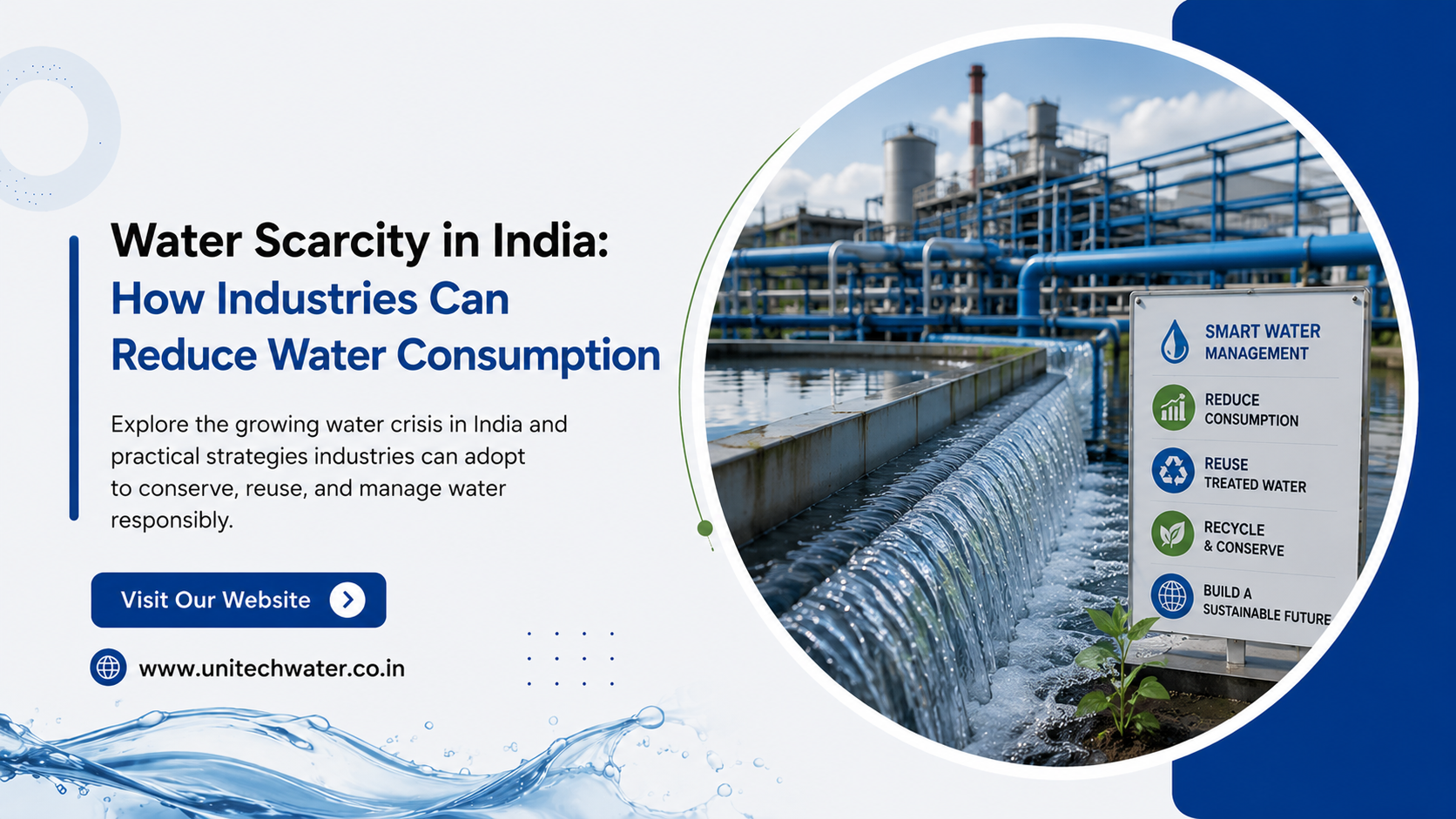
Water scarcity in India is no longer a distant concern it's an emergency that can no longer be pushed to the back of the boardroom agenda. India's annual per capita water availability stood at 1,486 cubic metres in 2021, already falling under the water stress category, and is projected to drop further to 1,341 cubic metres by 2025 edging the country closer to the official scarcity threshold. With only 4% of the world's freshwater resources supporting 17% of the world's
population, water scarcity in India means every sector agriculture, households, and industry alike is competing for an increasingly limited resource.
While farming remains the largest consumer of freshwater, industries are under growing pressure to clean up their act. Manufacturing units, textile plants, chemical factories, and processing industries depend heavily on water for cooling, cleaning, processing, and steam generation. As reservoirs run low and groundwater tables sink further each year, the conversation has shifted from "if" industries should act to "how fast" they can.
This blog breaks down why water scarcity in India is becoming a business risk, not just an environmental one, and what practical steps industries can take to reduce water consumption without compromising productivity.
Why Water Scarcity in India Is an Industrial Problem Too
It's easy to assume water scarcity is mainly an agricultural or domestic issue. But the numbers tell a different story. Research from the Council on Energy, Environment and Water warns that 11 of India's 15 major river basins are approaching severe water stress. Recent data from the Central Water Commission shows that water levels in 166 monitored reservoirs dropped by nearly 8 billion cubic metres in just two weeks during April–May 2026, with 13 major reservoirs falling below 50% of their normal capacity.
This volatility hits industries directly. When water availability becomes unpredictable, industrial output particularly cooling systems and manufacturing processes suffers, disrupting supply chains and discouraging investment. Even financial institutions are taking note: nearly 40% of Indian banks' loan portfolios are exposed to water-stressed sectors, creating risks of bad loans if production halts due to water shortages.
Add to this the groundwater problem. India is the world's largest user of groundwater, accounting for roughly 25% of global extraction, and many industrial clusters sit in regions where 14–17% of groundwater assessment units are already over-exploited, particularly in states like Punjab, Haryana, and Rajasthan. For industries operating in or near these zones, water isn't just an operating cost anymore it's a long-term supply risk.
Industrial Water Conservation: Why It Matters Now
Industrial water conservation isn't only about compliance with pollution control norms or staying within permitted withdrawal limits. It's about business continuity. A factory that can't
secure consistent water supply faces production delays, regulatory scrutiny, and reputational damage all of which are far costlier than investing in water-saving infrastructure upfront.
The good news is that industrial water management has matured significantly. Technologies that once felt experimental are now standard practice in forward-thinking facilities. From recycling wastewater to installing smart monitoring systems, industries have more tools than ever to cut their water footprint while maintaining output.
How Industries Can Reduce Water Consumption: Practical Strategies
1. Install Industrial RO Systems for Water Recycling
One of the most effective water-saving solutions for industries is the use of industrial RO systems. Reverse osmosis technology allows industries to treat and reuse wastewater generated during production, rather than discharging it and drawing fresh water repeatedly. This is particularly valuable for industries like textiles, pharmaceuticals, food processing, and chemical manufacturing, where water quality requirements are strict.
A well-designed industrial RO system doesn't just reduce intake from municipal or groundwater sources it also lowers effluent discharge, helping industries meet Zero Liquid Discharge (ZLD) norms that are becoming increasingly common across water-stressed states.
At Unitech Water Solution, this is one of the most frequent requests from industrial clients: a reliable, scalable RO setup that fits their specific production load and water chemistry, rather than a generic one-size-fits-all system.
2. Reuse Treated Wastewater Across Operations
Not every use of water inside a factory requires fresh, potable-grade water. Cooling towers, floor washing, gardening, and even certain pre-treatment processes can run on treated greywater. Many modern industrial units are now installing Membrane Bioreactors (MBR) to treat greywater from sinks and similar sources for reuse in flushing, cooling towers, and landscaping. This single shift can cut freshwater dependency by a significant margin.
3. Conduct Regular Water Audits
You can't manage what you don't measure. A water audit identifies exactly where water is being used, where it's being wasted, and where leaks or inefficiencies are quietly inflating consumption. Many industries are surprised to discover that a large share of their water use
comes from outdated equipment, leaking pipelines, or poorly calibrated processes rather than core production needs.
4. Upgrade to Water-Efficient Equipment
Older machinery often consumes far more water than necessary simply because it wasn't designed with efficiency in mind. Replacing or retrofitting equipment with water-efficient alternatives, low-flow nozzles, closed-loop cooling systems, and automated shut-off valves can meaningfully reduce daily consumption without slowing down production lines.
5. Harvest Rainwater for Non-Critical Use
Industrial facilities typically have large rooftop and open-yard areas, making them well-suited for rainwater harvesting. Collected rainwater can be used for non-process activities like landscaping, sanitation, and even pre-treatment stages, reducing the load on freshwater sources during dry months.
6. Monitor Consumption with Smart Metering
Smart water meters give real-time visibility into consumption patterns, helping facility managers spot abnormal usage, leaks, or inefficiencies before they snowball into bigger problems. This kind of real-time monitoring is increasingly being paired with automation to flag issues instantly rather than during a monthly review.
7. Train Staff on Water-Saving Practices
Technology alone isn't enough. Employees handling day-to-day operations need to understand why water conservation matters and how their daily choices of leaving taps running, ignoring minor leaks, and overusing water in cleaning processes add up across a facility.
Water Conservation Strategies for Manufacturing Industries
Manufacturing units, given their scale, have a unique opportunity to lead by example. Strategies such as closed-loop water systems, condensate recovery, process water reuse, and partnering with water treatment specialists for customized solutions can collectively reduce a plant's water footprint by 30–50% in many cases. Manufacturing industries that adopt these strategies early often find they're better positioned to handle regulatory changes and water restrictions during peak summer months, when scarcity is most acute.
This is where working with experienced partners makes a difference. Unitech Water Solution has worked with manufacturing units across sectors to design water management systems tailored to their production cycles, helping them cut consumption while staying compliant with discharge norms.
The Way Forward
India's water crisis isn't a distant future problem it's unfolding right now, visible in shrinking reservoirs, deepening groundwater stress, and tightening regulations on industrial water use. For industries, the choice isn't really between acting and not acting; it's between acting proactively or being forced to adapt under pressure later.
Investing in industrial RO systems, wastewater recycling, smart monitoring, and water-efficient equipment isn't just good environmental practice it's increasingly a competitive advantage. Industries that get ahead of this curve protect themselves from supply disruptions, regulatory penalties, and rising water costs, while contributing to a more sustainable future for the country.
If your industry is looking to build a practical, customized water conservation strategy, working with specialists like Unitech Water Solution can help translate these strategies into systems that actually fit your production scale and water chemistry.
Frequently Asked Questions
Industries can reduce water consumption by installing industrial RO systems for recycling process water, conducting regular water audits, upgrading to water-efficient equipment, and reusing treated wastewater for non-critical operations like cooling and cleaning.
The best ways include adopting closed-loop water systems, harvesting rainwater for non-process use, installing smart water meters to track consumption, and training staff on responsible water use. Combining these with wastewater recycling typically delivers the biggest reductions.
Manufacturing industries benefit most from condensate recovery, process water reuse, closed-loop cooling systems, and partnering with water treatment experts to design solutions specific to their production processes and water chemistry.
With reservoirs and groundwater levels declining across several Indian states, industrial water management helps reduce dependency on shrinking freshwater sources, ensures regulatory compliance, and protects industries from production disruptions caused by water shortages.
Industrial RO systems treat and purify wastewater so it can be reused within the facility, reducing the need to draw fresh water repeatedly. This lowers both water intake and effluent discharge, making it one of the most practical water-saving solutions for industries today.