



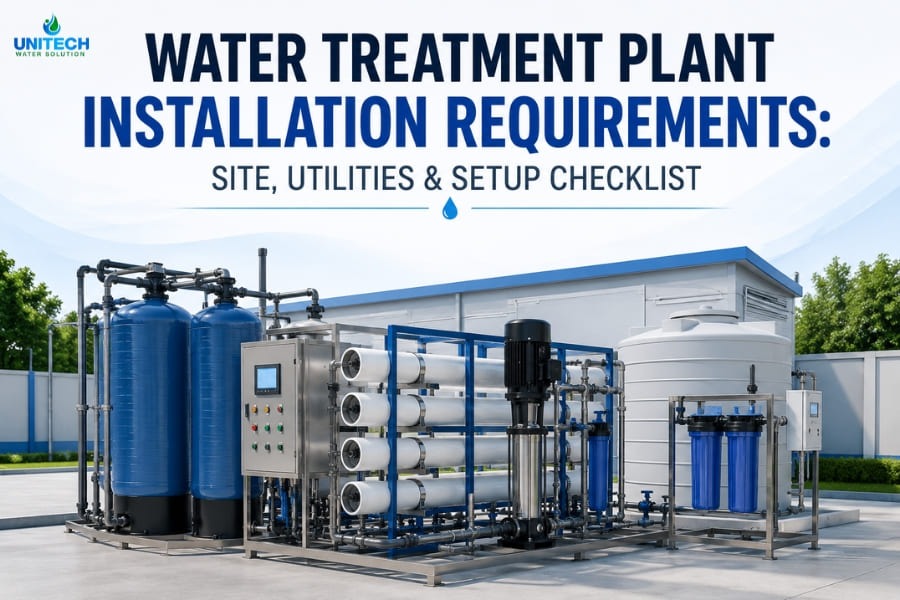
Installing a water treatment plant requires more than selecting treatment equipment and placing it at the site. The water treatment plant installation process depends on the raw water source, treatment capacity, water quality, available space, civil work, electrical supply, piping, drainage, storage and operating requirements.
Whether the project involves an industrial RO plant, filtration system, water softening plant, ultrafiltration system or a complete water treatment plant, planning these requirements before equipment installation helps avoid delays, unnecessary modifications and operational problems.
This guide covers the key water treatment plant installation requirements that businesses should evaluate before starting a new project.
What Are the Basic Water Treatment Plant Installation Requirements?
A successful installation starts with evaluating the site and understanding what the treatment system needs to operate safely and efficiently.
The major requirements include:
- Raw water source and quality
- Required treatment capacity
- Site area and plant layout
- Civil foundation and equipment support
- Electrical power supply
- Raw and treated water storage
- Process piping
- Drainage and reject-water arrangements
- Chemical handling and storage
- Equipment access and maintenance space
- Control and automation requirements
- Testing and commissioning
These requirements can vary considerably depending on the type and capacity of the water treatment plant.
1. Analyze the Raw Water Source and Quality
The first step in any water treatment plant installation is understanding the water that will enter the system.
The treatment process should be selected based on actual raw-water characteristics rather than capacity alone.
Common parameters to evaluate include:
- TDS
- pH
- Hardness
- Turbidity
- Total suspended solids
- Iron
- Manganese
- Chloride
- Sulphate
- Microbiological contamination
- BOD and COD where applicable
For an industrial RO plant, parameters such as TDS, hardness, silica, iron and suspended solids can influence pretreatment and membrane selection.
For sewage or wastewater applications, different parameters become important.
The raw-water analysis therefore forms the foundation of the entire treatment system design.
2. Determine the Required Treatment Capacity
The next requirement is to determine how much water the plant needs to treat.
Capacity is usually expressed in:
- LPH — Litres Per Hour
- KLD — Kilolitres Per Day
- MLD — Million Litres Per Day
For example, a facility requiring 100,000 litres of treated water per day may require a different configuration from one requiring 500,000 litres per day.
Capacity planning should consider:
- Average daily consumption
- Peak demand
- Operating hours
- Future expansion
- Raw-water availability
- Treated-water storage
- Required recovery rate
Avoid sizing a plant purely according to current average consumption. Future production requirements should also be considered when practical.
3. Plan the Site Area and Plant Layout
Adequate space is essential for equipment installation, operation and maintenance.
The water treatment plant layout should provide sufficient room for:
- Pretreatment equipment
- RO or filtration systems
- Chemical dosing
- Pumps
- Storage tanks
- Electrical panels
- Control systems
- Piping
- Operator movement
- Maintenance activities
The layout should also allow technicians to access pumps, membranes, filters, valves and other components without dismantling surrounding equipment.
Consider Future Expansion
If production is expected to increase, reserve space for additional:
- RO skids
- Filter vessels
- Storage tanks
- Pumps
- Membrane housings
- Treatment modules
A slightly more flexible layout can make future capacity expansion easier.
Need Help Planning Your Water Treatment Plant?
The right plant layout depends on your water source, treatment capacity, available area and required treated-water quality. Share these details with the engineering team to determine a practical configuration before installation begins.
4. Prepare the Civil Foundation
Heavy treatment equipment requires a suitable and level foundation.
Depending on the plant configuration, civil work may be required for:
- RO skids
- Pressure vessels
- Filter vessels
- Pumps
- Chemical tanks
- Storage tanks
- Blowers
- Electrical equipment
The foundation should account for the equipment weight, operating loads, vibration and installation environment.
Drainage should also be considered during civil planning so that water leakage, filter backwash or RO reject water does not accumulate around equipment.
5. Arrange the Electrical Power Supply
Electrical requirements depend on plant capacity and the equipment installed.
Major electrical loads may include:
- High-pressure pumps
- Feed pumps
- Transfer pumps
- Dosing systems
- UV systems
- Ozone systems where applicable
- Air compressors
- Blowers
- Automation systems
Before installation, confirm:
- Available electrical load
- Voltage
- Phase requirements
- Panel location
- Cable routing
- Earthing
- Protection systems
- Backup power requirements
For larger industrial systems, the electrical design should be coordinated with the equipment layout and process requirements.
6. Plan Raw Water and Treated Water Storage
Water treatment systems often require storage tanks before and after treatment.
Raw Water Storage
A raw-water tank provides a controlled feed to the treatment system and can help manage fluctuations in incoming water availability.
Treated Water Storage
A treated-water tank stores the output for subsequent use or distribution.
Depending on the application, additional tanks may be required for:
- Filtered water
- RO permeate
- RO reject
- Chemical solutions
- Backwash water
Storage capacity should be planned according to plant production, operating hours and consumption patterns.
7. Install Process Piping Correctly
Piping connects the treatment stages and carries raw water, treated water, reject water and chemical solutions.
The installation may include:
- Raw-water piping
- Pretreatment piping
- RO feed piping
- Permeate piping
- Reject piping
- Backwash lines
- Drain lines
- Chemical dosing lines
- Treated-water distribution
Pipe material, diameter, pressure rating and connection method should be selected according to the water characteristics and process requirements.
Improper piping can cause pressure losses, leakage and difficulties during maintenance.
8. Provide Proper Drainage and Reject-Water Management
Drainage is an important but sometimes overlooked water treatment plant setup requirement.
Depending on the system, wastewater may come from:
- Filter backwashing
- Membrane cleaning
- RO reject
- Equipment drainage
- Chemical cleaning
- Tank overflow
The site should have an appropriate arrangement for collecting, treating, reusing or disposing of these streams according to the applicable requirements.
For RO systems in particular, reject-water management should be considered during the initial plant design rather than after installation.
9. Plan Chemical Storage and Dosing
Some water treatment systems require chemical dosing for pretreatment, pH adjustment, antiscalant dosing, disinfection or membrane cleaning.
The installation area may therefore require:
- Chemical storage tanks
- Dosing pumps
- Dosing lines
- Bunded containment
- Chemical handling equipment
- Appropriate ventilation
- Safety provisions
The chemical dosing system should be positioned so that operators can safely inspect and maintain it.
10. Provide Equipment Access and Maintenance Space
A treatment plant should not be designed only around fitting equipment into the available area.
Maintenance access is equally important.
Technicians may need to remove or service:
- RO membranes
- Cartridge filters
- Pumps
- Valves
- Filter media
- UV components
- Instrumentation
- Dosing pumps
For example, membrane housings require enough working clearance for membrane replacement.
A well-planned layout can reduce maintenance time and make routine servicing safer.
11. Plan Automation and Control Systems
Modern water treatment plants can incorporate different levels of automation depending on the application and operating requirements.
Automation may control:
- Pump operation
- Tank levels
- Pressure
- Flow
- Conductivity/TDS
- Chemical dosing
- Automatic valves
- System alarms
- Plant shutdown conditions
A PLC-based control system can help coordinate multiple treatment stages and provide operators with information about plant performance.
For larger installations, automation can also support more consistent operation and reduce unnecessary manual intervention.
12. Testing and Commissioning Requirements
Equipment installation is not the final step.
Before the plant is put into regular operation, the system should undergo appropriate testing and commissioning.
This may include:
Equipment Inspection
Check pumps, vessels, membranes, valves, electrical panels, piping and instruments.
Leak Testing
Verify process piping, tanks and connections for leakage.
Electrical Testing
Check electrical connections, protection systems, controls and motor operation.
Instrument Calibration
Confirm that relevant pressure, flow, conductivity, level and other instruments provide reliable readings.
Trial Operation
Run the plant under controlled conditions and verify the treatment process.
Water Quality Testing
Test treated water against the required quality parameters before moving to regular operation or reuse.
Water Treatment Plant Installation Checklist
Before starting installation, review the following:
|
Requirement |
Check |
|
Raw water analysis |
✓ |
|
Required plant capacity |
✓ |
|
Site area confirmed |
✓ |
|
Plant layout prepared |
✓ |
|
Civil foundation completed |
✓ |
|
Electrical load available |
✓ |
|
Raw water storage planned |
✓ |
|
Treated water storage planned |
✓ |
|
Process piping planned |
✓ |
|
Drainage/reject management |
✓ |
|
Chemical dosing area |
✓ |
|
Maintenance access |
✓ |
|
Automation requirements |
✓ |
|
Safety provisions |
✓ |
|
Testing and commissioning plan |
✓ |
How Long Does Water Treatment Plant Installation Take?
Installation time depends on the plant capacity, technology, equipment configuration, site readiness and level of automation.
A smaller packaged system may require considerably less installation work than a large industrial water treatment plant involving multiple treatment stages, storage tanks, extensive piping and electrical integration.
The overall project can include:
Site preparation → Civil work → Equipment placement → Piping → Electrical work → Instrumentation → Automation → Testing → Commissioning
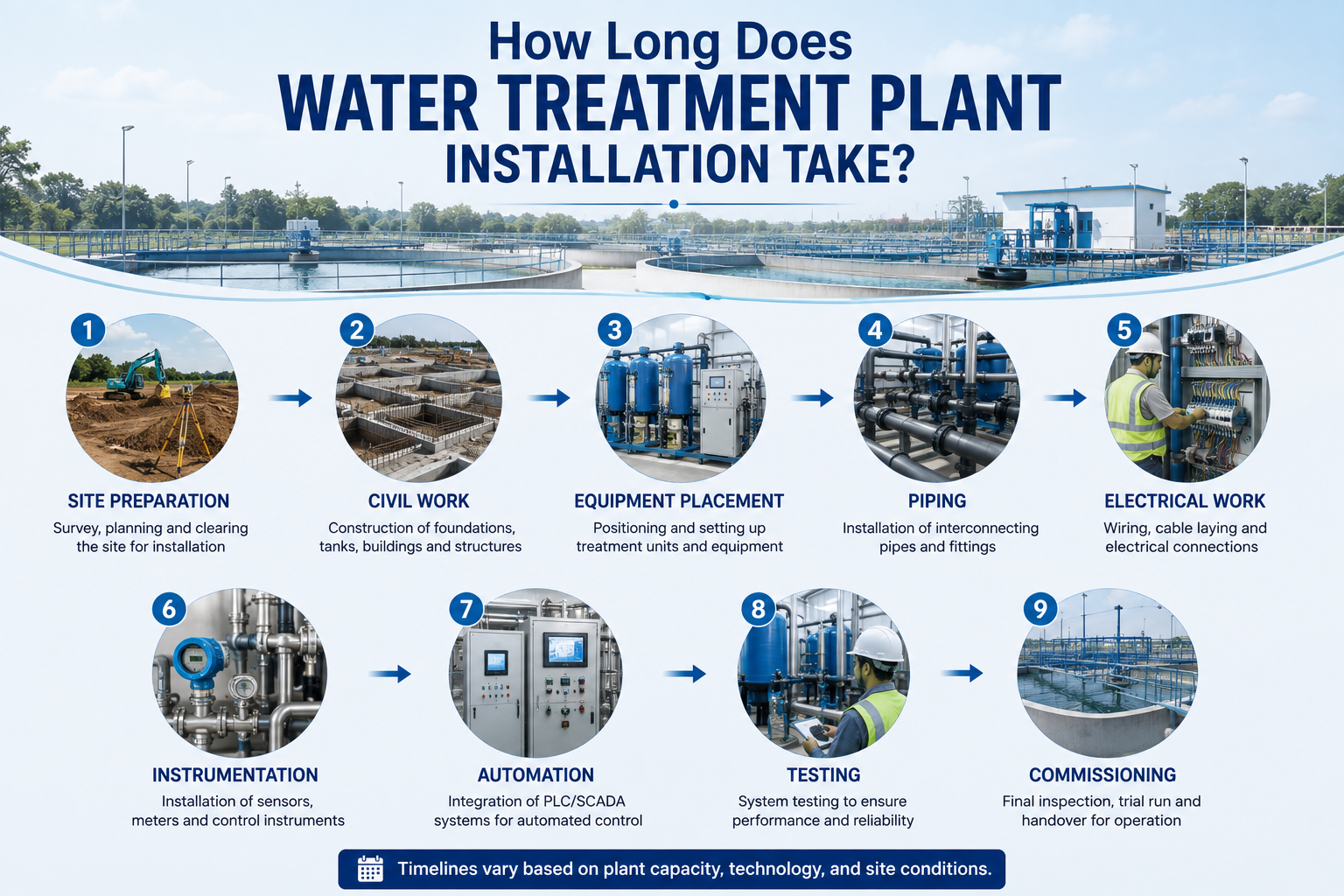
Delays in civil work, electrical connections, piping or site preparation can affect the overall commissioning schedule.
Why Professional Installation Matters
A water treatment system can have high-quality equipment and still perform poorly if the installation is not properly planned.
Professional installation helps ensure:
- Correct equipment positioning
- Proper piping connections
- Appropriate electrical integration
- Correct pressure and flow conditions
- Reliable automation
- Easier maintenance
- Safer operation
- Proper commissioning
This becomes particularly important for industrial water treatment plants, where multiple treatment stages need to operate together.
Choosing a Unitech Water Solutions as Water Treatment Plant Installation Partner
When selecting a company for your project, look beyond equipment supply.
Evaluate whether the provider can support:
- Water analysis
- Process design
- Plant configuration
- Equipment selection
- Layout planning
- Manufacturing
- Installation
- Piping and electrical integration
- Automation
- Testing
- Commissioning
- After-sales support
A complete engineering approach can reduce coordination between multiple vendors and make the installation process easier to manage.
For projects involving industrial RO plants, filtration systems, water softening, ultrafiltration or complete water treatment plants, the installation plan should be developed around the actual application rather than using a one-size-fits-all configuration.
Ready to Plan Your Water Treatment Plant Installation?
Before you finalize equipment, make sure your site, water quality, capacity, utilities, piping and installation requirements are properly evaluated.
Share your raw-water source, required capacity, available space and intended application with Unitech Water Solutions to discuss a suitable water treatment plant configuration.