



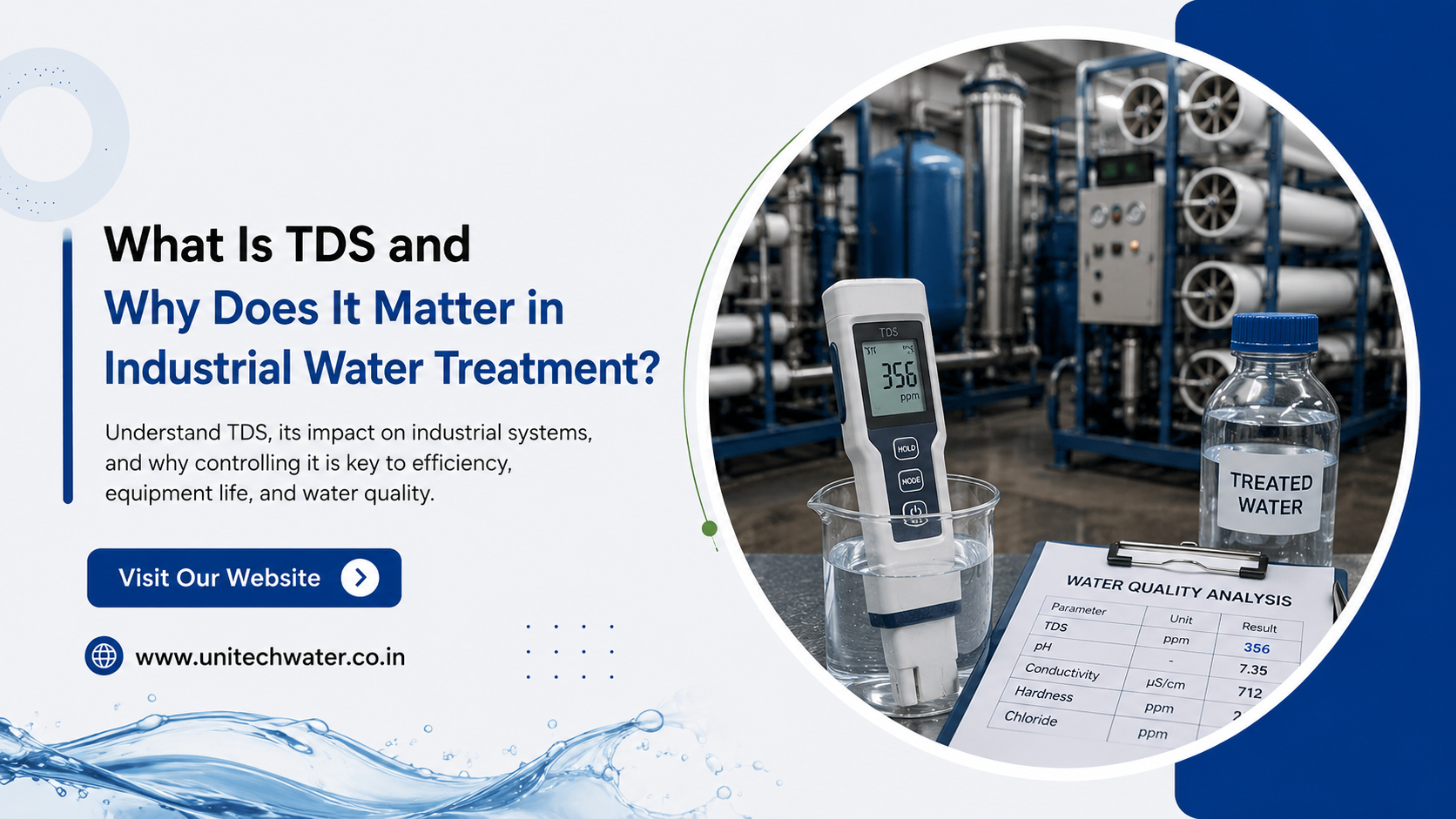
If you work in a manufacturing plant, processing unit, or any facility that relies on water for production, you've likely encountered the term TDS in water during routine quality checks or testing. But what exactly does TDS mean, and why does it carry so much weight in industrial settings? This single parameter can determine the difference between smooth, efficient operations and frequent equipment breakdowns, product defects, or compliance failures.
In this blog, we'll break down what TDS in water really means, why it matters specifically for industrial processes, and how the right treatment approach can protect your equipment, your output quality, and your bottom line.
What Is TDS in Water?
TDS stands for Total Dissolved Solids. It refers to the combined concentration of all inorganic and organic substances dissolved in water things like calcium, magnesium, sodium, bicarbonates, sulfates, chlorides, and trace organic matter. These dissolved solids originate from natural sources such as rock erosion, or from human activities like agriculture, urban runoff, and industrial discharge.
TDS is typically measured in milligrams per litre (mg/L) or parts per million (ppm), and it's usually tested using a TDS meter that measures electrical conductivity, since dissolved ions conduct electricity. While TDS itself isn't automatically harmful, it acts as an important indicator a high or unusual reading often signals the presence of contaminants, scaling agents, or substances that could interfere with industrial processes.
For drinking water, the Bureau of Indian Standards under IS 10500 sets an acceptable TDS limit, while permitting higher levels only where alternative sources aren't available. But industrial water treatment plays by a different rulebook entirely, because the acceptable range depends heavily on what the water is being used for.
Why TDS in Industrial Water Treatment Is a Different Conversation
Here's where things get interesting for industries: there's no single "ideal" TDS number that applies across the board. Acceptable TDS levels for industrial applications vary significantly boiler feed water may need to stay below 100 ppm, while cooling towers can tolerate much higher levels. This means a facility running both boilers and cooling systems needs different water treatment strategies for each application, not a one-size-fits-all approach.
This is precisely why Total Dissolved Solids (TDS) management is treated as a core parameter in industrial water treatment, rather than an afterthought. Get it wrong, and the consequences show up in ways that directly hit production and maintenance budgets.
Why TDS Matters So Much in Industrial Settings
1. Equipment Damage and Scaling
High TDS water, when heated or evaporated, leaves behind mineral deposits inside boilers, heat exchangers, and pipelines. Over time, this scaling reduces heat transfer efficiency, increases energy consumption, and shortens equipment lifespan. For industries running continuous operations, unplanned downtime for descaling can be far costlier than proactive water treatment.
2. Corrosion Risks
Certain dissolved solids, particularly chlorides and sulfates, accelerate corrosion in metal piping and machinery. This isn't just a maintenance headache corroded infrastructure can lead to leaks, contamination of process water, and safety hazards in industrial environments.
3. Product Quality Issues
For industries like pharmaceuticals, food and beverage processing, textiles, and electronics manufacturing, water quality directly affects the final product. Inconsistent TDS levels can alter taste, appearance, chemical reactions, or even cause batch failures problems that are expensive to trace back and fix after the fact.
4. Regulatory and Discharge Compliance
Industries are also accountable for the water they release back into the environment. Effluent with high TDS that isn't properly treated can violate discharge norms, leading to penalties or shutdowns. This makes TDS monitoring as important on the output side as it is on the input side of a water treatment plant.
5. Operational Cost Efficiency
Water with high TDS often requires more frequent filter changes, chemical dosing, or membrane cleaning, all of which add to operating costs. Managing TDS proactively reduces these recurring expenses significantly over time.
What Is the Ideal TDS Level for Industrial Water?
Unlike drinking water, where there's a fairly standardized range, industrial water purification requirements shift based on the specific process:
- Boiler feed water: Typically needs to stay under 100 ppm to prevent scaling and ensure efficient steam generation.
- Cooling tower water: Can tolerate a wider TDS range, though excessively high levels still increase scaling risk over time.
- Process water (pharma, food, electronics): Often requires near-zero TDS, achieved through advanced purification methods like reverse osmosis combined with deionization.
- Reuse water (CPCB Class A standards): Treated wastewater intended for reuse in flushing, landscaping, or cooling tower makeup is generally expected to stay below 500 mg/L TDS.
This variability is exactly why industries can't simply borrow drinking water TDS guidelines and apply them to their processes. Every application has its own threshold, and getting it right requires testing, monitoring, and a treatment system designed around actual usage.
How Industrial RO Systems Help Manage TDS
When it comes to actually reducing TDS, industrial RO systems remain one of the most reliable and widely used solutions. Reverse osmosis works by forcing water through a semi-permeable membrane that blocks dissolved salts, minerals, and contaminants while allowing purified water to pass through.
For industries dealing with high-TDS source water whether from groundwater, municipal supply, or recycled process water an industrial RO system offers a scalable way to bring TDS down to levels suitable for sensitive applications like boiler feed or pharmaceutical-grade processes. Combined with pre-treatment stages like sediment filtration and softening, RO systems can handle high-TDS input water more efficiently and extend membrane life.
This is one of the most common challenges Unitech Water Solution helps industrial clients solve: designing a treatment setup that accounts for source water variability rather than assuming a fixed TDS level year-round. A well-configured water treatment plant doesn't just reduce TDS once it maintains consistent output quality despite seasonal or supply-source fluctuations.
Building a TDS Management Strategy That Works
Managing TDS effectively isn't a one-time fix; it requires an ongoing approach:
- Regular testing: Use TDS meters for quick daily checks, but confirm accuracy periodically with lab testing, especially for sensitive applications.
- Source water assessment: Understand whether your water comes from groundwater, municipal supply, or recycled sources, since each carries different baseline TDS levels.
- Application-specific treatment: Don't apply the same treatment standard across boilers, cooling towers, and process water each needs its own benchmark.
- Preventive maintenance: Schedule membrane cleaning, filter replacement, and system audits based on actual TDS trends rather than fixed calendar intervals.
Industries that build this kind of structured approach typically see fewer equipment failures, more consistent product quality, and lower long-term water treatment costs.
Final Thoughts
TDS might seem like a small technical detail, but in industrial water treatment, it's often the parameter that determines whether your equipment runs smoothly or breaks down prematurely, whether your product meets quality standards, or whether you stay compliant with discharge norms. Understanding what TDS in water actually represents and treating it as application-specific rather than universal is the first step toward smarter water management.
If your facility is dealing with inconsistent TDS levels or you're unsure which treatment setup fits your process, working with experienced water treatment partners like Unitech Water Solution can help you design a system that's built around your actual water chemistry and production needs, not generic assumptions.
Frequently Asked Questions
TDS (Total Dissolved Solids) measures the amount of dissolved minerals, salts, and impurities in water. It is important because it affects water quality, industrial processes, and equipment performance.
Industries can reduce TDS using technologies like reverse osmosis (RO), deionization, and distillation. Industrial RO systems are the most widely used and effective solution.
High TDS levels can cause scaling, corrosion, and reduced equipment efficiency. Proper TDS control improves system performance and extends equipment life.
The ideal TDS level depends on the application, with sensitive industries requiring very low TDS water. Requirements vary for boilers, cooling towers, and manufacturing processes.
An industrial RO system uses a semi-permeable membrane to remove dissolved salts and impurities. This process produces clean, low-TDS water suitable for industrial applications.