



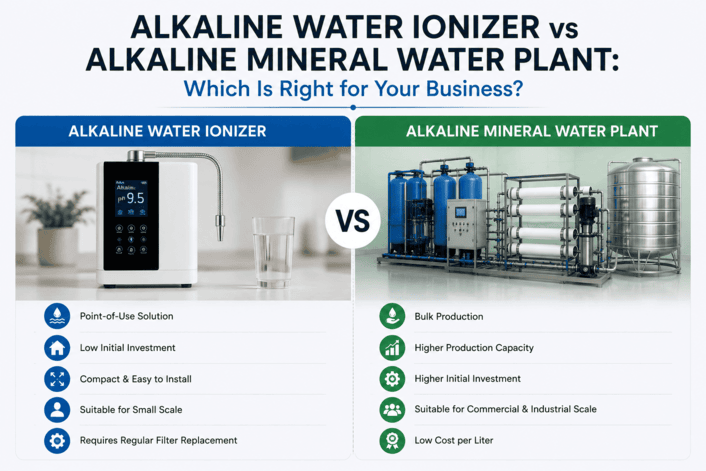
Choosing between an alkaline water ionizer vs alkaline mineral water plant depends on what you want to produce, how much water you need to process, and whether the system is intended for individual, commercial, or packaged-water production.
Although both systems can produce alkaline water, they use different technologies. An alkaline water ionizer uses electrolysis to alter the characteristics of filtered water, while an alkaline mineral water plant combines water purification with controlled mineral treatment to produce alkaline water at a larger production scale.
For businesses planning commercial alkaline water production, understanding the difference between these systems is important before investing in equipment.
What Is an Alkaline Water Ionizer?
An alkaline water ionizer is a water-treatment appliance or system that uses electrolysis to produce water with different pH characteristics.
The process generally involves passing treated water through an electrolytic cell containing electrodes. Depending on the system configuration, the electrolysis process separates the water into streams with different characteristics.
A typical alkaline ionizer system may include:
- Pre-filtration
- Water purification
- Electrolytic cell
- Electrodes
- pH adjustment controls
- Water outlet
- Control panel
The quality of the incoming water can significantly affect the performance and maintenance requirements of an ionizer. For commercial applications, appropriate filtration and pretreatment should therefore be considered before the ionization stage.
What Is an Alkaline Mineral Water Plant?
An alkaline mineral water plant is a larger water-treatment and production system designed to produce alkaline mineral water at commercial or industrial scale.
Unlike an ionizer-focused system, an alkaline mineral water plant can incorporate multiple treatment stages, such as:
Raw water treatment → filtration → RO purification → mineral adjustment → alkaline treatment → disinfection → storage → bottling
Depending on the product specification, the plant may include:
- Raw-water treatment
- Multimedia filtration
- Activated carbon filtration
- Micron filtration
- Reverse osmosis
- UV or ozone treatment
- Mineral dosing or remineralization
- Alkaline treatment
- Storage tanks
- Bottle rinsing
- Filling
- Capping
- Labelling
- Packaging
This makes an alkaline mineral water plant more suitable for businesses planning to manufacture and package alkaline water at commercial volumes.
Alkaline Ionizer vs Alkaline Mineral Water Plant: Key Differences
The primary difference is scale and production approach.
|
Factor |
Alkaline Water Ionizer |
Alkaline Mineral Water Plant |
|
Primary Technology |
Electrolysis |
Water purification + mineral/alkaline treatment |
|
Typical Scale |
Small to commercial |
Commercial / industrial |
|
Main Purpose |
Alkaline water generation |
Alkaline mineral water production |
|
RO Integration |
Optional depending on feed water |
Commonly integrated |
|
Mineral Adjustment |
Technology dependent |
Can be incorporated into process |
|
Bottling Integration |
Usually separate |
Can be integrated |
|
Production Capacity |
Lower to moderate |
Higher |
|
Automation |
Varies |
Can be fully automated |
|
Suitable for Bottled Water |
Limited / configuration dependent |
Yes |
|
Expansion |
Equipment dependent |
Modular configurations possible |
|
Application |
Point-of-use and selected commercial applications |
Commercial packaged-water production |
The right choice ultimately depends on your production capacity, product specifications, water source and business model.
Alkaline Water Ionizer vs Alkaline Mineral Water Plant: How the Process Differs
Alkaline Water Ionizer Process
The basic process can be represented as:
Filtered Water → Electrolytic Cell → Electrolysis → Alkaline Water
The ionizer uses electrodes to facilitate electrolysis and generate water with a higher pH on the alkaline side of the system.
The incoming water should already be suitable for the ionizer. If the raw water contains excessive hardness, iron, turbidity, or other contaminants, additional pretreatment may be necessary.
Alkaline Mineral Water Plant Process
A commercial alkaline water production line generally involves more treatment stages:
Raw Water → Pretreatment → RO → UV/Ozone → Mineral Adjustment → Alkaline Treatment → Storage → Bottling
The exact process depends on the raw-water quality and the required characteristics of the finished product.
This approach allows manufacturers to control purification and product conditioning as separate stages rather than relying solely on ionization.
Production Capacity: Ionizer vs Alkaline Mineral Water Plant
Production capacity is one of the most important factors when comparing an alkaline ionizer vs alkaline water plant.
An ionizer may be appropriate when the requirement involves relatively small quantities of alkaline water. However, a business producing packaged alkaline water for distributors, retailers, hotels, institutions, or other commercial customers typically needs a dedicated production line.
An alkaline mineral water plant can be configured around the required production volume and may include automated:
- Water treatment
- Filling
- Capping
- Labelling
- Conveying
- Packaging
For larger production requirements, the plant can also be designed with higher-capacity filling equipment and additional automation.
Water Purification: Which System Offers More Control?
Water purification is an important distinction between these two systems.
An ionizer primarily focuses on the ionization stage, so the quality of the water entering the unit is critical.
A commercial alkaline mineral water plant can incorporate a complete purification sequence based on the raw-water analysis.
For example:
Multimedia Filter
↓
Activated Carbon Filter
↓
Micron Filtration
↓
RO Plant
↓
UV/Ozone
↓
Mineral Adjustment
↓
Alkaline Treatment
This configuration gives manufacturers greater control over the treatment process and finished-water characteristics.
Mineral Adjustment and Alkaline Treatment
The terms alkaline water and alkaline mineral water should not automatically be treated as identical.
An alkaline mineral water production system can be designed to manage mineral content and alkalinity according to the desired product specifications.
Depending on the process design, mineral adjustment may involve controlled addition or blending of selected minerals after purification.
The exact approach depends on:
- Raw-water chemistry
- RO permeate characteristics
- Desired mineral profile
- Target pH
- Product specifications
- Regulatory requirements
This is one reason why commercial production should begin with a raw-water analysis and defined product specification.
Bottling and Packaging Integration
If your objective is to sell alkaline water in PET bottles, jars, or other commercial packaging, the overall production system needs to go beyond water treatment.
A complete alkaline mineral water plant can be integrated with:
- Bottle rinsing
- Bottle filling
- Capping
- Inspection
- Labelling
- Shrink wrapping
- Conveyors
Depending on the required production rate, businesses can select suitable filling and packaging machinery.
This creates a continuous production flow from purified water to finished packaged products.
Read full guide:Mineral Water Bottling Plant
Automation and Scalability
Automation requirements can also influence the choice between an ionizer and a commercial alkaline water plant.
An ionizer generally involves a relatively compact system with limited process stages.
A commercial plant can incorporate automation across multiple stages, including:
- Automatic valves
- Level controls
- Pump controls
- RO operation
- Chemical dosing
- UV/ozone systems
- Filling
- Capping
- Labelling
- Packaging
For a growing business, a modular configuration can also allow additional treatment or packaging capacity to be added as demand increases.
Which System Is Better for a Business?
There is no universal answer to which technology is better. The correct choice depends on the intended application.
Choose an Alkaline Water Ionizer When:
- You require relatively lower water production
- The application is focused on alkaline water generation
- You have suitable incoming water
- A compact system is preferred
- Large-scale bottling is not the primary objective
Choose an Alkaline Mineral Water Plant When:
- You want to manufacture alkaline mineral water commercially
- Higher production capacity is required
- Water purification needs multiple treatment stages
- You plan to sell packaged alkaline water
- Automated bottling and packaging are required
- Future production expansion is expected
For a packaged-water business, a dedicated alkaline mineral water production plant generally provides more flexibility than relying on a standalone ionizer.
Alkaline Water Ionizer vs Alkaline Mineral Water Plant: Quick Decision Guide
|
Business Requirement |
More Suitable Option |
|
Small-scale alkaline water production |
Alkaline Water Ionizer |
|
Point-of-use alkaline water |
Alkaline Water Ionizer |
|
Commercial packaged alkaline water |
Alkaline Mineral Water Plant |
|
Integrated RO purification |
Alkaline Mineral Water Plant |
|
Automated bottling |
Alkaline Mineral Water Plant |
|
Higher production capacity |
Alkaline Mineral Water Plant |
|
Modular production expansion |
Alkaline Mineral Water Plant |
|
Compact installation |
Ionizer, depending on application |
What Should You Consider Before Selecting an Alkaline Water System?
Before investing in either system, evaluate these factors:
1. Raw Water Quality
Test TDS, hardness, pH, iron, turbidity and other relevant parameters.
2. Required Production Capacity
Determine your expected daily production and future demand.
3. Product Specification
Define the required pH, mineral profile, packaging format and water-quality requirements.
4. Bottling Requirement
If the business involves packaged alkaline water, consider the complete filling, labelling and packaging line.
5. Available Space
Plant size depends on treatment capacity, storage requirements and packaging equipment.
6. Automation Level
Decide whether manual, semi-automatic or fully automated operation is appropriate.
7. Future Expansion
Choose equipment that can accommodate increased production without requiring a complete plant replacement.
Which Alkaline Water System Should You Choose?
The alkaline water ionizer vs alkaline mineral water plant decision ultimately comes down to your business objective.
For relatively small-scale alkaline water generation, an ionizer may be sufficient. For commercial alkaline water production, particularly where purification, mineral adjustment, bottling and future scalability are required, a dedicated alkaline mineral water plant offers a more complete production solution.
The right configuration should be finalized after evaluating your raw-water quality, production target, product specification, packaging requirements and available infrastructure.
Planning an alkaline water production business?
Share your required capacity and water source with our team, and we can help determine a suitable treatment and production configuration.