



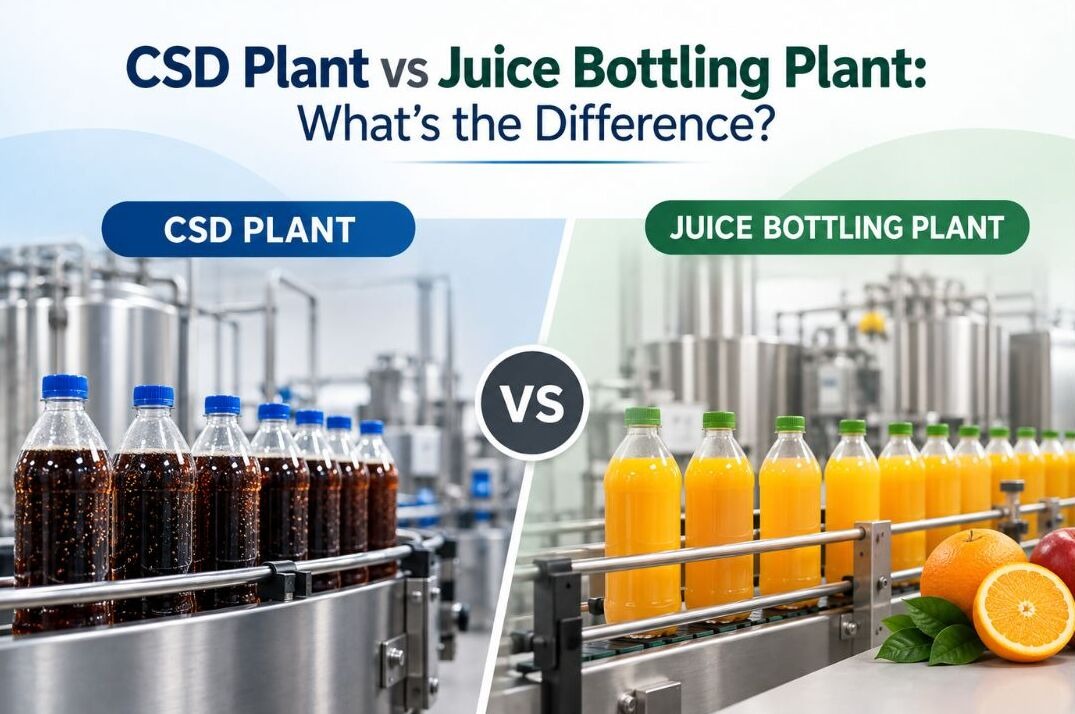
A CSD plant vs juice bottling plant differs mainly in how the beverage is prepared and filled. A CSD plant is designed for carbonated soft drinks and requires syrup preparation, carbonation, CO₂ control, and pressure-controlled filling. A juice bottling plant handles juice and fruit-based beverages and may require blending, filtration, pasteurization, and product-specific filling.
Both use bottling and packaging machinery, but the processing equipment and filling conditions are different. The right choice depends on the beverage type, production capacity, bottle format, processing method, and automation requirement.
What Is a CSD Plant?
A CSD plant is a production system used to prepare, carbonate, fill, cap, and package carbonated soft drinks such as soda and other fizzy beverages.
A typical carbonated soft drink plant follows this production flow:
Water Treatment → Syrup Preparation → Mixing → Carbonation → Filling → Capping → Labelling → Packaging
Carbonation is the key process. CO₂ is introduced into the prepared beverage under controlled conditions before filling. Because the beverage contains dissolved gas, pressure and temperature must be controlled during filling to minimize excessive foaming and CO₂ loss.
A CSD bottling plant therefore requires filling equipment specifically designed for carbonated beverages.
What Is a Juice Bottling Plant?
A juice bottling plant is a production line used to prepare, process, fill, seal, and package juice or fruit-based beverages.
The exact juice bottling process depends on the product formulation. A typical process may include:
Ingredient Preparation → Mixing/Blending → Product Treatment → Filling → Capping → Labelling → Packaging
A juice processing plant may also require filtration, homogenization, or pasteurization depending on the type of beverage and its processing requirements.
Unlike a CSD plant, carbonation is generally not the core process. Product composition, temperature, viscosity, hygiene, and required shelf stability have a greater influence on the equipment configuration.
CSD Plant vs Juice Bottling Plant: What Are the Key Differences?
The main difference is that a CSD plant requires carbonation and pressure-controlled filling, while a juice bottling plant requires processing and filling technology selected according to the juice formulation.
|
Factor |
CSD Plant |
Juice Bottling Plant |
|
Main Product |
Carbonated soft drinks |
Juice/fruit beverages |
|
Carbonation |
Required |
Generally not required |
|
CO₂ System |
Required |
Generally not required |
|
Preparation |
Syrup mixing + carbonation |
Mixing/blending + product treatment |
|
Filling |
Pressure-controlled |
Product-specific |
|
Pasteurization |
Product dependent |
May be required |
|
Main Filling Concern |
CO₂ retention and foaming |
Temperature, viscosity and product characteristics |
|
Packaging |
PET, glass or suitable formats |
PET, glass or suitable formats |
The machinery should therefore be selected according to the beverage being manufactured rather than simply the required number of bottles per hour.
How Does Beverage Preparation Differ?
CSD production focuses on syrup mixing and carbonation, while juice production focuses on ingredient preparation, blending, and product-specific treatment.
CSD Production
A typical carbonated beverage production process combines treated water with prepared syrup or ingredients. The beverage is then carbonated before entering the filling machine.
Important operating factors include:
- Beverage formulation
- CO₂ level
- Temperature
- Pressure
- Carbonation stability
Juice Production
Juice production can involve fruit juice, concentrates, pulp, water, sweeteners, and other permitted ingredients.
Depending on the formulation, processing can include mixing, filtration, homogenization, and thermal treatment.
Because juice formulations vary considerably, the production line should be designed around the actual product.
How Is CSD Filling Different From Juice Filling?
CSD filling requires controlled pressure to retain carbonation and reduce foaming, while juice filling depends on product temperature, viscosity, processing method, and packaging requirements.
A carbonated beverage filling process typically includes:
Bottle Rinsing → Pressure Equalization → Filling → Controlled Pressure Release → Capping
The beverage filling machine maintains suitable pressure conditions while the carbonated product enters the bottle. This helps control foaming and unnecessary CO₂ loss.
Juice may require hot filling, cold filling, or another suitable filling configuration depending on the product and manufacturing process.
Read full guide: Carbonated Soft Drink Filling Machine: How It Works
What Machinery Is Required for CSD and Juice Plants?
Both plants require filling and packaging equipment, but their beverage preparation and processing machinery differ.
|
Production Stage |
CSD Plant |
Juice Plant |
|
Water treatment |
Common |
Application dependent |
|
Mixing/blending |
Yes |
Yes |
|
Carbonation |
Yes |
No, generally |
|
Product processing |
Product specific |
Product specific |
|
Filling |
CSD-specific |
Juice/product-specific |
|
Capping |
Yes |
Yes |
|
Labelling |
Yes |
Yes |
|
Packaging |
Yes |
Yes |
A complete beverage bottling line may also include conveyors, bottle blowing, inspection, coding, labelling, and shrink wrapping equipment.
Which Plant Is Better for PET Bottle Production?
Both CSD and juice plants can use PET bottles when the bottle specification and production process are suitable for the beverage being manufactured.
Businesses can either purchase ready-made bottles or manufacture bottles in-house from PET preforms.
For an integrated line, the process can be:
PET Preform → Bottle Blowing → Beverage Filling → Capping → Labelling → Shrink Wrapping
The bottle specification should be selected according to product characteristics, filling conditions, closure type, and production requirements.
How Does Production Capacity Affect Plant Selection?
Production capacity determines the required speed of the processing, filling, labelling, conveying, and packaging equipment.
Capacity is commonly evaluated using BPM (bottles per minute) along with daily or shift production.
Before selecting equipment, consider:
- Required BPM
- Bottle size
- Number of operating shifts
- Product type
- Filling technology
- Labelling speed
- Packaging speed
- Future production requirements
The entire production line should be balanced. A high-speed filling machine provides limited benefit if the labelling or packaging equipment cannot maintain the same production flow.
CSD Plant vs Juice Bottling Plant: Which Should You Choose?
Choose a CSD plant for carbonated beverages requiring CO₂ and pressure-controlled filling. Choose a juice bottling plant for juice or fruit-based beverages requiring product-specific preparation, processing, and filling.
A CSD plant is more appropriate when:
- Carbonated soft drinks or soda are the primary products
- Carbonation is required
- CO₂ management is necessary
- Pressure-controlled filling is required
A juice bottling plant is more appropriate when:
- Juice or fruit beverages are the primary products
- Ingredient or pulp processing is required
- Product-specific treatment is necessary
- Carbonation is not the main production process
If you plan to manufacture both product categories, inform the machinery supplier before finalizing the line. The filling technology, product-contact components, cleaning requirements, and changeover system need to be evaluated for multiple products.
What Should You Check Before Choosing a Beverage Plant?
Before choosing a beverage plant, define the product, target capacity, bottle format, processing requirements, filling method, and automation level.
Five questions can narrow down the right configuration:
- What beverage will you manufacture?
- What bottle sizes will you use?
- What production capacity or BPM do you need?
- Does the product require carbonation or thermal processing?
- Do you need bottle blowing, filling, labelling, and packaging as one integrated line?
These specifications give an equipment manufacturer a much clearer basis for designing the plant.
Final Takeaway
The CSD plant vs juice bottling plant decision starts with the product itself. A carbonated soft drink plant requires carbonation, CO₂ management, and pressure-controlled filling, while a juice processing plant requires preparation and filling conditions suited to the specific juice formulation.
For either project, don't evaluate the filler alone. Processing, bottle handling, filling, capping, labelling, and packaging should be planned as one balanced production line.
Planning a CSD or Beverage Bottling Plant?
Share your beverage type, bottle size, required BPM, and automation requirement with Unitech Water Solutions to discuss the appropriate machinery and production-line configuration.