



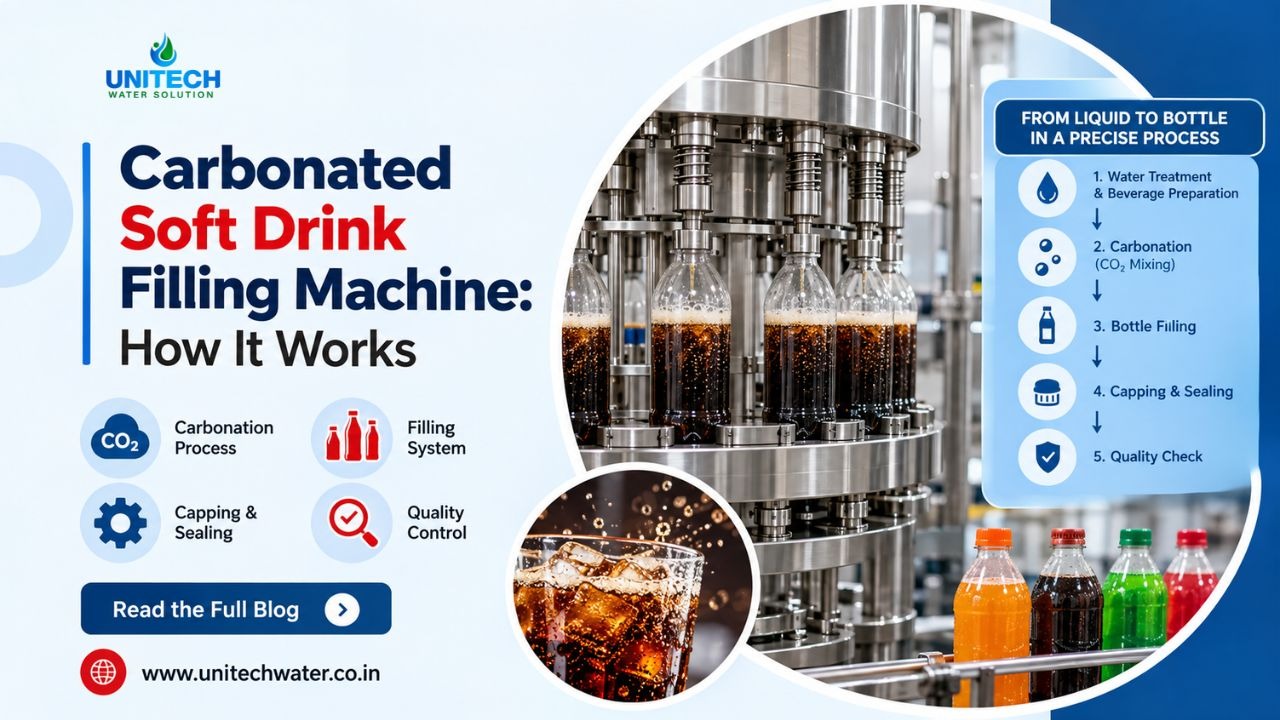
A carbonated soft drink filling machine fills carbonated beverages into bottles under controlled pressure to minimize foaming, reduce product loss, and retain dissolved CO₂. Unlike a standard water filler, CSD filling equipment must manage both beverage pressure and carbonation throughout the filling and sealing process.
A typical CSD filling machine integrates bottle handling, rinsing, pressure equalization, filling, and capping into a coordinated production process. For commercial beverage manufacturers, the machine can also connect with upstream beverage preparation and downstream labelling and packaging equipment to form a complete carbonated beverage bottling line.
What Is a Carbonated Soft Drink Filling Machine?
A carbonated soft drink filling machine is specialized bottling equipment designed to fill carbonated beverages into PET or other compatible containers while maintaining controlled pressure and minimizing CO₂ loss.
The machine is commonly used for products such as carbonated soft drinks, soda, sparkling beverages, and other carbonated drinks.
Unlike still-water filling, carbonated beverages require specific filling conditions because dissolved carbon dioxide can escape when pressure changes suddenly. A carbonated beverage filling machine therefore controls the filling environment to help maintain carbonation and consistent fill levels.
Depending on the line configuration, the machine may integrate:
- Bottle feeding
- Bottle rinsing
- Pressure equalization
- Beverage filling
- Capping
- Bottle discharge
- Conveyor integration
For larger production requirements, the filler becomes one part of a complete CSD production and packaging line.
How Does a Carbonated Soft Drink Filling Machine Work?
A carbonated soft drink filling machine works by feeding and rinsing bottles, equalizing bottle pressure, filling the carbonated beverage under controlled pressure, sealing the bottle, and transferring it to downstream packaging equipment.
The exact CSD filling process varies according to the machine configuration, bottle type, beverage characteristics, and required production capacity.
Step 1: Bottle Feeding and Rinsing
Empty bottles first enter the soft drink filling machine through a conveyor or bottle-handling system.
Before filling, bottles are rinsed or cleaned according to the production-line configuration. This prepares the container for beverage filling and helps maintain hygienic production conditions.
The bottles are then transferred automatically toward the filling section.
Step 2: Beverage Preparation and Carbonation
Before the beverage reaches the filler, treated water, syrup, and other ingredients are processed according to the product formulation.
The beverage is then carbonated by introducing controlled amounts of CO₂.
A simplified production flow is:
Water Treatment → Syrup Preparation → Beverage Mixing → Carbonation → Filling
Temperature, pressure, formulation, and carbonation level can influence filling behaviour, so beverage preparation and filling equipment must work as an integrated process.
Step 3: Bottle Pressure Equalization
Before the beverage enters the bottle, the filling system establishes suitable pressure conditions inside the container.
This is important because filling a carbonated beverage into an unpressurized container can cause rapid CO₂ release and excessive foaming.
Pressure equalization helps create more stable filling conditions before the filling valve opens.
Step 4: Counter Pressure Filling
During counter pressure filling, the bottle and beverage system operate under controlled pressure so that the carbonated drink can enter the bottle with reduced disturbance.
This helps:
- Minimize excessive foaming
- Reduce beverage loss
- Maintain more consistent fill levels
- Limit unnecessary CO₂ release
- Improve filling stability
Filling valves regulate the beverage flow until the required filling level is reached.
Step 5: Pressure Release and Bottle Transfer
Once filling is complete, pressure needs to be released in a controlled manner.
A sudden pressure drop can cause foaming and product overflow. The machine therefore manages the transition before transferring the filled bottle toward the capping section.
Step 6: Bottle Capping
Filled bottles are capped promptly to seal the beverage and help retain carbonation.
Depending on the bottle and closure system, the capping unit positions and applies the cap automatically.
The sealed bottles are then transferred to the next stage through a conveyor.
Step 7: Labelling and Secondary Packaging
After filling and capping, bottles can move through:
Inspection → Labelling → Batch Coding → Shrink Wrapping/Packing
This allows the carbonated drink bottling machine to operate as part of a continuous production line rather than as standalone equipment.
Why Is Counter Pressure Filling Used for Carbonated Drinks?
Counter pressure filling is used because it helps fill carbonated beverages while maintaining pressure around the product, which reduces excessive foaming and unnecessary CO₂ loss.
Carbonated beverages contain dissolved carbon dioxide. When pressure falls rapidly during filling, CO₂ can leave the liquid and create foam.
This can result in:
- Product overflow
- Uneven filling
- Beverage wastage
- Reduced carbonation
- Slower production
A CSD filling machine uses controlled pressure conditions to manage this behaviour.
Temperature also matters. Beverage temperature, carbonation level, and pressure interact during the filling process, so the complete system needs to be configured for the product being manufactured.
What Are the Main Components of a CSD Filling Machine?
The main components of a CSD filling machine typically include bottle-handling equipment, rinsing mechanisms, filling valves, a pressure-control system, capping equipment, conveyors, sensors, and an automated control system.
|
Component |
Main Function |
|
Bottle feeding system |
Transfers empty bottles into the machine |
|
Rinser |
Rinses/prepares bottles before filling |
|
Filling valves |
Controls beverage flow into bottles |
|
Pressure system |
Maintains required filling conditions |
|
Product tank/bowl |
Supplies beverage to filling valves |
|
Capping unit |
Applies and secures bottle caps |
|
Conveyor |
Transfers bottles through production stages |
|
Sensors |
Detect bottles and machine conditions |
|
Control panel |
Controls and monitors machine operation |
The exact components vary according to machine design and the level of automation.
Planning a CSD Bottling Line?
Machine selection should start with your beverage type, bottle size, required BPM, carbonation level, and automation requirement. Matching these specifications early can help determine the right filling and packaging configuration.
Discuss Your CSD Filling Requirement
What Is the Production Capacity of a Carbonated Soft Drink Filling Machine?
The production capacity of a carbonated soft drink filling machine is generally measured in bottles per minute (BPM) or bottles per hour and depends on bottle size, filling-valve configuration, beverage characteristics, carbonation, and automation level.
Two machines handling different bottle formats may therefore produce different outputs even when their basic filling technology is similar.
Key factors affecting capacity include:
Bottle Size
Smaller and larger bottles can require different filling times and handling configurations.
Number of Filling Valves
The number and design of filling valves directly influence how many bottles can be processed during a given production period.
Carbonation Level
The product's carbonation characteristics can affect filling behaviour and the operating conditions required to control foaming.
Production-Line Balance
A high-speed filler alone does not guarantee high output.
The:
- Bottle feeding system
- Blow moulding machine
- Labelling machine
- Conveyor
- Capping system
- Shrink wrapping machine
must be capable of supporting the target production speed.
For this reason, businesses should evaluate complete line capacity, not just the advertised speed of the filler.
How Does a CSD Filling Machine Fit Into a Complete Bottling Line?
A CSD filling machine sits between beverage preparation/carbonation and downstream bottle labelling and packaging within a complete carbonated beverage bottling line.
A typical production flow can look like:
- Raw Water Treatment
- Syrup Preparation
- Beverage Mixing
- Carbonation
- Bottle Production/Feeding
- Bottle Rinsing
- CSD Filling
- Capping
- Inspection
- Labelling
- Shrink Wrapping / Secondary Packaging
Each stage should be sized around the required production output.
For example, installing a high-capacity carbonated beverage filling machine alongside a slower labelling or packaging machine can create a production bottleneck.
This is why a complete CSD plant machinery configuration should be planned as an integrated system.
Carbonated Soft Drink Filling Machine vs Water Filling Machine: What's the Difference?
The main difference is that a carbonated soft drink filling machine must manage dissolved CO₂ and pressure during filling, while a water filling machine handles a non-carbonated liquid and does not require the same carbonation-pressure control.
|
Factor |
CSD Filling Machine |
Water Filling Machine |
|
Product |
Carbonated beverages |
Still water |
|
CO₂ |
Present |
Not required |
|
Pressure management |
Critical |
Different filling conditions |
|
Foaming control |
Important |
Generally less challenging |
|
Filling method |
Pressure-controlled |
Depends on machine design |
|
Beverage preparation |
Mixing + carbonation |
Water treatment |
|
Main application |
Soft drinks/soda |
Drinking/mineral water |
Because the product characteristics are different, businesses should not select filling equipment based only on BPM.
What Bottle Types Can a Carbonated Beverage Filling Machine Handle?
A carbonated beverage filling machine can be configured for suitable PET, glass, or other pressure-compatible containers, depending on the machine design and beverage application.
For PET beverage production, bottle specifications are particularly important because the container needs to suit the product and filling conditions.
Machine selection should consider:
- Bottle material
- Bottle volume
- Bottle neck specification
- Bottle shape
- Cap type
- Required pressure resistance
- Production speed
If PET bottles are produced in-house, a PET Stretch Blow Moulding Machine can be integrated upstream of the filling line.
What Should You Consider When Choosing a Carbonated Soft Drink Filling Machine?
Choose a carbonated soft drink filling machine based on the beverage, required production capacity, bottle specifications, filling technology, automation level, and compatibility with the complete bottling line.
The following factors should be evaluated before purchasing equipment.
1. Required Production Capacity
Determine your required BPM or bottles-per-hour output based on realistic sales and production requirements.
2. Bottle Size and Format
Specify every bottle format the machine will need to handle rather than selecting equipment around only one container.
3. Beverage Characteristics
Carbonation, temperature, formulation, and foaming behaviour can affect the filling configuration.
4. Filling Technology
The filling system should be suitable for carbonated beverages and capable of maintaining controlled pressure during production.
5. Automation Level
Evaluate whether you need:
- Standalone filling
- Automatic rinsing-filling-capping
- Integrated conveyors
- Automatic labelling
- Automatic secondary packaging
6. Line Integration
Check whether the filler can integrate effectively with bottle blowing, conveyors, labelling, inspection, and packaging equipment.
7. Cleaning and Hygiene
Machine construction should allow appropriate cleaning and maintenance for beverage production.
8. Future Expansion
If production demand is expected to increase, consider whether the machine and overall line configuration can accommodate future capacity requirements.
Is a CSD Filling Machine Suitable for a Complete Soft Drink Plant?
Yes. A CSD filling machine can form the core bottling section of a complete carbonated soft drink plant when integrated with water treatment, syrup preparation, beverage mixing, carbonation, bottle handling, capping, labelling, and packaging equipment.
The filler itself does not represent the entire production plant.
A complete project may require:
Water treatment + syrup preparation + mixing + carbonation + filling + capping + labelling + packaging
Businesses planning commercial carbonated beverage production should therefore determine whether they require only a filling machine or an integrated turnkey production line.
Final Takeaway
A carbonated soft drink filling machine is specifically designed to manage the challenges involved in filling carbonated beverages, particularly pressure control, foaming, CO₂ retention, consistent filling, and immediate bottle sealing.
The right CSD filling machine should be selected according to the beverage formulation, carbonation level, bottle size, required BPM, automation, and downstream packaging requirements. For larger commercial projects, evaluating the entire carbonated beverage bottling line is more important than choosing the filler in isolation.
Planning a Carbonated Soft Drink Production Line?
Share your beverage type, bottle size, required production capacity, and automation requirement with Unitech Water Solutions to identify a suitable CSD plant and filling-line configuration.