


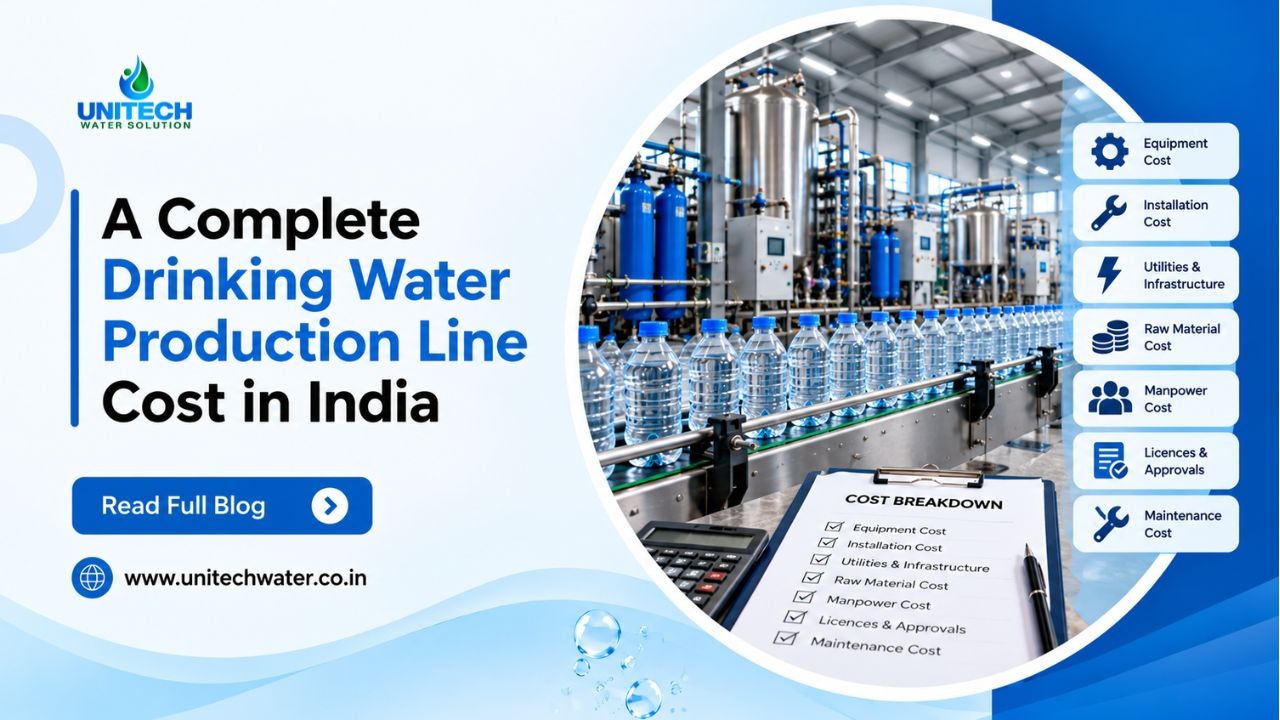
Planning a packaged drinking water business starts with one important question: how much will the production line cost? The answer depends on more than the price of an RO plant or a bottle filling machine. You also need to consider packaging equipment, production capacity, installation, factory infrastructure, and daily operating needs.
Understanding the drinking water production line cost before purchasing machinery helps you plan your investment and avoid unexpected expenses. A small semi-automatic setup may suit a new business with limited demand, while an automatic line may make more sense for a company supplying multiple distributors.
In this guide, we explain the main machinery costs, compare semi-automatic and fully automatic lines, and discuss installation expenses in India. You will also find a practical budgeting example and a checklist to help you prepare for a supplier quotation.
Before You Invest, What Really Drives the Cost?
The drinking water production line cost depends on the equipment configuration, output target, source water quality, packaging format, and level of automation. Two plants with the same rated capacity can receive different quotations because their treatment and packaging requirements differ.
Main Factors Affecting the Price
- Production capacity: A higher-capacity system needs equipment that can handle greater water flow and faster filling.
- Water quality: Raw water testing helps determine the required filtration, RO treatment, and other treatment stages.
- Automation: Automatic rinsing, filling, capping, labeling, and packing can reduce manual handling but increase the initial investment.
- Bottle sizes: A line handling several bottle formats may require additional change parts or adjustments.
- Bottle manufacturing: Producing PET bottles on-site requires a blowing machine, moulds, compressed air, and supporting utilities.
- Installation requirements: Electrical connections, drainage, piping, flooring, and factory layout all affect the final project budget.
A reliable quotation should describe the equipment supplied, its rated capacity, the expected operating conditions, and the work excluded from the price.
Which Machines Will You Need, and What Does Each Cost?
A complete production line combines water treatment, hygienic storage, filling, sealing, labeling, and packing. The following indicative figures are planning references drawn from published supplier estimates, not verified market-wide averages. Actual prices depend on specifications, taxes, installation, and supplier terms.
|
Equipment |
Indicative Published Price |
Main Purpose |
|
RO water treatment system |
₹4–10 lakh for small-scale systems |
Purifies water according to the required treatment design |
|
PET bottle blowing machine |
₹9–15 lakh for some semi-automatic models |
Makes bottles from PET preforms |
|
Basic water filling machine |
Around ₹8 lakh for some models |
Fills bottles with treated water |
|
Automatic filling machine |
₹18–32 lakh for some mid-range models |
Supports faster, more automated filling |
|
Labeling machine |
₹3–8 lakh for selected models |
Applies product labels |
|
Shrink-wrapping machine |
₹3.5–18 lakh across selected configurations |
Packs bottles into grouped units |
|
Batch coding machine |
₹2 lakh and above in some configurations |
Prints production and traceability details |
Source note: These indicative prices reflect equipment examples in AIM Tech India's published cost guide. They should not be interpreted as current quotations or a complete bill of materials.
1. Water Treatment and RO System
The treatment section may include raw water storage, pressure sand filtration, activated carbon filtration, cartridge filtration, an RO system, and UV or ozone treatment where required by the treatment design.
The exact arrangement depends on laboratory test results and applicable product standards. A supplier should size the system according to the required treated-water output, recovery rate, and raw water characteristics.
2. Bottle Blowing, Filling, and Capping
A PET blowing machine produces bottles from preforms. Alternatively, a business can purchase ready-made bottles and avoid the initial investment in bottle-blowing equipment.
The filling section rinses where applicable, fills, and caps the bottles. Check whether the quotation includes conveyors, cap feeding, bottle handling, and the change parts needed for your selected bottle sizes.
3. Labeling, Coding, and Secondary Packaging
Labeling and coding equipment prepares bottles for sale and traceability. Shrink wrapping or other suitable packing equipment groups the finished bottles for storage and distribution.
Choose these machines according to the required bottles per minute, label type, pack format, and available floor space.
Semi-Automatic vs. Fully Automatic Water Bottling Lines
The water bottle production line price depends heavily on how much work the machines perform automatically and how much handling employees must do.
|
Feature |
Semi-Automatic Line |
Fully Automatic Line |
|
Initial investment |
Generally lower |
Generally higher |
|
Manual handling |
More operator involvement |
Less routine manual handling |
|
Production flow |
May involve separate operating steps |
Designed for a more continuous workflow |
|
Labour requirements |
Often higher per unit at scale |
Can reduce labour per unit |
|
Flexibility |
Can suit smaller or changing production runs |
Best evaluated against planned volume and formats |
|
Best suited for |
Start-ups and smaller operations |
Businesses with steady, higher-volume demand |
Which Option Should You Choose?
A semi-automatic line can be a practical starting point if demand is still developing and the business has access to trained operators. However, the lowest purchase price does not always mean the lowest long-term cost.
A fully automatic line may be more suitable when production runs regularly, orders are large, and manual handling restricts output. Compare expected labour savings, energy use, maintenance, downtime, and the cost of future expansion before deciding.
How Production Capacity Affects the Cost
Production capacity is commonly expressed in litres per hour (LPH) for water treatment and bottles per minute (BPM) or bottles per hour (BPH) for filling and packaging. These measurements describe different stages, so they should not be compared as if they mean the same thing.
For example, a 2,000 LPH treatment system does not automatically guarantee a particular number of finished bottles per hour. Bottle size, filling speed, changeovers, downtime, and storage capacity also matter.
|
Project Scale |
Indicative Total Investment Published by Competitor |
Typical Planning Focus |
|
Small-scale plant |
₹35–75 lakh |
Essential treatment and a suitable starter bottling line |
|
Mid-scale plant |
₹80 lakh–₹1.5 crore |
Higher throughput and more automated packaging |
|
Large-scale plant |
₹1.5–3.5 crore or more |
High-volume production and integrated handling |
These are broad total-project estimates published by AIM Tech India, not prices for the bottling machinery alone. The ranges may include different assumptions about land or premises, civil work, compliance, laboratory facilities, and working capital.
Match Treatment Capacity to Filling Capacity
A production line performs only as well as its slowest critical stage. If the filling machine consumes treated water faster than the RO system can supply it, production may stop while the storage tank refills.
Ask your supplier to confirm the rated output of each major component and explain how the full line will perform under your planned operating conditions.
Installation Expenses and Other Costs to Budget For
The automatic water bottling plant cost is only one part of the total project budget. Installation and supporting facilities can add significant expenses, especially when the building needs major changes.
|
Additional Expense |
What to Include |
|
Factory preparation |
Flooring, drainage, partitions, and hygienic production areas |
|
Electrical work |
Power supply, panels, wiring, earthing, and backup where needed |
|
Plumbing and piping |
Raw water, treated water, drains, and process connections |
|
Storage |
Raw water and treated water tanks sized for the process |
|
Quality control |
Suitable laboratory facilities, instruments, and qualified staff |
|
Approvals and compliance |
Applicable licences, registrations, testing, and inspections |
|
Initial materials |
Bottles or preforms, caps, labels, and packaging materials |
|
Working capital |
Wages, utilities, maintenance, transport, and day-to-day purchases |
Do not assume every item is included in a machinery quotation. Ask for separate prices for supply, freight, installation, commissioning, operator training, taxes, and any civil work.
Also confirm the current legal and certification requirements for your product category before committing funds. Packaged drinking water and natural mineral water are distinct product categories in India, and the applicable standards and approvals must match the product you intend to sell.
A Practical Budgeting Example
Consider an entrepreneur planning a packaged drinking water unit to serve nearby retailers, offices, and distributors. Instead of immediately purchasing every machine, the entrepreneur first estimates expected orders and decides which bottle sizes to sell.
The entrepreneur then takes these steps:
- Test the raw water. Use the results to define the treatment process and identify any additional pretreatment needs.
- Set a realistic output target. Estimate the daily production required from confirmed or likely customer demand.
- Compare line configurations. Request quotations for semi-automatic and fully automatic equipment at the required output.
- List excluded expenses. Add installation, factory preparation, laboratory facilities, approvals, and working capital.
- Compare the complete offers. Review equipment specifications, warranties, service support, spare parts, and delivery schedules.
The key lesson is simple: compare complete project scopes rather than choosing a supplier based on one headline price. A lower machinery quote may exclude equipment or services that another supplier has already included.
Cost Planning Checklist
Before requesting your quotation, confirm the following:
- Required treated-water capacity in LPH
- Target bottle sizes and expected daily production
- Semi-automatic or fully automatic configuration
- Ready-made bottles or in-house bottle manufacturing
- Raw water test report and treatment requirements
- Filling, capping, labeling, coding, and packing requirements
- Installation, freight, taxes, and commissioning
- Laboratory, compliance, and factory infrastructure expenses
- Warranty, maintenance, spare parts, and service support
- Working capital for the initial operating period
Conclusion
The right drinking water production line cost depends on the production capacity you need, the quality of your source water, your packaging choices, and the level of automation you select. Machinery is only one part of the investment; installation, quality control, approvals, and working capital also deserve attention.
Before making a purchase, compare complete quotations and check that the treatment and bottling sections can support your planned output. A well-matched line can help you control operating costs, maintain a consistent production process, and expand as demand grows.
Get a Tailored Drinking Water Plant Quotation
Planning a new plant or upgrading an existing one? Contact Unitech Water Solution to discuss your water treatment and bottling requirements. Share your target capacity, bottle sizes, source water details, and preferred automation level to help define the equipment scope and obtain a project-specific quotation.
Frequently Asked Questions
The cost varies according to capacity, automation, source water quality, packaging equipment, and installation requirements. Published supplier estimates place some small-scale total projects at ₹35–75 lakh, but this is not a universal price. Ask for an itemized quotation based on your site, production target, and required machinery.
A typical configuration may include pretreatment filters, an RO system, suitable disinfection equipment, storage tanks, a filling and capping machine, labeling, batch coding, and secondary packaging. Bottle-blowing equipment may be optional if you purchase ready-made bottles. Always check the supplier's scope of supply.
Generally, yes, in terms of initial machinery investment. A semi-automatic line usually needs more operator involvement, while a fully automatic line can reduce manual handling. The right choice depends on expected sales, labour costs, production hours, maintenance, and the cost of upgrading later.
Not always. Some quotations include installation and commissioning, while others charge separately for freight, electrical work, plumbing, civil modifications, and travel. Ask the supplier to list all inclusions and exclusions in writing before placing the order.
Buying ready-made bottles can reduce the initial investment and simplify the setup. An in-house blowing machine adds equipment, mould, compressed-air, and utility requirements but may suit businesses with consistent bottle demand. Compare the delivered cost of purchased bottles with the full operating cost of making them.
Share your intended capacity, source water test report, bottle sizes, expected production hours, automation preference, location, and whether you need bottle manufacturing. Request a detailed breakdown covering equipment, installation, taxes, utilities, commissioning, and after-sales support.
The main factors include treatment capacity, raw water quality, equipment materials, automation, filling speed, bottle formats, packaging requirements, and installation conditions. Imported components, custom designs, and after-sales service arrangements can also affect the final quotation.