


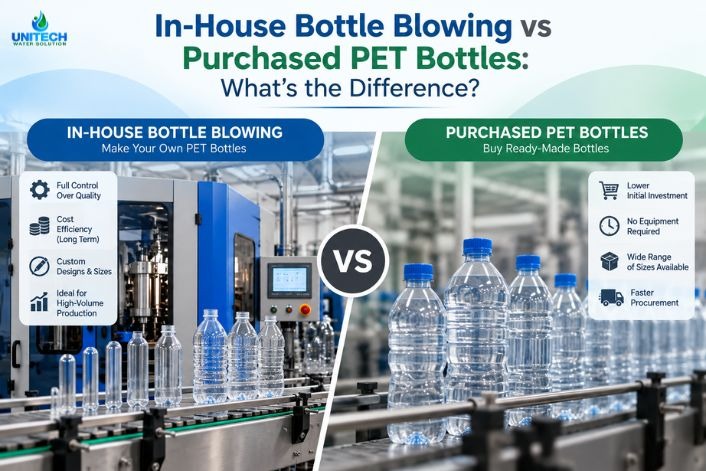
If you run or plan a packaged drinking water plant, one decision affects your margins for years: do you buy empty bottles, or make them yourself? The choice of in-house bottle blowing vs purchased PET bottles shapes your investment, running cost, hygiene control and storage needs.
This guide explains both options in plain terms. It shows where each one makes sense and how to decide for your plant.
Quick Answer
- Purchased PET bottles: low starting investment and simple operations. But you pay for transport, storage space and the supplier's margin on every bottle.
- In-house bottle blowing: higher upfront investment, but a lower cost per bottle at steady volumes, fresher bottles and full control over design.
- Rule of thumb: startups and low-volume plants often begin with bought bottles. Plants with steady, growing output usually gain more from in-house PET bottle manufacturing.
What Is In-House Bottle Blowing?
In-house bottle blowing means you buy PET preforms and turn them into bottles at your own plant. A preform is a small, thick-walled, test-tube-shaped piece of PET with the neck and thread already moulded.
This is called the two-stage process:
- A preform manufacturer makes the preforms by injection moulding.
- Your PET bottle blowing machine reheats each preform, stretches it and blows it into a bottle shape using high-pressure air.
The machine that does this is a PET stretch blow moulding machine. Its mould decides the bottle's shape, volume and design. The bottle then goes to your filling, capping and labelling line.
What Does Buying PET Bottles Mean?
Here, a bottle manufacturer or converter blows the bottles and ships them empty to your plant. You unpack them, feed them to the rinser or filler and continue as usual. You need no blowing equipment, but every bottle depends on outside supply, transport and storage.
In-House Blowing vs Purchased PET Bottles: Side-by-Side
|
Factor |
In-House Blowing |
Purchased PET Bottles |
|
Upfront investment |
Higher (blowing machine, compressor, chiller, moulds) |
Low |
|
Cost per bottle |
Usually lower at steady volume |
Includes supplier's blowing cost and margin |
|
Freight and storage |
Preforms are compact and cheap to ship |
Empty bottles take far more space |
|
Hygiene |
Fresh bottles, less handling time |
More packing, transit and storage exposure |
|
Bottle design |
Custom moulds and weights possible |
Limited to what the supplier offers |
|
Supply risk |
You depend on preform supply only |
Depend on bottle supplier's schedule |
|
Skills needed |
Trained operator and maintenance |
Minimal |
|
Best for |
Growing or established plants |
Startups, trial runs, low volume |
1. Cost: The "Shipping Air" Problem
A blown bottle is mostly empty space. Industry estimates put the difference at roughly 8 to 10 times more shipping and storage volume for empty bottles than for preforms. Buying bottles means paying to move and store that air.
For in-house PET bottle production, your cost per bottle is roughly:
Preform + electricity + compressed air + labour + mould wear and spares + rejects + machine depreciation
Compare that total with your supplier's delivered price per empty bottle.
Small savings add up fast. As a purely illustrative example, suppose you save ₹0.20 per bottle on a line that fills 5,000 bottles per hour for 10 hours a day over 300 days. That is 15 million bottles a year, or about ₹30 lakh saved annually. Use your own quotes to work out the real number.
2. Hygiene and Quality Control
Bottles that are packed, stacked, trucked, warehoused and unpacked collect dust and handling marks. Blowing in-house shortens the time between forming the bottle and filling it, so there is less exposure.
Be realistic, though. Blowing does not replace proper rinsing and sanitation. You still need to follow good manufacturing practice either way. What in-house blowing gives you is a cleaner starting point and direct control over the container.
3. Storage, Space and Logistics
With bought bottles, you need large, clean, dry storage for bulky stock. Preforms take a fraction of that space and are sturdier in transit, so fewer bottles get crushed or deformed on the way.
In-house blowing needs its own floor space, though. Plan room for the machine, an air compressor and a chiller.
4. Design Flexibility and Lightweighting
When you blow your own bottles, you can:
- Order custom moulds for your brand's bottle shape
- Fine-tune preform weight to save resin
- Switch bottle sizes (for example 200 ml, 500 ml, 1 litre) by changing moulds
- Test new designs without waiting for a supplier
Buying bottles limits you to the supplier's catalogue and minimum order quantities.
5. Equipment You Will Need
In-house PET bottle manufacturing starts with choosing the right machine for your output:
- Semi-automatic PET stretch blow moulding machines suit smaller plants and start-ups moving in-house. See oursemi-automatic machines (1000–1200 BPH) and 2000–2200 BPH.
- Automatic machines give more consistent output with less manual loading. Explore the2400 BPH automatic machine.
- Fully automatic machines suit larger lines. See the 3200–3400 BPH and 5200–5400 BPH options.
Besides the blowing machine, budget for a high-pressure air compressor, a chiller, moulds and a trained operator. You can browse the full range on ourPET stretch blow moulding machine page.
6. When to Buy Bottles and When to Blow In-House
Buying bottles is usually smarter if:
- You are a start-up testing the market
- Your volume is low or unpredictable
- You lack floor space, power or skilled staff
- You want the lowest possible starting investment
In-house blowing is usually smarter if:
- Your output is steady and growing
- Freight and storage costs for empty bottles are eating your margin
- You want custom bottle shapes or lighter bottles
- You are planning a new plant or expanding aturnkey mineral water project
There is no single volume that suits everyone. Local freight rates, bottle prices and power costs move the break-even point, so run the numbers with real quotes.
7. Quick Readiness Checklist
Before moving to in-house blowing, confirm:
- ✔ Your volume is steady enough to keep the machine running
- ✔ You have floor space, three-phase power and a compressed air setup
- ✔ You can source quality food-grade preforms reliably
- ✔ You have or can train an operator and maintenance person
- ✔ You have compared total in-house cost against your delivered bottle price
8. Compliance in India
Whichever route you choose, your finished product must meet Indian standards for packaged drinking water and natural mineral water, along with FSSAI requirements. The bottle must be food-grade PET. Check current BIS and FSSAI requirements before you finalise your process. If you plan anISI-compliant plant, discuss bottle sourcing with your consultant early.
Common Mistakes to Avoid
- Comparing only unit price. Include freight, storage, rejects and downtime.
- Buying a machine that is too big or too small. Match capacity to your filler.
- Ignoring performance quality. Defects in a preform stay in the finished bottle.
- Skipping training. A well-trained operator cuts rejects and downtime.
- Forgetting utilities. The compressor and chiller are part of the investment.
Conclusion
The in-house bottle blowing vs purchased PET bottles decision comes down to volume, cash flow and control. Buy bottles if you need a low-cost start. Move to in-house PET bottle production when your output is steady and freight, storage and design limits start costing you money.
Ready to cut your bottle costs with in-house PET bottle production?
Tell us your output target, and our team will suggest the right machine and setup for your plant.
Frequently Asked Questions
With in-house blowing you buy preforms and blow the bottles yourself. With purchased bottles, a supplier blows them and ships them empty to you.
It is often cheaper per bottle at steady volumes because you save on freight, storage and the supplier's margin. It needs a higher upfront investment, so the answer depends on your volume and local costs.
You need a PET bottle blowing machine, also called a PET stretch blow moulding machine, plus a high-pressure air compressor, a chiller and bottle moulds.
Yes. Semi-automatic machines in the 1000–2200 BPH range are designed for smaller plants.
It reduces storage, transport and handling time for empty bottles, which lowers exposure. You still need proper rinsing and sanitation.
Yes, many plants do. Plan your floor space and utilities early so the switch is easy.