



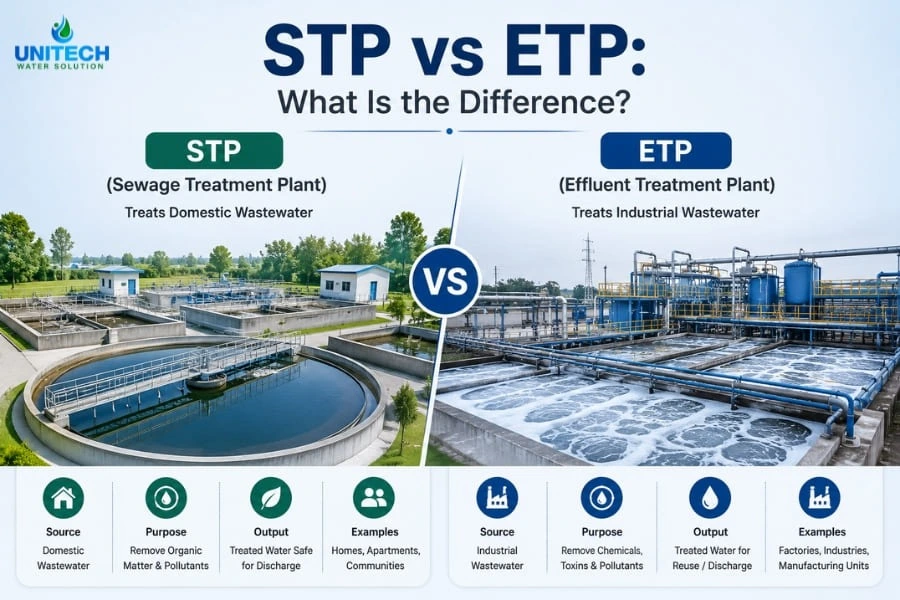
STP vs ETP is an important comparison when planning a wastewater treatment system for a residential, commercial, institutional, or industrial facility. Although both systems treat wastewater, they are designed for different types of wastewater and pollutants.
An STP (Sewage Treatment Plant) primarily treats domestic sewage generated from toilets, kitchens, bathrooms, hostels, apartments, hotels, hospitals, and commercial buildings. An ETP (Effluent Treatment Plant) is designed to treat industrial effluent containing pollutants generated from manufacturing and industrial processes.
Choosing between a sewage treatment plant and effluent treatment plant depends mainly on the source of wastewater, pollutant characteristics, treatment objectives, required capacity, and final water disposal or reuse requirements.
What Is an STP?
A Sewage Treatment Plant (STP) is a wastewater treatment system designed to treat sewage generated from domestic and similar sources. The treatment process removes suspended solids, organic matter, nutrients, and other contaminants before the treated water is discharged or reused.
Typical STP applications include:
- Residential apartments and housing societies
- Hotels and resorts
- Hospitals and healthcare facilities
- Schools and colleges
- Offices and commercial buildings
- Institutions and campuses
- Municipal and community facilities
An STP generally uses a combination of physical, biological, and tertiary treatment processes. Depending on the application and required treated-water quality, technologies such as MBBR, SBR, MBR, or conventional biological treatment can be used.
Related: Sewage Treatment Plant Cost in India
What Is an ETP?
An Effluent Treatment Plant (ETP) treats wastewater generated by industrial and manufacturing processes. Industrial effluent can contain chemicals, oils, heavy metals, high concentrations of organic pollutants, dissolved solids, suspended solids, and other process-specific contaminants.
ETPs are commonly used in industries such as:
- Textile and dyeing
- Pharmaceutical manufacturing
- Food processing
- Chemical manufacturing
- Paper and pulp
- Dairy processing
- Metal finishing
- Engineering and manufacturing
Unlike domestic sewage, industrial wastewater can vary significantly from one facility to another. Therefore, an industrial effluent treatment plant is generally designed after evaluating the wastewater characteristics and treatment requirements.
Depending on the industry, an ETP may include processes such as screening, equalization, pH correction, coagulation and flocculation, biological treatment, filtration, sludge handling, and tertiary treatment.
STP vs ETP: Key Difference
The biggest difference between STP and ETP is the source and composition of wastewater they are designed to treat.
|
Parameter |
STP |
ETP |
|
Full Form |
Sewage Treatment Plant |
Effluent Treatment Plant |
|
Wastewater Source |
Domestic sewage |
Industrial effluent |
|
Typical Applications |
Apartments, hotels, hospitals, offices |
Factories and manufacturing units |
|
Main Pollutants |
Organic matter, solids, nutrients |
Chemicals, oils, metals, organics, solids |
|
Treatment Design |
Based mainly on sewage characteristics |
Industry-specific |
|
Biological Treatment |
Commonly used |
Used where suitable |
|
Chemical Treatment |
Usually limited |
Often required |
|
pH Adjustment |
Usually less critical |
Often important |
|
Sludge Characteristics |
Relatively predictable |
Varies by industry |
|
Treatment Technology |
MBBR, SBR, MBR, etc. |
Depends on industrial effluent |
|
Water Reuse |
Flushing, gardening, cooling, etc. |
Process reuse or other applications |
The distinction is important because STP and ETP are not interchangeable systems. A treatment plant should be selected according to the actual wastewater characteristics rather than simply the required capacity.
Planning a new wastewater treatment system?
Share your wastewater source and treatment requirements with our team to narrow down the right STP or ETP configuration.
STP vs ETP: Difference in Wastewater Characteristics
Domestic Sewage
Domestic sewage primarily comes from human activities such as bathing, washing, toilets, kitchens, and other household or institutional activities. It typically contains biodegradable organic matter, suspended solids, nutrients, pathogens, and other common sewage contaminants.
The treatment process therefore focuses on reducing BOD, COD, suspended solids, pathogens, and other pollutants to the required treated-water standards.
Industrial Effluent
Industrial wastewater is much more variable. A textile factory, pharmaceutical plant, dairy, chemical unit, and metal-processing facility can all generate completely different wastewater streams.
Industrial effluent may contain:
- High BOD and COD
- Suspended solids
- Dissolved solids
- Oil and grease
- Heavy metals
- Chemicals
- Colour
- Process-specific contaminants
- Variable pH
This is why an ETP treatment process is generally customized according to the industry and wastewater analysis.
STP Treatment Process
A typical STP treatment process can include several stages depending on the technology and treated-water requirements.
1. Screening
Screens remove larger floating materials and debris from incoming sewage before it enters the main treatment system.
2. Primary Treatment
Primary treatment helps separate suspended solids and settleable materials from sewage.
3. Biological Treatment
Microorganisms break down biodegradable organic matter. Technologies such as MBBR, SBR, and MBR can be used depending on capacity, space availability, treated-water requirements, and operating considerations.
4. Secondary Clarification or Membrane Separation
The biological solids are separated from the treated water using clarification or membrane-based separation, depending on the STP configuration.
5. Tertiary Treatment
Additional filtration and disinfection may be used when higher-quality treated water is required for applications such as flushing, gardening, cooling, or other reuse purposes.
ETP Treatment Process
The ETP treatment process varies according to the type of industrial effluent being treated.
A typical system may include:
Screening & Collection
Large solids and debris are removed from the incoming industrial wastewater.
Equalization
Wastewater is collected and mixed to reduce variations in flow, pollutant concentration, and pH before further treatment.
pH Correction
Acidic or alkaline wastewater may require chemical dosing to bring the pH into a suitable range for downstream treatment.
Coagulation & Flocculation
Chemicals can be added to destabilize suspended and colloidal particles and form larger flocs that can be separated more easily.
Biological Treatment
Where the wastewater contains biodegradable organic matter, biological treatment may be incorporated into the ETP.
Filtration & Tertiary Treatment
Depending on the final water-quality requirement, processes such as pressure filtration, activated carbon filtration, ultrafiltration, or RO may be added.
STP vs ETP: Which One Do You Need?
The choice is relatively straightforward when the source of wastewater is clearly identified.
If your wastewater mainly comes from toilets, bathrooms, kitchens, residential buildings, hotels, offices, hospitals, or institutions, an STP is generally the appropriate treatment category.
If wastewater is generated from manufacturing or industrial processes, an ETP may be required because the effluent can contain industry-specific pollutants that conventional sewage treatment is not designed to handle.
For facilities that generate both domestic sewage and industrial wastewater, separate treatment systems or an appropriately engineered combined approach may be considered based on wastewater characteristics and applicable discharge or reuse requirements.
Need help selecting the right wastewater treatment system?
Share your wastewater source, daily flow, water-quality parameters, and intended reuse or discharge requirement with our treatment specialists.